Article Contents

Citation:

Advanced neural network depicts precise structural colours


  • Light: Advanced Manufacturing  7, Article number: 48 (2026)
More Information

doi: https://doi.org/10.37188/lam.2026.048

  • A mixture probability sampling network is proposed to address the challenge of non-unique mappings between colour and nanostructures. This network successfully outputs structural colours with almost 100% precision, depicting wide-gamut nano-paintings.
  • 加载中
  • [1] Li, Y. J. et al. Recent progress on structural coloration. Photonics Insights 3, R03 (2024). doi: 10.3788/PI.2024.R03
    [2] Yu, N. F. & Capasso, F. Flat optics with designer metasurfaces. Nature Materials 13, 139-150 (2014). doi: 10.1038/nmat3839
    [3] Chen, W. T., Zhu, A. Y. & Capasso, F. Flat optics with dispersion-engineered metasurfaces. Nature Reviews Materials 5, 604-620 (2020). doi: 10.1038/s41578-020-0203-3
    [4] Kristensen, A. et al. Plasmonic colour generation. Nature Reviews Materials 2, 16088 (2016). doi: 10.1038/natrevmats.2016.88
    [5] Song, M. W. et al. Versatile full-colour nanopainting enabled by a pixelated plasmonic metasurface. Nature Nanotechnology 18, 71-78 (2023). doi: 10.1038/s41565-022-01256-4
    [6] Kumar, K. et al. Printing colour at the optical diffraction limit. Nature Nanotechnology 7, 557-561 (2012). doi: 10.1038/nnano.2012.128
    [7] Lee, T. et al. Nearly perfect transmissive subtractive coloration through the spectral amplification of mie scattering and lattice resonance. ACS Applied Materials & Interfaces 13, 26299-26307 (2021). doi: 10.1021/acsami.1c03427
    [8] Nagasaki, Y., Suzuki, M. & Takahara, J. All-dielectric dual-color pixel with subwavelength resolution. Nano Letters 17, 7500-7506 (2017). doi: 10.1021/acs.nanolett.7b03421
    [9] Yang, W. H. et al. All-dielectric metasurface for high-performance structural color. Nature Communications 11, 1864 (2020). doi: 10.1038/s41467-020-15773-0
    [10] Li, Z. L. et al. Extremely-fine color printing by 2D materials with the synergetic effects of Fabry–Pérot cavity and exciton absorption. Laser & Photonics Reviews 16, 2200394 (2022). doi: 10.1002/lpor.202200394
    [11] ElKabbash, M. et al. Fano resonant optical coatings platform for full gamut and high purity structural colors. Nature Communications 14, 3960 (2023). doi: 10.1038/s41467-023-39602-2
    [12] Dong, Z. G. et al. Schrödinger’s red pixel by quasi-bound-states-in-the-continuum. Science Advances 8, eabm4512 (2022). doi: 10.1126/sciadv.abm4512
    [13] Xiang, J. et al. Manipulating the orientations of the electric and magnetic dipoles induced in silicon nanoparticles for multicolor display. Laser & Photonics Reviews 12, 1800032 (2018). doi: 10.1002/lpor.201800032
    [14] Unni, R., Yao, K. & Zheng, Y. B. Deep convolutional mixture density network for inverse design of layered photonic structures. ACS Photonics 7, 2703-2712 (2020). doi: 10.1021/acsphotonics.0c00630
    [15] Zhang, P. S. et al. RGB achromatic metalens for neural network-enhanced high resolution digital imaging. Laser & Photonics Reviews 19, e00460 (2025). doi: 10.1002/lpor.202500460
    [16] Ji, W. Y. et al. Recent advances in metasurface design and quantum optics applications with machine learning, physics-informed neural networks, and topology optimization methods. Light: Science & Applications 12, 169 (2023). doi: 10.1038/s41377-023-01218-y
    [17] Dai, P. et al. Inverse design of structural color: finding multiple solutions via conditional generative adversarial networks. Nanophotonics 11, 3057-3069 (2022). doi: 10.1515/nanoph-2022-0095
    [18] Ma, W. et al. Probabilistic representation and inverse design of metamaterials based on a deep generative model with semi-supervised learning strategy. Advanced Materials 31, 1901111 (2019). doi: 10.1002/adma.201901111
    [19] Wei, Z. Y. et al. Ultraprecision, high-capacity, and wide-gamut structural colors enabled by a mixture probability sampling network. Light: Science & Applications 15, 164 (2026). doi: 10.1038/s41377-025-02122-3
    [20] Piggott, A. Y. et al. Inverse design and demonstration of a compact and broadband on-chip wavelength demultiplexer. Nature Photonics 9, 374-377 (2015). doi: 10.1038/nphoton.2015.69
    [21] Sun, S. S. et al. Inverse design of ultra-compact multimode waveguide bends based on the free-form curves. Laser & Photonics Reviews 15, 2100162 (2021). doi: 10.1002/lpor.202100162
    [22] Lin, J. G. et al. High-performance achromatic flat lens by multiplexing meta-atoms on a stepwise phase dispersion compensation layer. Light: Science & Applications 14, 110 (2025). doi: 10.1038/s41377-024-01731-8
    [23] Wang, S. M. et al. A broadband achromatic metalens in the visible. Nature Nanotechnology 13, 227-232 (2018). doi: 10.1038/s41565-017-0052-4
    [24] Wang, Y. J. et al. High-efficiency broadband achromatic metalens for near-IR biological imaging window. Nature Communications 12, 5560 (2021). doi: 10.1038/s41467-021-25797-9
    [25] Liang, H. W. et al. High performance metalenses: numerical aperture, aberrations, chromaticity, and trade-offs. Optica 6, 1461-1470 (2019). doi: 10.1364/OPTICA.6.001461
    [26] Chen, S. Q. et al. From single-dimensional to multidimensional manipulation of optical waves with metasurfaces. Advanced Materials 31, 1802458 (2019). doi: 10.1002/adma.201802458
    [27] Jiang, H. et al. Metasurface-enabled broadband multidimensional photodetectors. Nature Communications 15, 8347 (2024). doi: 10.1038/s41467-024-52632-8
    [28] Li, Y. et al. Ultracompact multifunctional metalens visor for augmented reality displays. PhotoniX 3, 29 (2022). doi: 10.1186/s43074-022-00075-z
    [29] Triggs, G. J. et al. Chirped guided-mode resonance biosensor. Optica 4, 229-234 (2017). doi: 10.1364/OPTICA.4.000229
    [30] Bao, Y. J. et al. On-demand spin-state manipulation of single-photon emission from quantum dot integrated with metasurface. Science Advances 6, eaba8761 (2020). doi: 10.1126/sciadv.aba8761
    [31] Li, L. et al. Metalens-array–based high-dimensional and multiphoton quantum source. Science 368, 1487-1490 (2020). doi: 10.1126/science.aba9779
通讯作者: 陈斌, bchen63@163.com
  • 1. 

    沈阳化工大学材料科学与工程学院 沈阳 110142

  1. 本站搜索
  2. 百度学术搜索
  3. 万方数据库搜索
  4. CNKI搜索

Figures(1)

Article Metrics

Article views(21) PDF downloads(9) Citation(0) Citation counts are provided from Web of Science. The counts may vary by service, and are reliant on the availability of their data.

Advanced neural network depicts precise structural colours

  • 1. State Key Laboratory of Optoelectronic Materials and Technologies, School of Physics, Sun Yat-Sen University, Guangzhou 510275, China
  • 2. Quantum Science Center of Guangdong-Hong Kong-Macao Greater Bay Area (Guangdong), Shenzhen 518038, China
  • Corresponding author:

    Haowen Liang, lianghw26@mail.sysu.edu.cn

    Xue-Hua Wang, wangxueh@mail.sysu.edu.cn

doi: https://doi.org/10.37188/lam.2026.048

Abstract: A mixture probability sampling network is proposed to address the challenge of non-unique mappings between colour and nanostructures. This network successfully outputs structural colours with almost 100% precision, depicting wide-gamut nano-paintings.

  • Structural colours, which manipulate light at specific wavelengths through nanostructures, offer a novel strategy to achieve stable, customisable, and ultra-dense colouration1. The key to producing desirable colour effects lies in the precise control of the various degrees of freedom. Metasurfaces2,3 have emerged as a powerful and controllable tool to achieve this goal. Metasurface-based structural colours have been demonstrated using various mechanisms by accurately tailoring the optical response of light, such as plasmonic resonances46, Mie resonances79, Fabry-Pérot resonances10,11, and bound states in the continuum (BIC)12. In addition, the ease of fabricating metasurface-based structural colours enables high-density colourful pixels, transforming structural colours from laboratory demonstrations into promising candidates for next-generation microdisplays13.

    Designing metasurface-based structural colours that can achieve optimal colour effects requires fine-tuning numerous geometric parameters, which is a task where traditional forward design is limited by its time-consuming and computationally intensive nature. In contrast, the rapid growth of artificial intelligence networks provides unprecedented capabilities to solve complex multidimensional problems efficiently1416. However, when designing metasurface-based structural colours, previously developed neural networks face challenges in achieving precise colouration because of the one-to-many relationship between colour and geometry17,18.

    In a newly published paper in Light: Science & Applications, an international research team from Tongji University and the National University of Singapore developed a novel neural network called the mixture probability sampling network (MPSN) that can effectively overcomes these limitations19. As illustrated in Fig. 1, the MPSN integrates a mixture density network (MDN) with a pre-trained forward network. The MDN generates Gaussian mixture distributions of structural parameters, while the pre-trained network learns the correlation between the optical performance and structure to evaluate the quality of output designs. Further, the system improves the probability of identifying the structural parameters that best match the target colour by sampling the Gaussian mixture distribution multiple times and inputting the results into the pre-trained network.
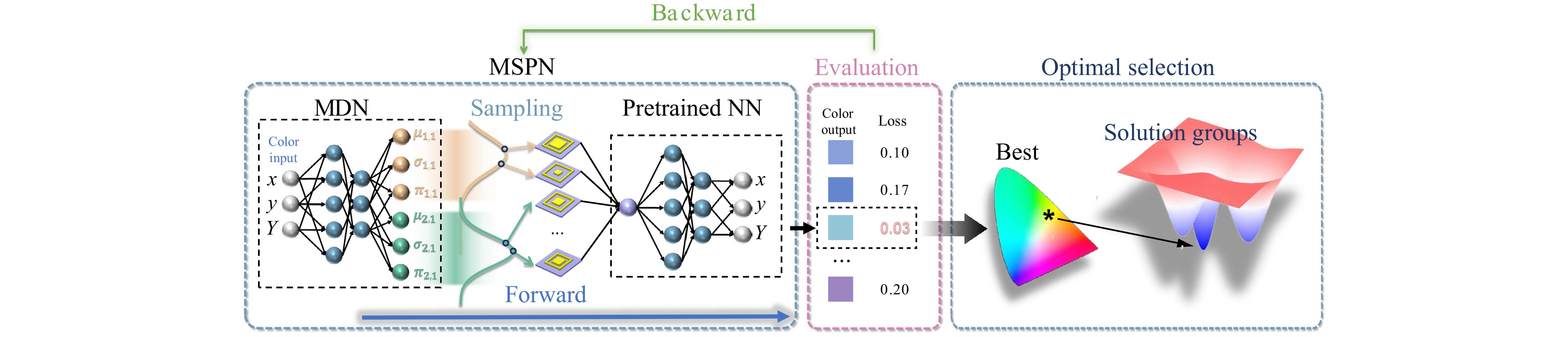
    Fig. 1  Framework of MPSN. The MPSN integrates the MDN with a pretrained neural network. The MDN translates colour into material distribution, while the pre-trained network converts material parameters into colour. The network training selects the smallest mean squared error between the sampled and actual colours, significantly enhancing the likelihood of outputting the globally optimal result.

    As a demonstration, the system was tested on a square-ring pillar metasurface. A dataset containing 8,411 samples was constructed using rigorous coupled-wave analysis. The MPSN achieved a prediction accuracy of 99.9% with a mean absolute error below 0.002. In the CIE 1931 chromaticity diagram, the designed colours exceeded 100% of the sRGB colour gamut, demonstrating exceptional colour reproduction and wide-gamut performance. Experimental validation included the fabrication of a 16-color palette and institutional logos, confirming the high fidelity between design and measurement.

    The proposed MPSN framework is not limited to colour engineering; it provides a universal strategy to address the non-uniqueness problem in nanophotonic inverse design using neural networks. For example, high-efficiency topological waveguides can be automatically generated and cascaded20,21; meta-atoms with precise chromatic dispersion crucial for achromatic meta-devices can be easily designed2225, and meta-units for multidimensional light-field modulation can benefit from this approach26,27. This method, which incorporates frameworks such as physics-informed neural networks, has the potential to reduce data dependency while enhancing physical interpretability and generalisation capability, thereby accelerating the practical application of intelligent photonic design in areas such as virtual reality28, biosensing29, and quantum optics30,31.

Reference (31)

Catalog

    /

    DownLoad:  Full-Size Img PowerPoint
    Return
    Return