



-
Liquid crystals (LCs) represent a unique class of materials with intermediate properties between those of conventional solids and liquids and are characterised by anisotropic optical behaviour that can be precisely controlled through electrical, magnetic, or thermal stimuli. Over the past several decades, extensive research has harnessed these distinctive characteristics to develop photonic applications, capitalising on their rapid switching dynamics, tuneable phase retardation, and seamless integration potential with established manufacturing techniques1–6. The inexorable demand for lighter, smaller, and more-versatile optical systems—driven primarily by the explosive growth of augmented and virtual reality (AR/VR) and adaptive optics—has spurred a decade of intense innovation in LC-based flat optics7,8.
Photoalignment techniques have been extensively studied and applied in various LC-based flat optics. These applications include such functionalities as grating9, vortex waveplates10, waveguides11, and varifocal lenses12. However, photoalignment inherently produces passive, polarisation-selective geometric phase elements, where the switching behaviour is governed solely by changes in the incident polarisation, rather than by active modulation of the phase profile. This characteristic limits the dynamic control of the optical elements because the phase profile cannot be actively toggled on and off. Consequently, the transition from passive to active modulation techniques is becoming increasingly critical to enhance the performance and functionality of LC-based flat optics for advanced optical applications.
In a significant advance, the successful design, fabrication, and characterisation of electrically switchable continuous-phase Fresnel zone plates (FZPs) using a sophisticated combination of polymerisable LCs and a two-photon polymerisation direct laser writing technique (TPP-DLW) have been reported13. Specifically, the unique contribution of Xu et al. lies in harnessing TPP-DLW to directly sculpt the 3D refractive-index landscape within a polymerisable nematic LC mixture (Fig. 1a). By applying a high voltage during laser writing, the LC director is locked locally into a homeotropic alignment within the polymerised regions, establishing a continuous phase distribution that is dynamically tuneable by an external electric field (Fig. 1b). This approach bypasses the need for photoalignment materials and avoids the pixelation artefacts of SLMs, offering true electrical ON/OFF switching and continuous-phase fidelity. The efficiency gains demonstrated are profound. The continuous 2π-wrapped FZP exhibited a focusing efficiency nearly double that of a comparable binary FZP (ratio: 196%), a crucial metric for power-sensitive applications, such as AR/VR headsets. Furthermore, they introduced a novel varifocal capability using a 4π-wrapped design (Fig. 1c). This single device switches between two distinct focal lengths (24 and 48 mm) and an electrically controlled OFF state based on the applied voltage, operating as a discrete, order-switchable kinoform (Fig. 1d). This dual-state reconfigurability is highly attractive for dynamic vision correction or focal plane adjustment in immersive displays.
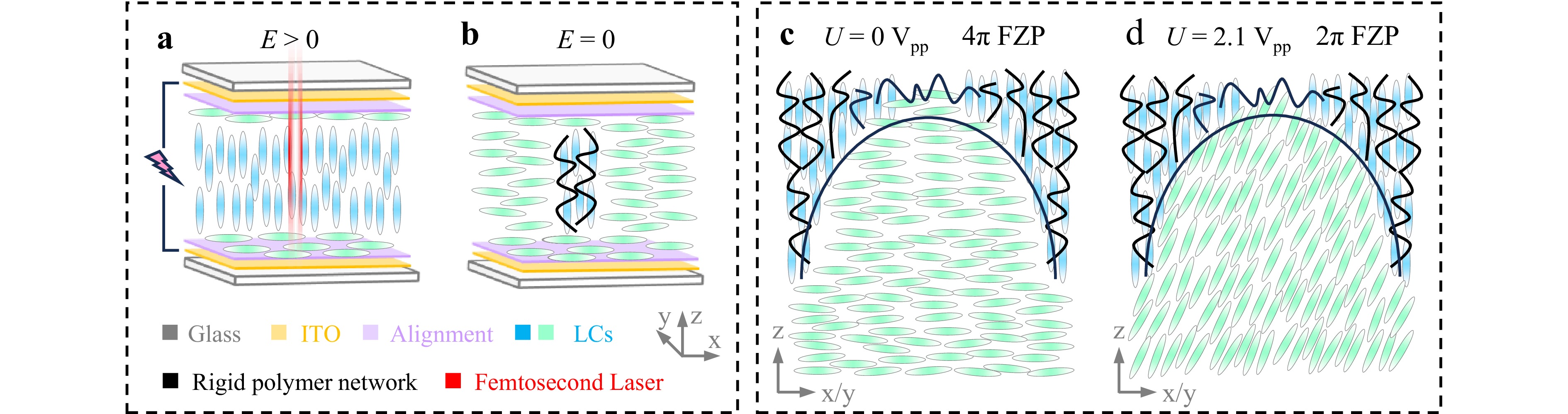
Fig. 1 Electrically switchable continuous-phase liquid-crystal (LC) Fresnel zone plate (FPZ). a Illustration of fabricating continuous-phase FZP using two-photon polymerization direct laser writing (TPP-DLW) under a high voltage applied to the LC. b The LC regions locked in a homeotropic alignment by the localized polymer network without external electric field. c 4π rad wrapped FZP with focal length of f = 24 mm. d 2π rad wrapped FZP with a focal length of f = 48 mm.
Several practical issues still merit attention, including the uniformity and long-term stability of the polymer-stabilised alignment under repeated electrical switching, as well as further optimisation of the diffraction efficiency and response speed. However, these are largely engineering refinements rather than conceptual limitations. The framework demonstrated therefore offers a clear route toward more-robust, electrically switchable continuous-phase LC diffractive optics for practical deployment.
Overall, this work firmly establishes TPP-DLW in polymerisable LCs as a powerful and practical modality for high-performance flat optics. By uniting the high-fidelity 3D sculpting capability of femtosecond laser lithography with the intrinsic tunability of LCs, Xu et al. have charted a clear course toward highly efficient, compact, and switchable diffractive elements. This breakthrough moves LC optics beyond simple binary designs and solidifies their relevance as a core enabling technology for next-generation photonic systems.
Continuous-phase liquid-crystal optics promise a flat revolution
- Light: Advanced Manufacturing , Article number: 62 (2026)
- Received: 06 March 2026
- Revised: 08 April 2026
- Accepted: 09 April 2026 Published online: 28 April 2026
doi: https://doi.org/10.37188/lam.2026.062
Abstract: The two-photon polymerization direct laser writing technique was demonstrated for the fabrication of continuous-phase Fresnel zone plates within a polymerizable nematic liquid crystal (LC). The dielectric responses of the LC facilitate the creation of switchable, variable focal length and energy-efficient optical components, making them highly suitable for advanced applications in augmented and virtual reality, adaptive optics, and next-generation photonic systems.
Rights and permissions
Open Access This article is licensed under a Creative Commons Attribution 4.0 International License, which permits use, sharing, adaptation, distribution and reproduction in any medium or format, as long as you give appropriate credit to the original author(s) and the source, provide a link to the Creative Commons license, and indicate if changes were made. The images or other third party material in this article are included in the article′s Creative Commons license, unless indicated otherwise in a credit line to the material. If material is not included in the article′s Creative Commons license and your intended use is not permitted by statutory regulation or exceeds the permitted use, you will need to obtain permission directly from the copyright holder. To view a copy of this license, visit http://creativecommons.org/licenses/by/4.0/.

 DownLoad: