




-
Metalenses are revolutionizing frontier fields from consumer products to biological microscopy and astronomical observation1–5 through their ultrathin planar structures and multidimensional wavefront control, yet large-scale fabrication and broadband achromatism each remain significant challenges, and achieving both simultaneously proves even more demanding6. Although traditional phase dispersion engineering is heavily constrained by the aspect ratio limits of nanofabrication7–11, recent developments in large-aperture meta devices have demonstrated significant progress. By expanding beyond strict continuous phase matching toward more flexible physical modeling and optimization driven design strategies, researchers have successfully scaled achromatic or quasi achromatic performance for continuous broadband light12–19. Nevertheless, these advancements often necessitate inherent physical trade-offs including diminished focusing efficiency, heightened fabrication complexity, or residual chromatic aberration.
Against this backdrop, the recent work by Wang and colleagues20 makes a significant contribution by proposing a minimalist optical system design. The research team shifts their core optical element from the conventional hyperbolic phase metalens (Fig. 1a) to the meta axicon (Fig. 1b). This choice is rooted in the physical constraints of the optical grating equation. Unlike traditional focusing lenses, the relative intensity distribution of a zero order Bessel beam generated by a meta axicon is fundamentally independent of the incident wavelength. By leveraging this natural dispersion law, the system obtains a point spread function (PSF) that exhibits extraordinarily high spatial consistency across the entire visible spectrum. This strategic shift transfers the burden of chromatic aberration correction from complex dispersion engineering to a physical design that prioritizes wavelength-invariant PSFs jointly with computational algorithms.
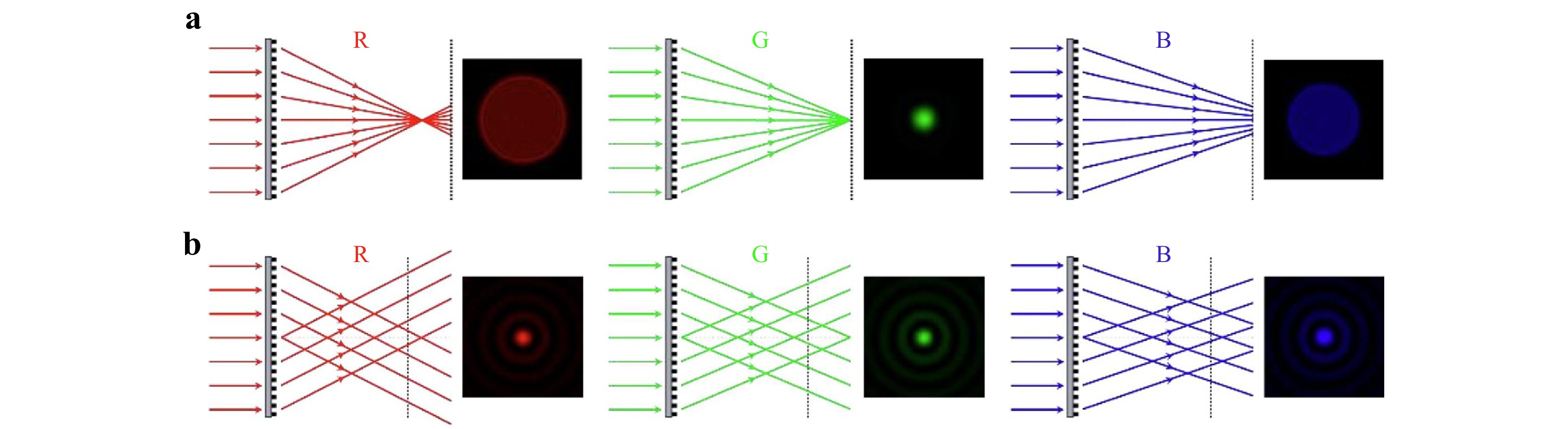
Fig. 1 a Ray tracing and PSF illustration of monochromatic metalenses. b Ray tracing and PSF illustration of meta-axicons20.
However, achieving high-resolution imaging with a wide field of view (FOV) remains a significant challenge. Traditional meta axicons are highly sensitive to incident angles, where oblique light disrupts wavefront symmetry and introduces off-axis aberrations that restrict the effective FOV. To overcome this limitation, the researchers20 developed an array of off-axis meta axicons featuring eccentric conical phases. Instead of relying on conventional global phase profiles, they applied a local optical path constraint to ensure that obliquely incident light is converted into uniform and co-propagating Bessel beams. Their experimental system uses a monolithic metasurface integrated with nine distinct elements, including a central 4 mm meta axicon surrounded by eight 3 mm off axis versions.
Each element is responsible for capturing a specific angular region of the field. The system then employs a non-blind deconvolution technique based on total variation (TV) regularization to perform independent, high quality image reconstruction for each region. These local optical fields are fused into a seamless 10-degree FOV, maintaining an angular resolution limit of at least 80% compared to a traditional diffraction limited lens of an equivalent aperture. Table 1 presents main performance comparison for metasurface achromatic imaging research7–20.
Achromatic design method Bandwidth (nm) Aperture (μm) NA Resolution (lp/mm) Ideal wideband phase matching7 400~600 50 0.106 228 Ideal wideband phase matching8 470~670 220 0.02 ≈ 40 Ideal wideband phase matching9 400~660 21.65 0.216 256 Ideal wideband phase matching10 650~1,000 30 0.24 228 Ideal wideband phase matching11 460~650 30 0.155 228 Multi-layer topology optimization19 400~800 20 0.5 80.6 Asymptotic phase compensation12 400~1,000 50 0.164 57 Phase dispersion compensation13 1,000~1,800 300 0.02 40.3 Dispersion-matched layers14 400~700 400 0.02 57 End-to-end learning reconstruction15 450~650 10,000 0.25 ≈ 113 Frequency-domain coherence optimization16 400~1,100 10,000 0.1 ≈ 150 Cubic phase for extended-depth-of-focus17 400~700 200 0.45 ≈ 250 Vortex Bessel beam imaging18 450~700 350 0.2 ≈ 50 Multi-field Bessel beam imaging20 450~700 4,000 0.067 244 Table 1. Main performance comparison for metasurface achromatic imaging research.
Beyond the conceptual breakthrough, this work points toward a feasible path for developing large-aperture computational imaging systems. However, transitioning from the laboratory to real world applications involves physical challenges. While current performance is validated under specific angles, the system's robustness in complex scattering environments requires further testing. A critical challenge remains in the trade-off regarding the numerical aperture (NA). Because axicons inherently possess a smaller equivalent NA than traditional lenses, increasing light gathering capability while maintaining consistent broadband PSF is a demanding task. Future research should also focus on quantifying the effective depth of field of the meta-imaging system and improving the algorithm's robustness to fabrication errors.
More broadly, these results arrive as researchers in meta-optics focus on how metasurfaces and algorithms can work together. The design, simple yet sophisticated, shows a new way to combine the natural physical laws with computational imaging capabilities. By moving past conventional engineering constraints, this work suggests a practical future for large FOV and large aperture meta cameras. This successful synergy between physical mechanisms and algorithmic reconstruction will likely lead to further investigation into next-generation intelligent imaging systems.
Minimalist optical achromatic meta-imaging with extended field of view
- Light: Advanced Manufacturing , Article number: 65 (2026)
- Received: 28 March 2026
- Revised: 10 April 2026
- Accepted: 13 April 2026 Published online: 11 May 2026
doi: https://doi.org/10.37188/lam.2026.065
Abstract: A minimalist optical system based on a monolithic integrated meta-axicon cluster achieves achromatic imaging over an extended field of view without relying on conventional dispersion engineering. By harnessing the inherent broadband consistency of Bessel beams and combining it with non-blind image restoration, the design circumvents the strict phase-matching constraints that have traditionally limited large-aperture meta-optics. This work establishes a promising paradigm for combining physics-driven optical elements with computational reconstruction, paving the way toward scalable, high-performance meta-imaging systems.
Rights and permissions
Open Access This article is licensed under a Creative Commons Attribution 4.0 International License, which permits use, sharing, adaptation, distribution and reproduction in any medium or format, as long as you give appropriate credit to the original author(s) and the source, provide a link to the Creative Commons license, and indicate if changes were made. The images or other third party material in this article are included in the article′s Creative Commons license, unless indicated otherwise in a credit line to the material. If material is not included in the article′s Creative Commons license and your intended use is not permitted by statutory regulation or exceeds the permitted use, you will need to obtain permission directly from the copyright holder. To view a copy of this license, visit http://creativecommons.org/licenses/by/4.0/.

 DownLoad: