



-
Singlet oxygen is one of the most important reactive oxygen species used in modern biophotonics and photocatalysis1. It underpins photodynamic therapy2, selective oxidation3, and environmental remediation4; however, its practical generation remains constrained by an old problem: the mismatch between where light is absorbed and where chemistry is required. Conventional molecular photosensitizers can efficiently generate singlet oxygen under visible light, but they are typically broadband, diffusive, and prone to photobleaching while raising concerns over toxicity, dosing, and off-target activation5. Nanostructured alternatives based on metals and semiconductors alleviate some of these drawbacks but usually fail to deliver the high local concentrations required for fast, highly localized action6. The challenge lies in simultaneously achieving strong optical absorption, efficient hot-carrier generation, and sufficiently long carrier persistence at the solid–liquid interface.
Long et al.7 address this challenge by using a quasi-bound state in the continuum (quasi-BIC), not simply to intensify light8,9 but to reorganise the entire photon-to-chemical conversion pathway. Their Au–TiO2 metasurface couples resonant light confinement to interfacial charge transfer, enabling rapid singlet oxygen generation within an optical path of approximately 100 nm (Fig. 1). The key innovation is not only stronger local fields but also the combination of critical coupling with ultralow noble-metal loading, which allows absorption to be enhanced without paying the usual penalty of excessive carrier recombination. The device consists of a TiO2 metasurface capped by an ultrathin 7 nm Au layer, forming a Schottky heterojunction in which the dielectric array hosts the quasi-BIC mode. By introducing a weak in-plane asymmetry through the relative rotation of neighbouring elliptical resonators10, the researchers continuously tune the radiative leakage rate and identify a critical-coupling condition where radiative and absorptive losses are matched11. At this operating point, the metasurface reaches approximately 45% absorptance at 532 nm despite its extremely small metal content and subwavelength thickness. This is a crucial design choice. In conventional hybrid metal–semiconductor photocatalysts, increasing the metal fraction can boost visible absorption but also introduces more recombination pathways12. Here, photonic engineering decouples these two tendencies: the system absorbs strongly while minimising the active metal volume.
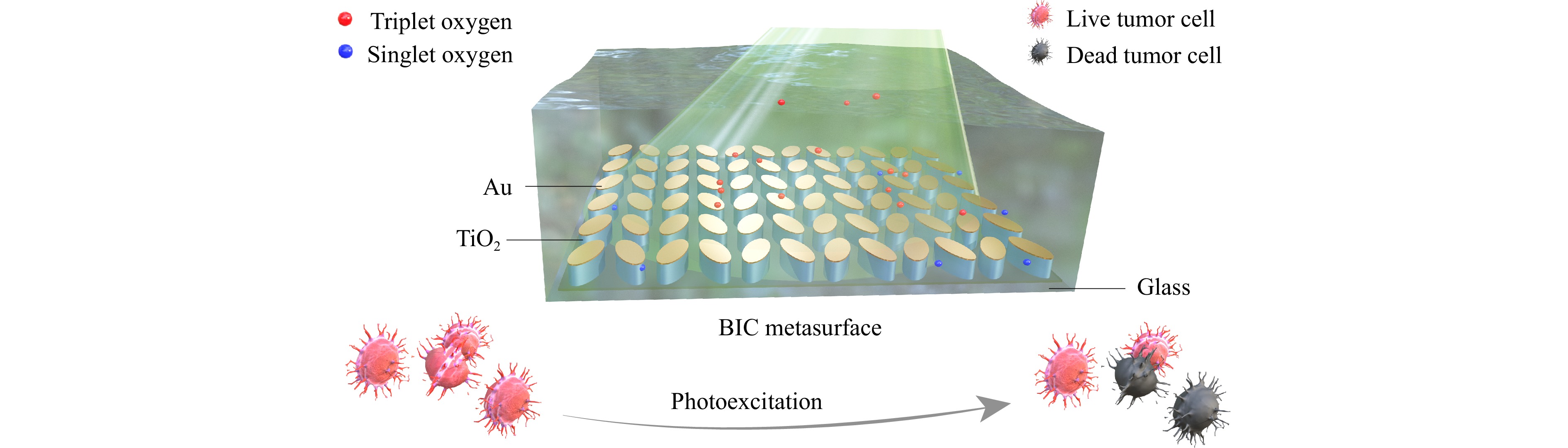
Fig. 1 Illustration of the nanogenerator for producing singlet oxygen for photodynamic therapy.
The physical picture is compelling. Simulations show that the quasi-BIC mode localises optical energy at the Au–TiO2 rim, where the near-field enhancement is approximately fourteen-fold. This confinement raises the electronic temperature in the Au nanostructure and facilitates hot-carrier injection across the Au/TiO2 Schottky barrier13. Simultaneously, the sparse use of noble metal reduces interfacial recombination and prolongs carrier persistence. In other words, the resonance does not merely create a hotspot; it redistributes where and how absorption occurs so that the absorbed energy becomes chemically more useful. The resulting chemical performance is striking. Time-correlated single-photon counting directly resolves the characteristic 1,270 nm phosphorescence of singlet oxygen, and spectral filtering confirms its assignment. The decay lifetime differs from that of Rose Bengal controls in a manner consistent with much higher local oxygen concentration near the TiO2 surface. Combining these measurements with adsorption analysis, the authors estimate a local singlet-oxygen concentration of about 1.12 M at the metasurface interface. This corresponds to an enhancement of approximately six orders of magnitude over typical photosensitizer-based conditions. Complementary SOSG activation and methylene blue bleaching assays show that the singlet oxygen signal emerges within the first few seconds of illumination, underscoring that the advantage is not only one of magnitude but also of speed.
Just as important as the efficiency is the programmability. Because the resonance wavelength is set geometrically, the metasurface response is tuned across the green spectral range by scaling the unit-cell dimensions. Arrays of differently tuned pixels can therefore be activated selectively by choosing the illumination wavelength. Under 532 nm excitation, only pixels resonant near that wavelength show strong activity and induce cell death in U2OS assays. When the wavelength is shifted to 562 nm, the cytotoxic response relocates to the red-shifted pixels. This is a notable departure from traditional dye-based photodynamic systems, which typically operate as broad-area sensitisers with little control over where chemistry occurs. Here, spectral information is translated directly into spatially resolved biochemical action. This pixel-level selectivity is especially significant because it suggests a new role for metasurfaces in chemistry and biomedicine. Metasurfaces are typically considered platforms for wavefront shaping, spectral filtering or optical sensing. However, in this study, the resonance pattern itself defines where reactive chemistry happens. Therefore, the platform moves metasurface photonics closer to a form of programmable interfacial chemistry, in which the optical design determines not only the mechanism of propagation of light but also where molecular transformation is triggered.
Additionally, the study points to a useful design principle for light-driven chemistry at solid–liquid interfaces: high absorption should not be pursued through heavy metal loading alone but through photonic structures that localise dissipation where charge separation can be exploited most effectively. This strategy should be transferable beyond singlet oxygen and beyond the specific Au–TiO2 system explored here. Similar quasi-BIC platforms may prove useful for other redox reactions, selective photocatalysis, on-chip microreactors, and phototherapeutic schemes in which spatial precision and low material doses are both essential. Some practical problems remain to be addressed. The present platform operates in the visible spectrum, whereas deeper biological use would benefit from red or near-infrared excitation. Long-term interfacial stability in complex media will also be significant for practical deployment, as will large-area fabrication and integration with more elaborate fluidic or biological environments. These limitations, however, are primarily technological rather than conceptual. The framework established here already shows that resonance engineering can do more than enhance optical signals: it can localise chemical reactivity itself. By coupling quasi-BIC photonics, critical absorption, and hot-carrier interfacial chemistry within a minimal-metal heterostructure, researchers have established a powerful route to on-demand singlet oxygen generation. The result is not merely a better photosensitizer-free platform but a broader demonstration that metasurfaces can be engineered to control when, where. and how light is converted into chemistry.
Metasurface generates singlet oxygen on demand
- Light: Advanced Manufacturing , Article number: 72 (2026)
- Received: 04 April 2026
- Revised: 18 April 2026
- Accepted: 21 April 2026 Published online: 21 May 2026
doi: https://doi.org/10.37188/lam.2026.072
Abstract: Although singlet oxygen is central to photodynamic therapy and photocatalysis, rapid and spatially precise generation has remained challenging. A quasi-BIC Au–TiO2 metasurface couples critical optical absorption to interfacial hot-carrier transfer, enabling molar-level local singlet oxygen production within seconds and wavelength-selective, pixel-resolved cytotoxicity without molecular sensitizers.
Rights and permissions
Open Access This article is licensed under a Creative Commons Attribution 4.0 International License, which permits use, sharing, adaptation, distribution and reproduction in any medium or format, as long as you give appropriate credit to the original author(s) and the source, provide a link to the Creative Commons license, and indicate if changes were made. The images or other third party material in this article are included in the article′s Creative Commons license, unless indicated otherwise in a credit line to the material. If material is not included in the article′s Creative Commons license and your intended use is not permitted by statutory regulation or exceeds the permitted use, you will need to obtain permission directly from the copyright holder. To view a copy of this license, visit http://creativecommons.org/licenses/by/4.0/.

 DownLoad: