






-
Counterfeiting remains a critical global challenge that undermines the credibility of banknotes, pharmaceuticals, and consumer products, while also posing pronounced threats to economic stability, human health, and national security1–4. According to the Organisation for Economic Co-operation and Development–European Union Intellectual Property Office (OECD–EUIPO), counterfeit and pirated goods accounted for approximately USD 467 billion in global trade as of 20215. Conventional single-level anticounterfeiting strategies, including quick response (QR) codes, stimulus-responsive inks, and digital authentication algorithms, suffer from limited dynamic reconfigurability and often rely on overly simplistic operating mechanisms6–9. Consequently, smart chromic materials capable of reversible and dynamic responses to external stimuli have emerged as promising candidates for next-generation information encryption and anticounterfeiting applications10–13. Based on the type of external stimulus, these materials are broadly classified as thermo-, electro-, photo-, mechano-, and hydrochromic systems14–18. Among these, hydrochromic materials, characterised by optical modulation, such as a change in colour or transmittance induced by water immersion or humidity variation, offer unique advantages, including cost-effectiveness, environmental sustainability, and a sensible triggering mechanism, as water is one of the most abundant resources in nature19–23. Moreover, their stimulus-dependent optical responses under predefined water-related conditions enable condition-selective authentication without the need for external power sources or complex device integration. These attributes render hydrochromic smart materials particularly attractive for advanced information encryption and anticounterfeiting applications.
In general, the working principle of hydrochromic materials is exemplified by porous structures inspired by Diphylleia grayi, in which the degree of refractive index (n) matching governs optical switching between opaque and transparent states14,24–26. Such water-triggered modulation is widely observed in natural systems and has further inspired the development of diverse bio-inspired hydrochromic designs. Previous hydrochromic smart materials have demonstrated rapid, real-time responsiveness20, excellent mechanical robustness21,27, pronounced light-transmittance modulation (e.g., luminance transmittance (Tlum, 360–780 nm) and solar transmittance (Tsol, 360–2,500 nm))27, and fast switching speed28,29. Nevertheless, most hydrochromic smart material systems remain restricted to single-band modulation (Fig. 1a)24–26,30,31. In particular, conventional hydrochromic designs often neglect the mid-infrared (MIR, 2.5–20 μm) region, thereby limiting their applicability in advanced anticounterfeiting scenarios and making them more vulnerable to decryption and replication. To address the growing demand for advanced anticounterfeiting technologies, real-world authenticity protection scenarios increasingly require multi-level protection schemes that enable authentication exclusively under specific stimuli or predefined conditions.
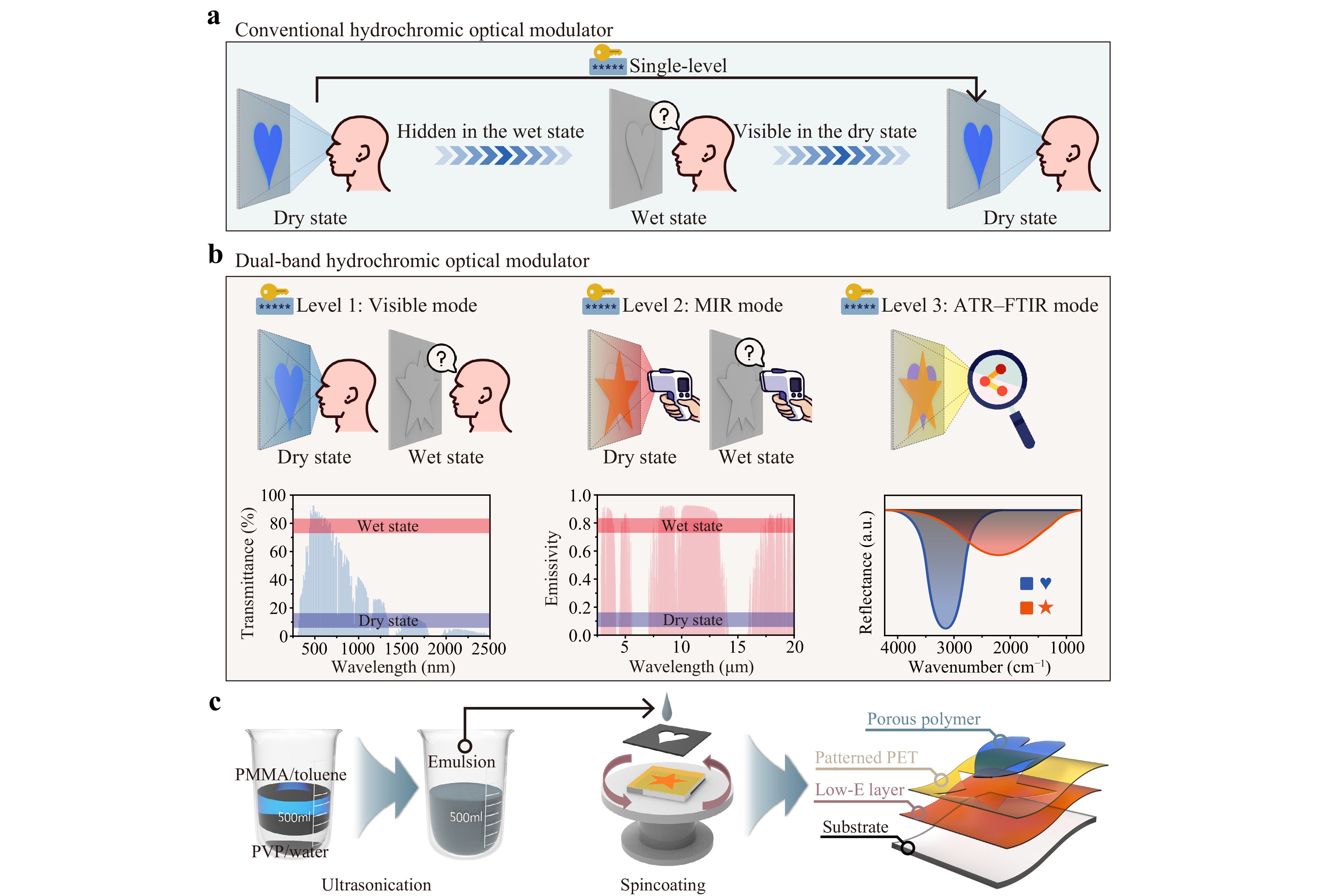
Fig. 1 a Schematic illustration of a conventional single-band hydrochromic optical modulator, which provides only a single level of anticounterfeiting functionality in the visible range. b Conceptual illustration of a dual-band hydrochromic optical modulator, enabling multi-level anticounterfeiting across the visible, MIR, and ATR-FTIR modes, with each mode selectively revealing different layers of information (the shaded blue and red regions represent the normalised AM1.5 global solar spectrum and the atmospheric transmittance window, respectively). c Schematic representation of the fabrication process for the dual-band modulator and the structural configuration of the final device.
Herein, we report a rationally designed dual-band hydrochromic modulator (denoted as “dual-band modulator”) that enables advanced multi-level anticounterfeiting (Fig. 1b). The dual-band modulator-based anticounterfeiting platform operates in three distinct modes: In Level 1 (visible mode), the dual-band modulator switches from an opaque state to a transparent state upon exposure to water. In Level 2 (MIR mode), the device exhibits low MIR emissivity in the dry state and substantially higher MIR emissivity in the wet state, which can be clearly distinguished via IR imaging. In Level 3 (attenuated total reflection–Fourier transform infrared, ATR-FTIR mode), authentication is achieved through specific functional-group absorption features, which can only be reliably verified using expert-assisted ATR-FTIR spectroscopy. Through the integration of these hierarchical multi-level pathways, the device enables condition-specific authentication, thereby substantially improving resistance against counterfeiting attempts. The proposed device comprises a porous polymer, patterned polyethylene terephthalate (PET), an integrated low-emissivity (low-E) layer, and an underlying substrate, which can be manufactured via a facile water-in-oil (W/O) emulsion process followed by spin-coating (Fig. 1c). Notably, the dual-band modulator exhibits pronounced optical contrast, achieving up to ~47.2% luminance transmittance modulation (ΔTlum) and ~0.55 MIR emissivity modulation (ΔεMIR) between the dry and wet states. It further demonstrates high operational durability, sustaining performance over 100 repeated dry–wet cycles and under stringent environmental conditions, including 80 °C and 60% RH, ultraviolet (UV) irradiation at 365 nm, and saltwater exposure for 20 days, while maintaining relatively consistent modulation behaviour. Building upon these characteristics and its simple fabrication process, the dual-band modulator-based anticounterfeiting device, featuring selective dual-band modulation and chemically addressable functional groups, represents a robust platform for advanced anticounterfeiting applications, while offering considerable potential for extension into next-generation smart optical and photonic systems.
-
Poly(methyl methacrylate) (PMMA) dissolved in toluene and polyvinylpyrrolidone (PVP) dissolved in water are ultrasonicated for 4 h (Fig. 1c) to form a stable emulsion, which is subsequently coated onto a low-E substrate, resulting in a structure composed of a porous polymer layer, a low-E layer, and the underlying substrate (Fig. 2a(i)). Scanning electron microscopy (SEM) images reveal the microstructure of the porous polymer film as a function of PMMA concentration (Fig. S1 and 2a(ii-vi)) after water evaporation. At ≤1 wt%, no discernible pores are observed (Fig. S1 and 2a(ii)), which may be attributed to insufficient solid content to form a continuous porous polymer network. Initial pore formation is observed at 2 wt% (Fig. 2a(iii)). From 4 wt%, the microstructure exhibits a marked increase in the number and size of pores, and the overall morphology remains similar between 4 wt% and 6 wt% (Fig. 2a(iv) and 2a(v)). At 8 wt%, the characteristic pore size is similar to that at 4 wt% and 6 wt%, whereas the overall areal pore coverage decreases, presumably due to the excessive PMMA content leading to a denser matrix that limits pore formation (Fig. 2a(vi)). Fig. 2b summarises the evolution of pore area fraction and average pore size with PMMA concentration. Pore formation is first observed at 2 wt%, with a pore area fraction of ~40% and an average pore size of ~0.7 μm. The pore area fraction reaches a maximum at 4 wt% (~60%) and subsequently declines, reaching ~30% at 8 wt%. Meanwhile, the average pore size increases markedly at 4 wt% (~3.9 μm) and remains relatively constant over the range of 4 wt% to 8 wt% (~3.7–3.9 μm). Relatively large error bars in the measured average pore size are observed at ≥4 wt%, likely due to the heterogeneous distribution of pore sizes. Moreover, increasing the number of coating layers results in a gradual decrease in surface porosity as surface pores become progressively covered (Fig. S2). These quantitative trends are in good agreement with the SEM observations. Finite-difference time-domain (FDTD) simulations further indicate that the device exhibits relatively low transmittance in the visible and near-infrared (NIR) regions (52.5% at 500 nm; 59.4% at 1,000 nm) and maintains low emissivity (εMIR ≈ 0.40 at 10 μm) in the dry state (Fig. 2c). Conversely, upon wetting, the transmittance increases to 77.6% and 88.1% at 500 and 1,000 nm, respectively, with εMIR increasing to 0.95. The electromagnetic field distributions at different wavelengths are presented in Fig. 2d, e. Under the dry state, strong scattering of incident visible light (500 nm) and NIR (1,000 nm) is observed within the structure, as evidenced by the high field intensities, which appear as near-red regions in Fig. 2d(i), d(ii). Conversely, when water infiltrates the pores, the reduced n contrast between PMMA (n = 1.49) and water (n = 1.33), compared with that between PMMA and air (n = 1.00), suppresses light scattering and promotes optical transmission. As a result, the field intensity decreases, as evidenced by the predominance of blue regions (Fig. 2d(iii) and 2d(iv)). In the MIR regime, 10 μm radiation under the dry state is predominantly reflected in the FDTD simulation, as indicated by the high field intensity (near-red) observed within the structure (Fig. 2e(i)), due to the MIR transparency of PMMA and the high reflectivity of the underlying low-E layer. By contrast, under the wet state, strong absorption of 10 μm radiation by water results in reduced field intensity (blue), as illustrated in Fig. 2e(ii). These simulation results demonstrate the capability of the modulator to achieve simultaneous dual-band optical modulation.
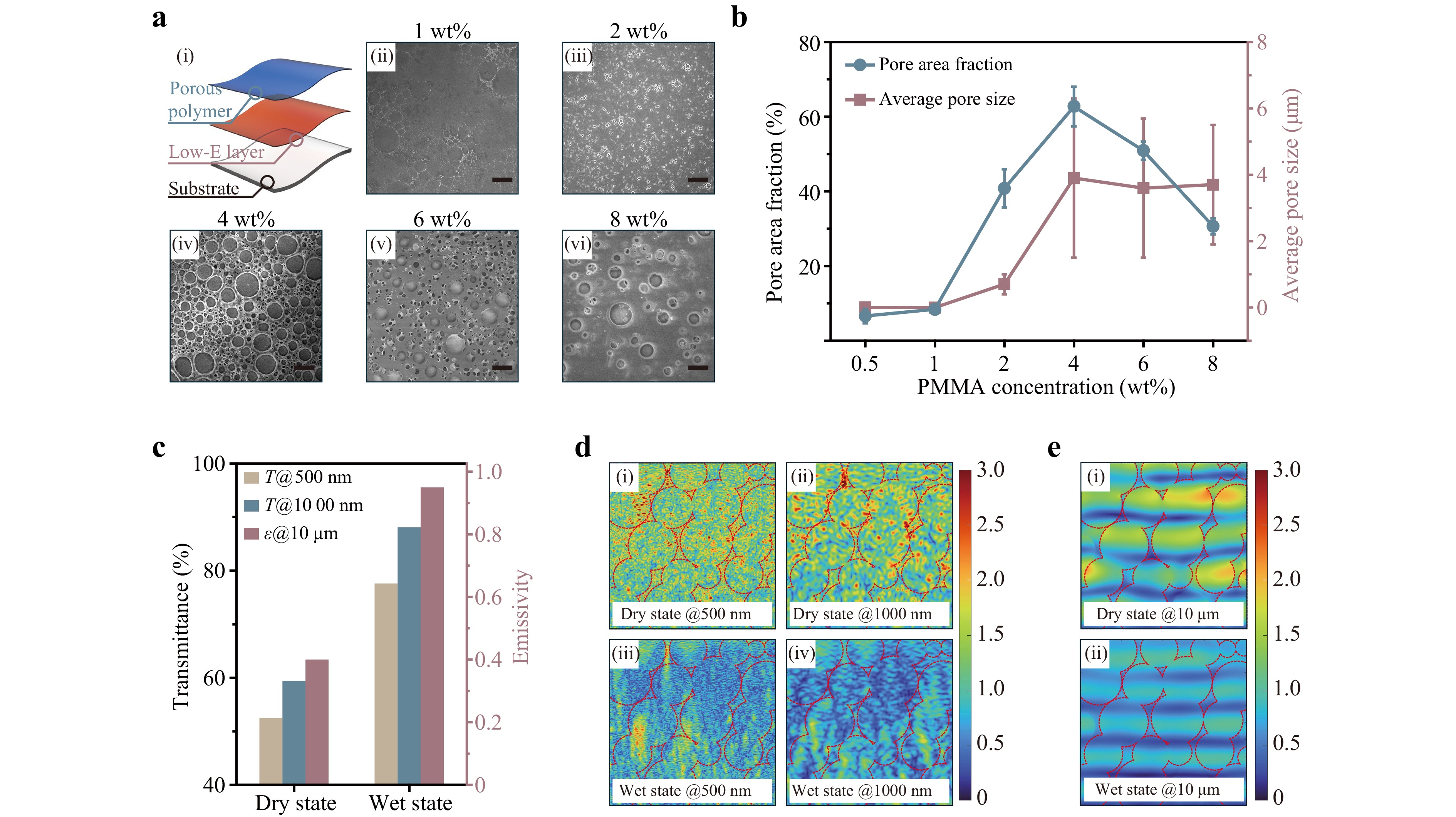
Fig. 2 a (i) Schematic illustration of the structure of the dual-band modulator and SEM images as a function of PMMA concentration: (ii) 1 wt%, (iii) 2 wt%, (iv) 4 wt%, (v) 6 wt%, and (vi) 8 wt% (scale bar: 10 μm). b Pore area fraction (%) and average pore size of porous PMMA films as a function of PMMA concentration. c FDTD simulation results illustrating transmittance and emissivity modulation behaviour of the dual-band modulator under dry and wet states. d Simulated electric field distributions illustrating light propagation at different wavelengths under dry and wet states (i) dry, 500 nm; (ii) dry, 1,000 nm; (iii) wet, 500 nm; and (iv) wet, 1,000 nm. e Simulated electric field distributions at a wavelength of 10 μm under (i) dry and (ii) wet states. The field maps display the lateral (x-axis) and depth (z-axis) directions, with colour representing relative electric field intensity, where red corresponds to higher intensity and blue to lower intensity. The red dotted line represents the porous structure.
-
Fig. 3a demonstrates the optical performance of the dual-band modulator as a function of PMMA concentration. Samples with concentrations of 2 wt% or lower show the highest Tlum and Tsol values (74.1% and 71.7%) under the dry state. In the wet state, the Tlum and Tsol values of these samples increase only slightly (96.1% and 87.3%), indicating limited transmittance modulation due to insufficient pore formation. At 4 wt%, the Tlum and Tsol values decrease to 9.2% and 9.8% in the dry state, while increasing to 56.4% and 60.4% in the wet state, respectively. The modulation capability decreases for the 6 and 8 wt% samples, which may be attributed to reduced pore area, consistent with the microstructural observations (Fig. S1, 2a, and 2b). This trend indicates that PMMA concentration governs the pore microstructure and, consequently, the optical performance of the device. At low PMMA concentration, insufficient polymer content limits pore formation, resulting in reduced dry–wet optical contrast. At high PMMA concentration, although pore size remains comparable, the decreased pore area fraction and increased polymer coverage suppress refractive-index contrast, leading to diminished transmittance modulation performance. Fig. 3b presents the ultraviolet–visible–near infrared (UV-Vis-NIR) spectra of the dual-band modulator with 4 wt% PMMA under dry and wet states. The dual-band modulator shows the robust modulation of ΔTlum/sol 47.2% and 50.6%, respectively. The photographs in Fig. 3c confirm the visible modulation capability of the sample, revealing a clear optical contrast between the dry and wet states. The εMIR performance of the samples was systematically assessed as a function of PMMA concentration (Fig. 3d). In the dry state, a consistently low εMIR value (~0.2) is maintained up to 2 wt%, and above 4 wt%, εMIR gradually increases, reaching a maximum of ~0.5 at 8 wt%. The increased dry state εMIR at higher PMMA concentrations is likely associated with increased polymer loading in the coating layer, which may reduce the reflectance contribution from the underlying low-E substrate. Meanwhile, across all samples in the wet state, consistently high emissivity of approximately 0.8 was observed, owing to the intrinsically high εMIR of water32. Fig. 3e demonstrates the εMIR modulation capability of the device, with the 4 wt% PMMA samples exhibiting a ΔεMIR of 0.55 between dry and wet states. The IR images visually confirm this ΔεMIR capability: in the dry state, the sample appears dark, indicating low εMIR, whereas in the wet state, the sample becomes brighter, indicating a marked increase in εMIR (Fig. 3f). In addition to the pronounced dual-band contrast, the device exhibits fast, reversible switching behaviour between dry and wet states, as presented in Fig. S3 and Video S1. Based on the balance between hydrochromic performance and ΔεMIR, the optimal fabrication parameters, including a 4 wt% PMMA concentration, a single coating layer, and a spin-coating speed of 500 rpm, were selected for the dual-band modulator (Fig. S4, S5, and S6). A comparison with hydrochromic optical modulators reported in previous studies is presented in Table S1, indicating that the present device achieves competitive optical performance while uniquely offering dual-band modulation functionality. The device exhibits highly consistent dual-band wavelength-responsive behaviour not only to direct water contact but also under varying relative humidity (RH). Fig. 3g presents photographs and IR images of the device at different RH, showing that the transparency and εMIR increase progressively with increasing RH, as evidenced by the gradual enhancement of transparency in the photographs and the corresponding brightening observed in the IR images. Fig. 3h(i), h(ii) present contour maps of transmittance and emissivity across a range of wavelengths as a function of RH. Both visible transmittance and MIR emissivity progressively increase with rising RH, as indicated by a shift toward red regions in the contour plots. When the RH level is lowered from 80% to 50%, both transmittance and emissivity gradually decrease, as indicated by the shift toward blue regions, demonstrating a reversible dual-band response. The modulation exhibits a strong linear dependence on RH (R2 ≈ 0.98), indicating excellent humidity sensitivity (Fig. S7) and highlighting its potential for application in optical humidity sensors and moisture-sensitive healthcare-related platforms. With its multiband modulation capability and excellent reversibility, the dual-band modulator demonstrates a robust response to both direct water contact and ambient humidity, highlighting its broad applicability beyond anticounterfeiting, including next-generation smart optical and photonic systems.
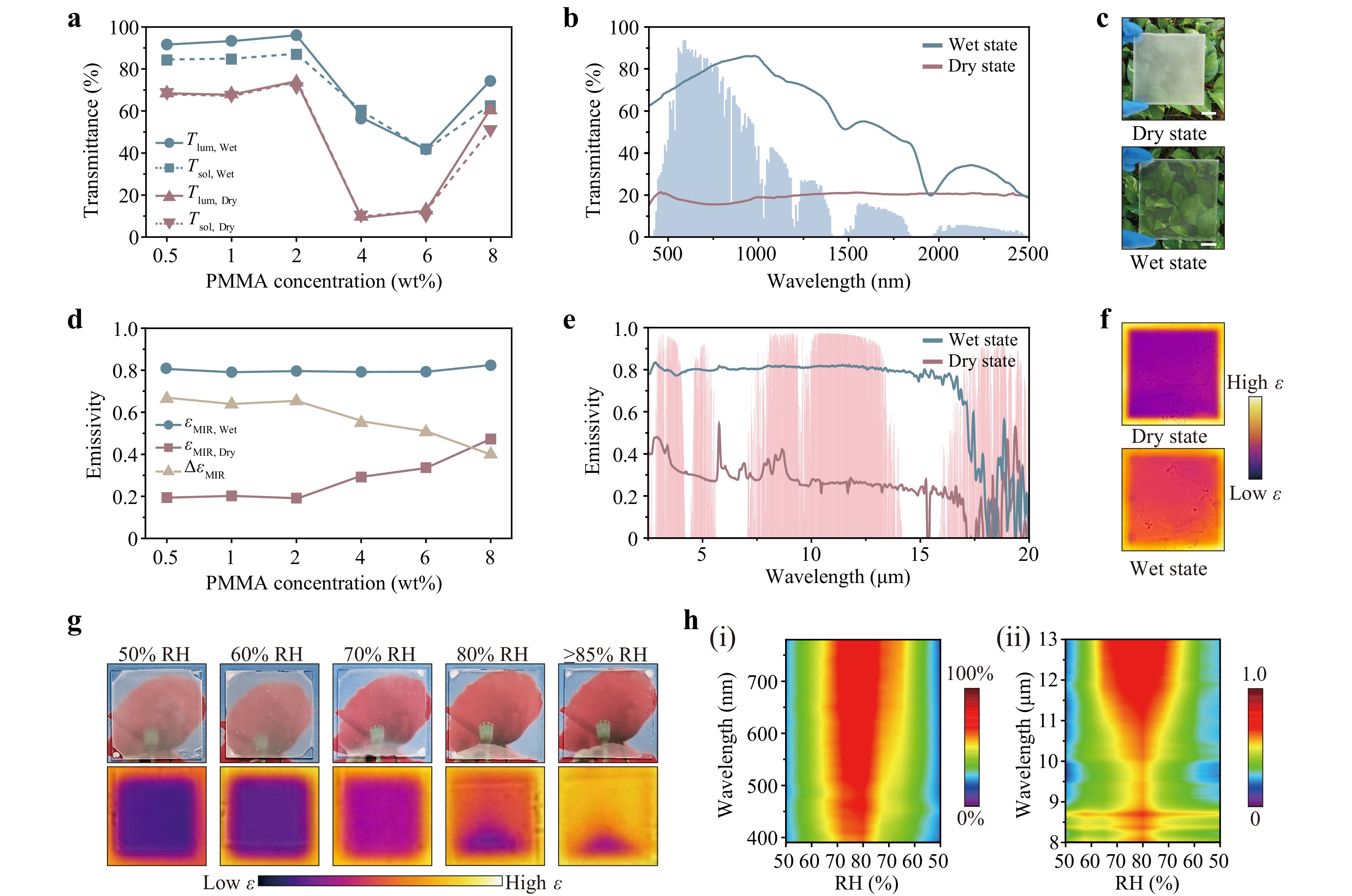
Fig. 3 a Optical transmittance of samples with varying PMMA concentrations in dry and wet states. b UV-Vis-NIR transmittance spectra of the 4 wt% PMMA sample in dry and wet states, overlaid with the normalised AM1.5 global solar spectrum (blue-shaded region). c Photographs of the 4 wt% PMMA sample in dry and wet states (scale bar: 2 cm). d Emissivity values of samples with different PMMA concentrations in dry and wet states. e Emissivity spectra of the 4 wt% PMMA sample in dry and wet states, shown together with the normalised AM1.5 atmospheric transmittance spectrum (red-shaded region). f IR images of the sample in dry and wet states. g Photographs and IR images of the 4 wt% PMMA sample under different RH conditions. h RH- and wavelength-resolved (i) transmittance contour map and (ii) emissivity contour map. The x-axis represents RH (%), the y-axis denotes wavelength, and the colour scale indicates (i) transmittance (%) and (ii) emissivity magnitude, with red indicating higher and blue indicating lower values.
-
Leveraging the dual-band modulation capability of the proposed hydrochromic functional device, the dual-band modulator-based anticounterfeiting prototypes are fabricated, as shown in Fig. 4. The facile spin-coating process described in Fig. 1c enables versatile substrate selection, including flexible PET, which exhibits excellent mechanical resilience under folding (Fig. 4a), thereby highlighting its suitability for flexible device applications. To demonstrate the multi-level anticounterfeiting capability, a conventional hydrochromic sample (serving as the control group) and the proposed prototype (i.e., the dual-band modulator) with a distinct “★” pattern are prepared for direct comparison (Fig. 4b). Both the control group and the dual-band modulator display opaque appearances with well-defined patterns under dry conditions (Fig. 4b(i), b(ii)). Conversely, under wet conditions, the pattern “★” becomes indistinct due to water-induced suppression of light scattering, yet reappears upon drying, thereby confirming reversible switching behaviour associated with Level 1 anticounterfeiting. Interestingly, the control group shows no discernible pattern in IR imaging due to the absence of a low-E layer (Fig. 4c(i)), whereas the dual-band modulator displays a clearly resolved “★” pattern, with strong contrast between the low-E layer and the patterned PET, thereby demonstrating Level 2 anticounterfeiting functionality (Fig. 4c(ii)). This comparison underscores the critical role of dual-band modulation in enabling multi-level anticounterfeiting, in contrast to conventional hydrochromic films that operate only in a single band. The device exhibits stable luminance transmittance modulation over 100 repeated dry–wet cycles (Fig. 4d). Moreover, transmittance modulation remains stable for ~20 days under accelerated testing conditions, involving severe environmental stress, including continuous heating at 80 °C and 60% RH, UV irradiation at 365 nm with an intensity equivalent to 1 sun, and exposure to 5 wt% saltwater (Fig. 4e), while maintaining an uncompromised ΔTlum value of ~40%, demonstrating durability comparable to that of high-performance energy-saving coatings33. This durability is partly attributed to the use of PMMA as the porous matrix, owing to its excellent UV resistance, thermal stability up to approximately 100 °C, and chemical stability in aqueous environments relative to other polymeric systems34. These results demonstrate the device’s strong environmental durability and its practical potential for real-world deployment. Owing to the facile W/O emulsion combined with the spin-coating process, various patterns can be readily integrated within a single device (Fig. 4f). As demonstrated, both the control group and the prototype exhibit a clear “♥” pattern in the dry state, which becomes visually distinguishable upon wetting, thereby corresponding to Level 1 anticounterfeiting based on visible optical contrast (Fig. 4f(i), f(ii)). Under IR imaging, however, the control group shows no discernible feature in either the dry or wet states, owing to the absence of a low-E layer, leading to uniformly high emissivity across the surface (Fig. 4f(i)). In contrast, the dual-band modulator reveals a clearly defined dark “★” feature in the MIR mode under the dry state, while this feature becomes progressively less distinguishable upon wetting due to the high emissivity of water, thereby enabling Level 2 anticounterfeiting (Fig. 4f(ii)). Fig. 4g presents a comparative analysis of the optical spectra of the control group and the prototype. The control group demonstrates a large luminance transmittance modulation (ΔTlum ≈ 40%); however, its solar transmittance modulation remains limited (ΔTsol ≈ 35%), because the NIR transmittance is already high even in the dry state, primarily owing to the absence of the low-E layer (Fig. 4g(i) and S8). Additionally, the absence of the low-E layer results in persistently elevated emissivity, leading to poor emissivity modulation capability, with ΔεMIR below ~0.1. As a result, the control group supports only Level 1 anticounterfeiting and does not provide the dual-band modulation necessary for Level 2 and advanced anticounterfeiting functionalities. By contrast, the prototype exhibits robust dual-band modulation performance, achieving high ΔTlum and ΔTsol values of ~50%, together with a pronounced emissivity modulation of ΔεMIR ≈ 0.52 (Fig. 4g(ii) and S8). This synergistic dual-band modulation spanning the visible and MIR spectral regions enables robust Level 2 anticounterfeiting under multiple optical wavelength channels. Furthermore, the prototype enables Level 3 anticounterfeiting through the identification of distinct characteristic functional groups, offering a chemically encoded security feature. ATR-FTIR analysis reveals characteristic vibrational absorption peaks of PMMA and PVP at ~2,990 cm−1 (C–H stretching), ~1,730 cm−1 (C=O stretching), ~1,650 cm−1 (C=O stretching), and ~1,147 cm−1 (–OCH3 stretching). The control group exhibits significantly stronger PMMA- and PVP-related absorption features owing to the absence of the low-E layer, whereas these peaks are noticeably attenuated in the dual-band modulator (Fig. 4h)35–38. These distinct spectroscopic signatures enable unambiguous chemical differentiation between the two films. Collectively, these results demonstrate a proof-of-concept multi-level anticounterfeiting platform integrating Level 1 (visible mode), Level 2 (MIR mode), and Level 3 (ATR-FTIR mode) within a single dual-band hydrochromic architecture.
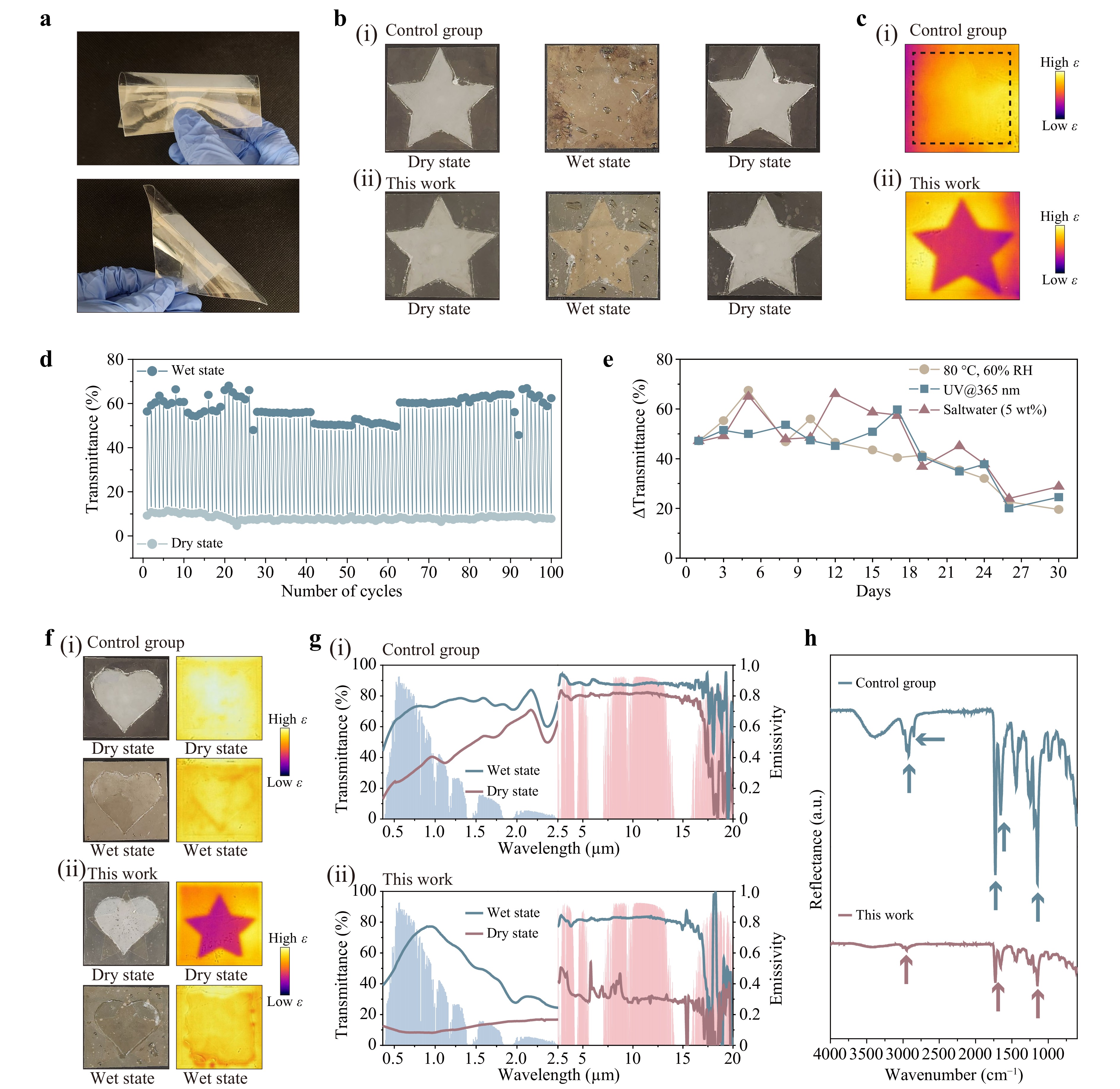
Fig. 4 a Photograph demonstrating the mechanical flexibility of the device. b Photographs of (i) the control group and (ii) the prototype in dry and wet states, and c corresponding IR images of (i) the control group and (ii) the prototype in dry state featuring a “★” pattern. d Cycling performance of the prototype under repeated drying and wetting cycles. e Evolution of ΔTlum of the prototype during 30 days of accelerated ageing under three stressors, including high temperature (80 °C, 60% RH, yellow curve), 365 nm UV irradiation (blue curve), and 5 wt% saltwater exposure (red). f Photographs and IR images of (i) the control group with “♥” patterns and (ii) the prototype incorporating both “♥” and “★” patterns within a single device. g UV-Vis-NIR transmittance and emissivity spectra of (i) the control group and (ii) the prototype in dry and wet states, presented alongside the normalised AM1.5 global solar spectrum (blue shading) and the atmospheric transmittance window (red-shaded region). h ATR-FTIR reflectance spectra of the control and the prototype, with arrows representing characteristic vibrational absorption peaks.
-
In this study, we report a hydrochromic-based dual-band anticounterfeiting device that is capable of enabling multi-level authentication using visible, MIR, and ATR-FTIR modes. The device exhibits strong optical modulation (ΔTlum of 47.2% and ΔεMIR of 0.55), as well as high sensitivity to both direct water contact and humidity variations. It also demonstrates excellent durability, sustaining stable modulation performance after 100 repeated dry–wet cycles and prolonged exposure to high temperature (80 °C and 60% RH), UV irradiation (365 nm), and saltwater (5 wt%). Benefiting from a facile and scalable W/O emulsion system combined with a spin-coating process, the device also allows for large-scale fabrication and flexible substrate compatibility, thereby enhancing its potential for practical deployment. Importantly, the device enables multi-level authentication: in Level 1 (visible mode), the dual-band modulator switches from an opaque state to a transparent state upon exposure to water; in Level 2 (MIR mode), the device exhibits low emissivity in the dry state and high emissivity in the wet state, which can be distinguished using IR imaging; and in Level 3 (ATR-FTIR mode), characteristic functional-group absorption signatures can be spectroscopically identified through expert-assisted ATR-FTIR analysis. Such a hierarchical design establishes a robust anticounterfeiting strategy in which authenticity can be validated only under predefined and orthogonal stimulus conditions, thereby significantly enhancing authentication security and reliability. The proposed design principle of hydrochromic dual-band modulation offers strong potential to serve as a versatile platform for multi-level anticounterfeiting and provides a new pathway toward advanced anticounterfeiting and next-generation smart chromic technologies.
-
Glass substrates (2.5 cm × 2.5 cm, single-sided indium tin oxide (ITO)-coated, Winteck Technology) were utilised for performance optimisation, while polyethylene terephthalate (PET) substrates (10 cm × 10 cm, single-sided ITO-coated and pristine, Sigma-Aldrich) were used for anticounterfeiting prototypes. Bare PET film was employed as a masking layer for pattern information in the anticounterfeiting prototypes. Poly(methyl methacrylate) (PMMA, Mw ~120,000, Sigma-Aldrich), polyvinylpyrrolidone (PVP, Mw ~40,000, Sigma-Aldrich), deionised (D.I) water, ethanol (95%, Aik Moh), and toluene (anhydrous, 99.8%, Sigma-Aldrich) were used as received without any further purification.
-
PMMA was selected as the porous matrix owing to its excellent compatibility with the W/O emulsion process, MIR transparency, and chemical stability. Accordingly, a series of PMMA solutions was prepared by dissolving 0.2, 0.45, 0.74, 1.55, 2.4 and 3.2 g of PMMA in 30 mL of toluene. Separately, a PVP aqueous solution was prepared by dissolving 0.5 g of PVP in 10 mL of D.I water. The two solutions were combined in a 60 mL vial and ultrasonicated for 4 h to form a stable and homogeneous W/O emulsion.
-
Glass substrates with a single-sided ITO coating were cleaned with ethanol prior to use. Subsequently, 500 μL of the W/O emulsion was coated onto the ITO-coated glass via spin-coating (POLOS SPIN150i) at various rotational speeds (100, 200, 300, 400, 500, and 600 rpm) and with different numbers of coating layers (1, 2, 4, 6, and 8 layers). After spin-coating, the samples were thermally dried at 60 °C for 5 min.
-
PET substrates (10 cm × 10 cm, 100 cm2) with single-sided ITO coatings and pristine PET films (10 cm × 10 cm, 100 cm2) were cleaned with ethanol prior to use. For the fabrication of the dual-band optical modulator-based anticounterfeiting device, a patterned PET film was used as a mask and laminated directly onto the ITO-coated PET substrate. Subsequently, 8 mL of the W/O emulsion was spin-coated at 500 rpm onto the ITO-coated side. For the control group (representing a conventional hydrochromic film), the same W/O emulsion was spin-coated under identical processing conditions onto pristine PET without the low-E layer. Well-defined porous polymer coating patterns were obtained by applying patterned masking tape to both substrates, followed by spin-coating and subsequent careful removal of the masking layer.
-
The microstructure of porous PMMA was characterised using a scanning electron microscope (FESEM, JEOL JSM-7600F). The average pore size was analysed using ImageJ software by measuring 100 pores from SEM images for each sample, and the mean value with the corresponding standard error was calculated. The pore area fraction was determined by applying binary thresholding to the SEM images using a consistent contrast threshold to distinguish between pore and non-pore regions. Chemical bonding characteristics of the dual-band optical modulator and the control group were confirmed through attenuated total reflection Fourier-transform infrared (ATR-FTIR) spectroscopy (Frontier, PerkinElmer). The transmittance modulation of the fabricated dual-band optical modulator under dry–wet states and humidity conditions was analysed using a UV-Vis-NIR high-sensitivity spectrometer equipped with a point detector (Avantes AvaSpec-ULS2048L StarLine Versatile Fiber-optic Spectrometer and AvaSpecNIR256-2.5-HSC-EVO), with a measurement spot size of 0.5 cm × 0.5 cm. The wet state was achieved by immersing the sample in water for 1 min, followed by thermal drying at 80 °C for 3 min to restore the dry state. The εMIR value of the samples was measured using a dual-band emissivity measurement instrument (IR-2, Shanghai Chengbo Photoelectric Technology). The εMIR values were recorded at five distinct locations across each sample, and the average εMIR value was subsequently calculated. Emissivity spectra were acquired using a PerkinElmer Frontier spectrometer equipped with an integrating sphere. The effective measurement spot size of the FTIR spectrometer was 2 cm × 2 cm. IR images of the dual-band optical modulator under dry–wet states and varying humidity conditions were captured using an IR camera (FLIR E4). Relative humidity (% RH) was controlled using a custom-built environmental chamber equipped with a hygrometer. The durability test was conducted over 30 days, during which the samples were continuously subjected to 80 °C in an oven, UV lamp irradiation, and periodic exposure to a 5 wt% salt solution. At predetermined intervals, the samples were removed, evaluated for modulation performance, and subsequently returned to each respective condition.
-
K.R. expresses sincere gratitude to Nanyang Technological University and the Singapore International Graduate Award. Y.L. is thankful for the funding support from the Global STEM Professorship Scheme sponsored by the Government of Hong Kong Special Administrative Region, Start-up funding from The Chinese University of Hong Kong, 2024 Shenzhen-Hong Kong-Macau Science and Technology Program (Category C) (SGDX20230821094659005), and Innovation and Technology Fund (ITS/221/23). Z.D. and K.R. thanks Centre of Hydrogen Innovations (CHI) grant CHI-P2023-08 and Academic Research Fund Tier 1 RG159/24 for funding support.
Dual-band hydrochromic optical modulator for multimodal anticounterfeiting and encryption
- Light: Advanced Manufacturing , Article number: 79 (2026)
- Received: 28 January 2026
- Revised: 01 May 2026
- Accepted: 06 May 2026 Published online: 07 May 2026
doi: https://doi.org/10.37188/lam.2026.079
Abstract: With the rise in digital threats and product counterfeiting, the development of advanced anticounterfeiting and encryption systems has become increasingly critical. Hydrochromic smart materials with dynamically tunable optical responses have emerged as a promising approach for next-generation anticounterfeiting applications. However, the vast majority of reported hydrochromic designs are based on single-band (visible) modulation, rendering them inherently vulnerable to decryption and replication. Herein, we address this challenge through the design of a controlled pore-structured hydrochromic dual-band anticounterfeiting platform, which enables multi-level information encoding across visible, mid-infrared, and attenuated total reflection Fourier-transform infrared modes, thereby enhancing authentication reliability. The platform is fabricated via a scalable and industrially compatible emulsion process and exhibits dry–wet dual-band optical modulation superior to that of the state-of-the-art, achieving up to ~47.2% luminance transmittance modulation and ~0.55 mid-infrared emissivity modulation. Moreover, it demonstrates excellent environmental durability, maintaining stable optical performance after repeated dry–wet cycles and under harsh operating conditions, including high temperature, ultraviolet irradiation, and saltwater exposure, thereby ensuring long-term operational stability. The uniquely engineered hydrochromic dual-band anticounterfeiting platform offers a promising strategy for dynamically tuning optical responses across multiple wavelength regimes, with broad potential applications beyond advanced anticounterfeiting.
Research Summary
Hydrochromism: Dual-band films enhance anticounterfeiting security
Hydrochromic films that switch optical properties after exposure to water could improve the security of anticounterfeiting labels and encrypted information. Most existing hydrochromic materials only change their appearance in visible light, making them easier to copy or decode. Keunhyuk Ryu and colleagues now report a porous polymer-based hydrochromic optical modulator that operates across multiple authentication modes. The device changes from opaque to transparent when wetted, while also switching its mid-infrared emissivity for thermal-camera readout. Additional chemical signatures can be verified using ATR–FTIR spectroscopy, creating three levels of authentication in one platform. The modulator achieves strong visible transmittance and infrared emissivity modulation, while maintaining stable performance after repeated wetting–drying cycles and environmental stress tests.
Rights and permissions
Open Access This article is licensed under a Creative Commons Attribution 4.0 International License, which permits use, sharing, adaptation, distribution and reproduction in any medium or format, as long as you give appropriate credit to the original author(s) and the source, provide a link to the Creative Commons license, and indicate if changes were made. The images or other third party material in this article are included in the article′s Creative Commons license, unless indicated otherwise in a credit line to the material. If material is not included in the article′s Creative Commons license and your intended use is not permitted by statutory regulation or exceeds the permitted use, you will need to obtain permission directly from the copyright holder. To view a copy of this license, visit http://creativecommons.org/licenses/by/4.0/.

 DownLoad: