



-
Ultrafast lasers delivering femtosecond pulses with high peak power have become one of the most effective tools in ultraprecision manufacturing, strong-field physics, nonlinear optics, medical diagnosis, astronomical detection, precision measurement, and fundamental research1–3. Among these, the passively mode-locked ultrafast fibre laser (MLFL) based on a saturable absorber (SA) is one of the most convenient routes for developing pulses shorter than 100 fs, thereby offering high beam quality, low cost, efficient cavity, alignment-free compact design, and excellent compatibility3–5.
Progress in SA design has followed the development of materials that show saturable absorption. For many years, the dominant SA has been the semiconductor saturable absorber mirror (SESAM), a quantum-well structure grown using molecular beam epitaxy (MBE)6,7. The high stability of SESAM makes it a reliable choice. However, SESAMs suffer from picosecond recovery, a narrow working band, low damage threshold, complex fabrication, and high costs. Thus, the community has been constantly searching for substitutes with faster recovery times and broader spectral ranges8,9.
Emerging low-dimensional (LD) materials with various advantages over SESAM provide a new prospect for the development of pulsed fibre lasers because of their distinct structures and physical properties10,11. Pauli-blocking instantaneously reduces absorption when the lower energy level is depleted10,12, producing regular femtosecond pulse trains12. These LD SAs offer broader operating spectra than SESAMs, thus providing a clear path to the next generation of low-threshold, low-cost MLFLs13. Among LD materials, graphene is particularly promising because of its ultrafast recovery time (< 100 fs) and linear energy dispersion. Graphene enables mode locking without disturbing the optical mode across a broad spectral range (from visible to infrared) with ultrashort pulses (< 90 fs) and high repetition rates (> 9 GHz)14,15. However, unstable output states and background pulses prior to soliton formation restrict its practical utilisation16.
To address the aforementioned challenges, Shao et al.17 constructed a nanocavity SA by transferring a MoS2-BN-graphene-BN-MoS2 heterostructure onto the end facet of a single-mode fibre (Fig. 1a). The refractive-index contrast between MoS2 and BN formed a nanocavity. Within this nanocavity, the optical field intensity in the graphene layer was enhanced by 230% owing to the standing-wave effect (Fig. 1b), and the fitted saturation intensity dropped from 62.9 MW cm−2 for bare graphene to 22.0 MW cm−2. Consequently, the heterostructure enabled stable single-soliton mode-locking and significantly improved polarisation tolerance.
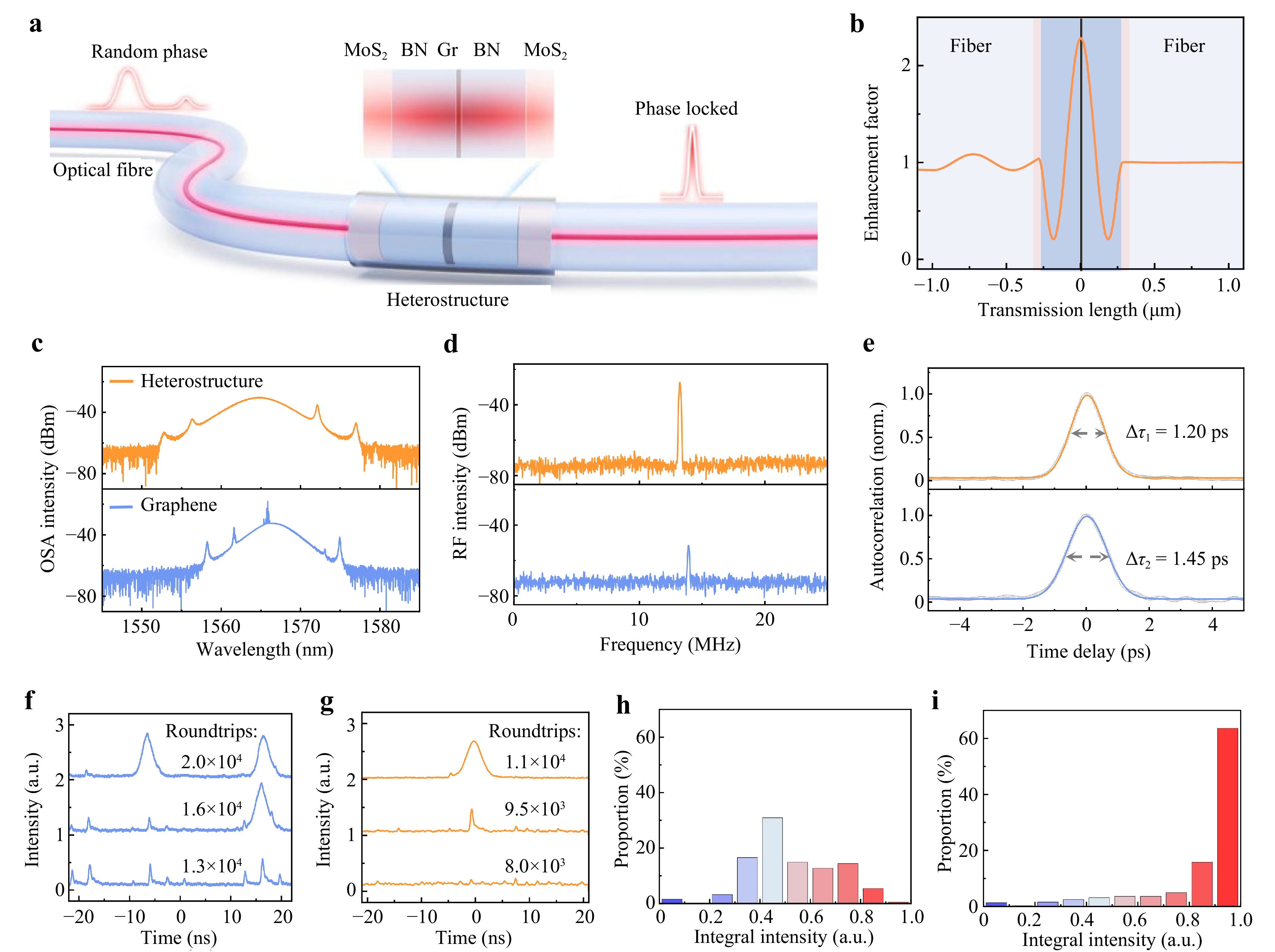
Fig. 1 a Schematic representation of the MoS2-BN-graphene-BN-MoS2 heterostructure embedded between optical fibre end facets. b Internal optical field intensity distribution of the heterostructure. Optical field intensity in graphene can be enhanced by ~230% with a BN thickness of 240 nm. c Spectra of output lasers with bare graphene-SA and heterostructure-SA. d RF spectra measured for bare graphene-SA and heterostructure-SA. e Autocorrelation trace with FWHM of ~1.20 ps for heterostructure-SA and ~1.45 ps for graphene-SA. f-g Temporal profiles at representative roundtrips during pulse formation obtained with f graphene-SA and g heterostructure-SA. h-i Statistics on the integral intensities of h graphene-SA and i heterostructure-SA.
The heterostructure was inserted into an all-fibre ring cavity pumped at 980 nm. The output spectrum shows a conventional soliton with clear Kelly sidebands; the non-soliton component that appears at 1565.8 nm with bare graphene is clearly removed (Fig. 1c). The radio-frequency signal exhibits a signal-to-noise ratio of 45 dB, compared with 22 dB for bare graphene (Fig. 1d); the pulse duration of 1.45 is reduced to 1.20 ps (Fig. 1e); and the output power has increased to 92.5 mW without any damage.
Real-time time-stretch dispersive Fourier transform measurements were used to resolve the soliton build-up process. With bare graphene, the laser passed through relaxation oscillation and energy fluctuation, reaches 11% in Fig. 1f, and a second soliton appears after approximately 20,000 rounds. With this heterostructure, the process stops at the single-pulse stage, and a stable soliton with only 3% energy fluctuation is established after approximately 11,000 round trips, with no splitting observed (Fig. 1g).
Polarisation tolerance was examined using an automatic controller that covered the entire Poincaré sphere. Without the SA, the cavity produced only continuous-wave light. With bare graphene, single-pulse mode-locking was obtained for 20% of the polarisation states (Fig. 1h). With the heterostructure, the single-pulse state is preserved for 85% of the states and pulse splitting is almost eliminated (Fig. 1i). The saturable absorption-related self-amplitude modulation coefficient increased from 6.7 × 10⁻⁴ to 2.3 × 10⁻³, far exceeding the mode-locking threshold and consequently dramatically improving the polarisation tolerance.
In summary, the developed 2D heterostructure nanocavity demonstrates strong compatibility for integration onto optical fibre end facets, showing significant promise for enhancing the performance and enabling the miniaturisation of all-fibre devices. This study not only provides a competitive alternative to traditional SESAMs by overcoming their inherent limitations such as narrow bandwidth and complex fabrication, but also effectively addresses the instability and polarisation sensitivity issues commonly associated with simple LD material-based SAs. Further optimisation of the heterojunction design and cavity dispersion management may extend the capability of the platform to support multiwavelength mode-locking and optical frequency comb production, highlighting its utility in communication, high-accuracy sensing, and biomedical photonic applications.
Innovative 2D heterostructure nanocavity for robust single-soliton mode-locking
- Light: Advanced Manufacturing , Article number: (2025)
- Received: 17 September 2025
- Revised: 04 November 2025
- Accepted: 06 November 2025 Published online: 10 December 2025
doi: https://doi.org/10.37188/lam.2025.083
Abstract: A robust saturable absorber that integrates MoS2-BN-graphene-BN-MoS2 nanocavity on fibre is proposed and demonstrated. The proposed absorber lowers saturation intensity to 22 MW cm−2, raises polarisation tolerance to 85%, and stabilises single-soliton mode-locking in all-fibre lasers. This work provides a practical and high-performance solution for achieving stable mode-locking in all-fibre lasers, effectively overcoming the inherent limitations of conventional 2D saturable absorbers.
Rights and permissions
Open Access This article is licensed under a Creative Commons Attribution 4.0 International License, which permits use, sharing, adaptation, distribution and reproduction in any medium or format, as long as you give appropriate credit to the original author(s) and the source, provide a link to the Creative Commons license, and indicate if changes were made. The images or other third party material in this article are included in the article′s Creative Commons license, unless indicated otherwise in a credit line to the material. If material is not included in the article′s Creative Commons license and your intended use is not permitted by statutory regulation or exceeds the permitted use, you will need to obtain permission directly from the copyright holder. To view a copy of this license, visit http://creativecommons.org/licenses/by/4.0/.

 DownLoad: