




-
Entangled photons are a cornerstone of quantum information science, enabling secure communication, enhanced sensing, and novel imaging approaches. Among their many applications, quantum imaging1–4 is particularly notable for its ability to utilize the spatial correlations of photon pairs to achieve effects that classical optics cannot. Well-known examples include ghost imaging5, imaging with undetected photons6, and interaction-free imaging7–9, all of which rely on the peculiar correlations between entangled photons to extract information about objects in unconventional ways. These techniques support applications ranging from fundamental quantum tests10 to low-light biological imaging11,12 and pattern recognition13,14. However, a persistent challenge remains: phase aberrations introduced by atmospheric turbulence or imperfections in optical elements degrade image quality in quantum imaging systems.
In the classical setting, adaptive optics provides a powerful remedy for wavefront correction. A representative example is Shack-Hartmann wavefront sensing15, in which a microlens array measures phase distortions induced by turbulence or optical imperfections, enabling their subsequent correction using spatial light modulators or deformable mirrors. Sensorless approaches16 utilize the zero-frequency component of the beam as a feedback metric to optimize the correction phase until this component reaches its maximum.
In quantum imaging, efforts to counteract phase distortions in entangled photons have included biphoton holography using polarization entanglement17 or a reference beam18, as well as strategies that use classical light to infer aberrations by leveraging the consistency between the propagation of the pump beam and the entangled biphoton correlations19,20. Researchers have also explored adapting classical adaptive optics to the realm of quantum imaging21,22. A particularly creative approach was demonstrated by Cameron et al., who used the sharpness of the biphoton centroid distribution at the Fourier plane as the metric for phase correction, thereby realizing label-free adaptive quantum imaging23.
Recently, Yi Zheng et al. conducted a new study to introduce an elegant solution: a position-correlated biphoton Shack-Hartmann wavefront sensor (PCB-SHWS)24. As illustrated in Fig. 1, this technique achieves single-shot measurement of the phase gradients experienced by position-correlated entangled photon pairs as they traverse turbulence. A compensating phase is then applied via a spatial light modulator to correct phase gradients induced by imperfect optics or turbulent media, enabling clear quantum imaging even under adverse conditions. This development is significant for two reasons. First, it brings a cornerstone tool of classical adaptive optics, the Shack-Hartmann sensor, into the quantum domain, bridging conceptual and technical gaps. Second, by enabling direct and efficient phase measurement of entangled photons, it paves the way for robust quantum imaging systems capable of operating in realistic, aberration-prone environments.
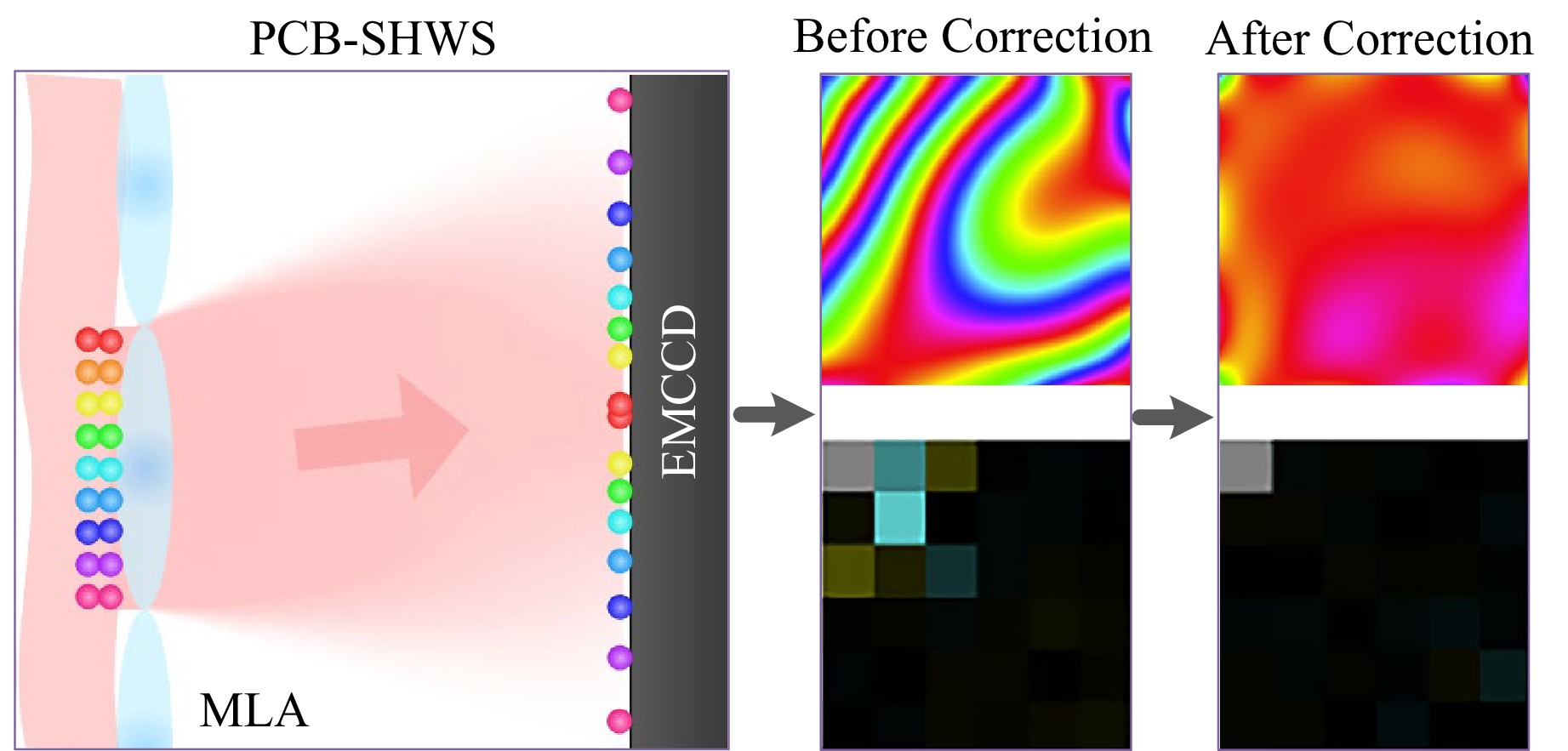
Fig. 1 Schematics of the proposed PCB-SHWS for quantum adaptive imaging. (Left) Schematic of turbulence phase measurement. Owing to phase aberrations, entangled photon pairs (represented by spheres) passing through a microlens array (MLA) exhibit centroid deviations, which are recorded by an electron-multiplying charge-coupled device (EMCCD) camera. The phase gradient is then retrieved from the recorded photon distribution. (Middle) Measured phase gradient of a plastic film. (Right) Phase aberrations induced by the film are compensated. Measured images reproduced from Ref. 24.
From biomedical microscopy to free-space quantum communication, the capability to maintain clear imaging with entangled photons in the presence of phase disturbances may accelerate the transition of quantum imaging from laboratory demonstrations to practical applications. This work illustrates a broader trend in quantum technologies: adapting classical techniques in ways that respect and leverage unique quantum resources. In the future, as researchers continue to refine tools such as the PCB-SHWS, the prospect of practical, high-resolution, and noise-resilient quantum imaging will increasingly come into focus.
Seeing clearly with entangled biphotons
- Light: Advanced Manufacturing , Article number: 5 (2025)
- Received: 28 October 2025
- Revised: 29 November 2025
- Accepted: 01 December 2025 Published online: 12 March 2026
doi: https://doi.org/10.37188/lam.2026.005
Abstract: Position-correlated biphoton Shack-Hartmann wavefront sensing is proposed and experimentally demonstrated. Based on this approach, the biphoton correlation propagating through phase turbulence can be measured and corrected, thus enabling adaptive quantum imaging against phase disturbances with only a single-shot measurement.
Rights and permissions
Open Access This article is licensed under a Creative Commons Attribution 4.0 International License, which permits use, sharing, adaptation, distribution and reproduction in any medium or format, as long as you give appropriate credit to the original author(s) and the source, provide a link to the Creative Commons license, and indicate if changes were made. The images or other third party material in this article are included in the article′s Creative Commons license, unless indicated otherwise in a credit line to the material. If material is not included in the article′s Creative Commons license and your intended use is not permitted by statutory regulation or exceeds the permitted use, you will need to obtain permission directly from the copyright holder. To view a copy of this license, visit http://creativecommons.org/licenses/by/4.0/.

 DownLoad: