




-
The human eye is a marvel of biological engineering capable of real-time visual processing with remarkable efficiency. Emulating this capability in artificial systems is the goal of neuromorphic vision (NV), which aims to embed sensory, memory, and computational functions into a single unit, thereby bypassing the energy and speed bottlenecks of traditional von Neumann architectures1–5. However, biological vision has limitations: it is largely blind to the polarization of light, a fundamental property that carries rich information about surface texture, material composition, and geometric shape6–8.
Conventional approaches to achieve polarization sensitivity involve stacking external optical components, such as polarizers and waveplates, which results in bulky and complex systems9,10. Metasurfaces have recently emerged as a promising platform for ultra-compact polarimetry11–13, as highlighted in the accompanying News and Views on chiral metasurfaces. However, they often face challenges in integration with active electronic components for on-chip sensing and computation. Thus, researchers have been on a quest for a material that intrinsically couples polarization sensitivity with active and tunable optoelectronic properties suitable for neuromorphic engineering.
In a recent paper published in Light: Science & Applications, Zhang et al. presented a compelling solution to this challenge14. They developed a high-performance polarization-sensitive NV sensor using pristine black arsenic-phosphorus (b-AsP), an anisotropic two-dimensional (2D) material. This work elegantly demonstrates how the intrinsic physical properties of a material can be harnessed to create a multifunctional device that simultaneously performs polarization sensing, synaptic emulation, and neuromorphic computation.
As illustrated in Fig. 1, the core of this innovation is a phototransistor fabricated from a high-quality b-As0.2P0.8 nanosheet. The low-symmetry puckered crystal structure of this material gives rise to strong in-plane anisotropy, implying that its electrical and optical responses differ significantly along the armchair (AC) and zigzag (ZZ) crystal directions. The authors meticulously characterised this anisotropy, showing pronounced polarization-dependent absorption and a high polarization ratio of up to 4.66 in the near-infrared communication band (1550 nm). This intrinsic property eliminates the need for external polarizers, paving the way for miniaturization.
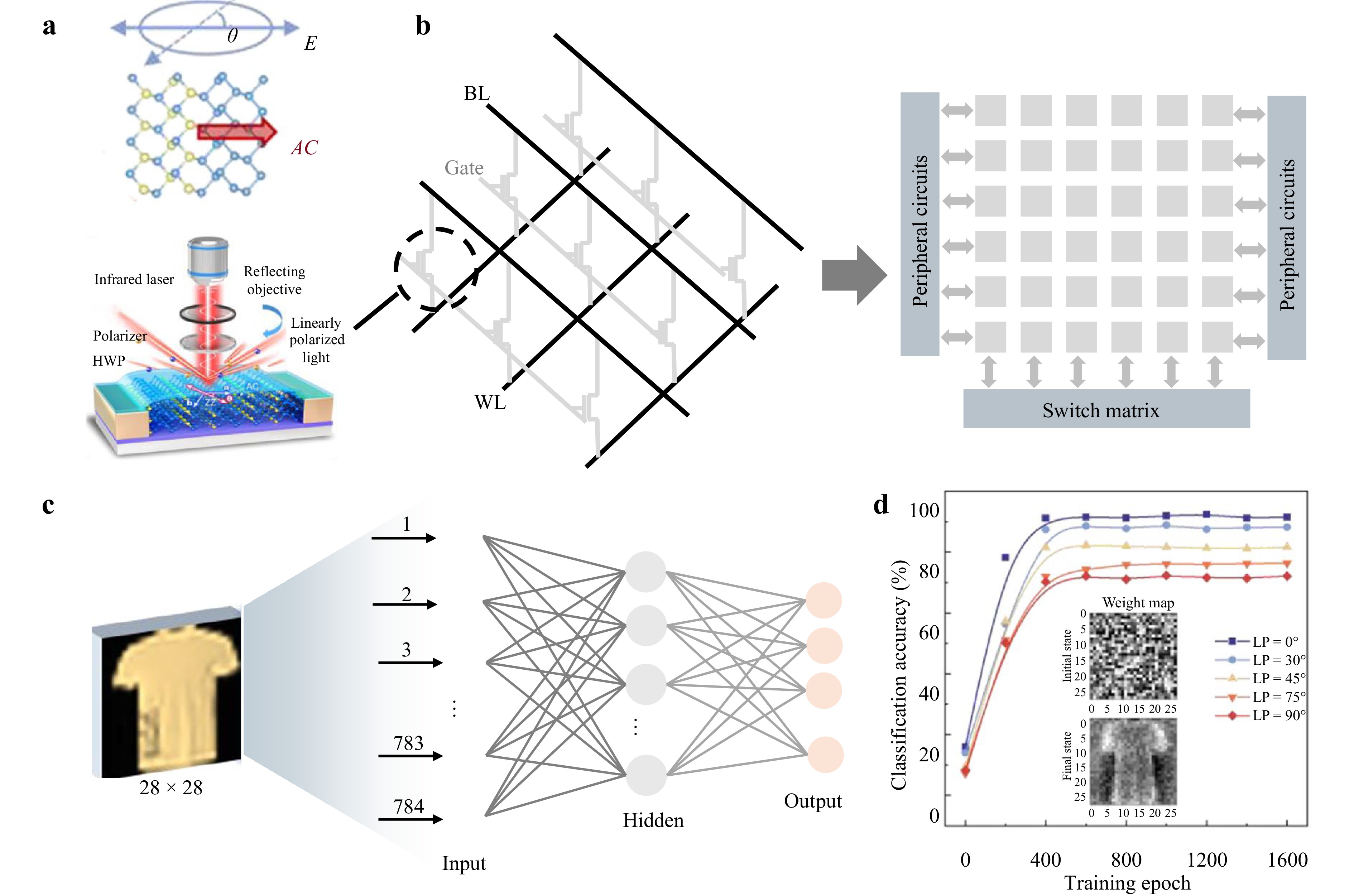
Fig. 1 Structure and neuromorphic computing applications of the b-AsP-based phototransistor. a Schematic of the polarization-sensitive black arsenic-phosphorus (b-AsP) crystal structure (top) and synaptic phototransistor device (bottom). The intrinsic in-plane anisotropy of b-AsP enables direct detection of the polarization angle of the incident light. b Illustration of a phototransistor array (left) and its integration into computing systems (right). c Architecture of the hybrid optoelectronic neural network (HOENN) used for image classification on the Fashion-MNIST dataset. d Comparison of classification accuracy achieved under different modulation strategies, highlighting the performance at an angle of linear polarization (AoLP) of 0°. (Part images are reproduced from Ref. 14).
However, a true breakthrough lies in how this anisotropy is leveraged in neuromorphic functions. The device successfully emulates key synaptic behaviours such as paired-pulse facilitation (PPF) with a high index of 201% and the transition from short-term to long-term plasticity, which is the foundation of learning and memory in biological neural networks. Crucially, the synaptic weight—the strength of the connection—can be dynamically tuned using two independent "knobs": the gate voltage and, innovatively, the polarization angle of the incident light. This multi-dimensional input control allows for a rich repertoire of adaptive behaviours in a single device or large-scale array (Fig. 1b), which is advantageous for constructing in-memory computing units with low power consumption and flexible modulation methods. Polarized pulses with different angles of linear polarization (AoLP) are employed for writing, and polarization-dependent long-term potentiation (LTP) behaviours are observed. In contrast, the device exhibits a typical long-term depression (LTD) under electric pulses. Both LTP and LTD possess multilevel intermediate states, which are critical for performing accurate weight updates on hardware computing platforms. By coupling electric pulses and polarized light inputs, the team constructed a hybrid optical-electronic neural network (HOENN) shown in Fig. 1c. Under an AoLP of 0°, this network achieved an impressive classification accuracy of over 90% on the challenging Fashion-MNIST dataset (Fig. 1d) and a reconstruction accuracy of 71.38% on the Yale Face Database, outperforming other polarization states by fully exploiting the dynamic response range of the device under optimal linear polarization.
Furthermore, the authors demonstrated practical applications of these sensors in polarization-resolved imaging. Using a raster-scanning setup, they measured photocurrent at different polarization angles and reconstructed the Stokes parameters (S0, S1, S2) and the degree of linear polarization (DoLP) of hidden objects. Their system revealed intricate structural details of a mascot hidden behind a silicon wafer, which are completely invisible to conventional intensity-based cameras. This capability is critical for applications such as anti-counterfeiting, remote sensing, and machine vision in complex lighting environments.
Zhang et al. proposed a complementary approach to metasurface-based polarimetry15. Although metasurfaces excel at front-end manipulation and analysis of light fields with high spatial resolution, the b-AsP neuromorphic sensor represents a paradigm of monolithic integration, where the sensing medium itself is computationally active. This moves beyond simple detection to in-sensor perception and preprocessing.
The road ahead is promising but requires further exploration. Scaling up from a single pixel to a high-density polarization-sensitive focal-plane array is the next critical step16. Advanced growth and fabrication techniques are required to ensure uniformity across a large array of devices17,18. Furthermore, integrating the capability to detect full-Stokes parameters, including circular polarization, possibly by incorporating quarter-wave plates on-chip, would enable the collection of even more information from a scene19,20. The interplay of advanced materials such as b-AsP, novel device architectures, and bioinspired algorithms will undoubtedly accelerate the development of autonomous systems that can see, remember, and think with an efficiency that rivals biology.
HTML
-
This work was supported by the Research Grant Council of Hong Kong S. A. R. (PolyU 15300824).

 DownLoad: