



-
Photonic crystals, characterised by their unique periodic micro- or nano-architectures, can interact with light to form photonic bandgaps, which prohibit the transmission of light in specific wavelength ranges1. When the photonic bandgap falls within the visible spectrum, photonic crystals display iridescent structural colours that are environmentally friendly2. For patterning applications using photonic crystals, the saturation and variability of colours are crucial metrics to evaluate the performance of photonic crystal materials3. In recent studies, the dynamic changes in the structural colours of photonic crystals have attracted considerable attention, with the research focus on the stability and durability of the architectures4.
Among the photonic crystal materials proposed to achieve colour changes, liquid crystals (LCs), a class of soft-matter photonic materials, offer distinct advantages5. Cholesteric liquid crystals (CLCs), which rely on the helical arrangement of LC molecules, enable wavelength-selective Bragg reflection and, exhibit vivid reflective colours and favourable polarisation-selective properties6,7. Current research efforts to achieve colour changes in LCs have extensively explored the modulation of cholesteric pitch through various external stimuli, including applied electric fields8,9, temperature10,11, light irradiation12,13, and mechanical deformation14–16.
In previous studies, the spatial patterning of polymer-stabilised LCs (PSLCs) was facilitated by inkjet printing and photo polymerisation. This approach significantly enhances the design flexibility of liquid crystal optical devices, thereby facilitating the on-demand fabrication of LC patterns with diverse colours, shapes, and functionalities17–19. Consequently, it achieves high-resolution-customisable optical effects and offers a novel fabrication strategy for high-performance liquid crystal optical devices. However, the existing functional optical devices based on CLCs require rigid glass encapsulation to maintain surface anchoring and prevent distortions caused by material fluidity, which fundamentally limits their potential for flexible photonic applications. In a recently published paper, Hu proposed a paintable soft photonic architecture using a coating techniquethat enables the fabrication of programmable patterns on various substrates20. The fundamental principles are illustrated in Fig. 1. A photonic architecture with a photo-programmable multi-stable status was constructed by painting it on a flexible substrate. The intrinsic chiral photo-switch induces a broad range of structural colour variations due to helical pitch expansion. A unique intrinsic chiral photo-switch with excellent thermo-stability was introduced into the LC to enable remarkable manipulation of the helical pitch, thereby allowing precise multi-stable modulation across a wide spectral bandwidth spanning the entire visible to near-infrared regions upon light stimulation.
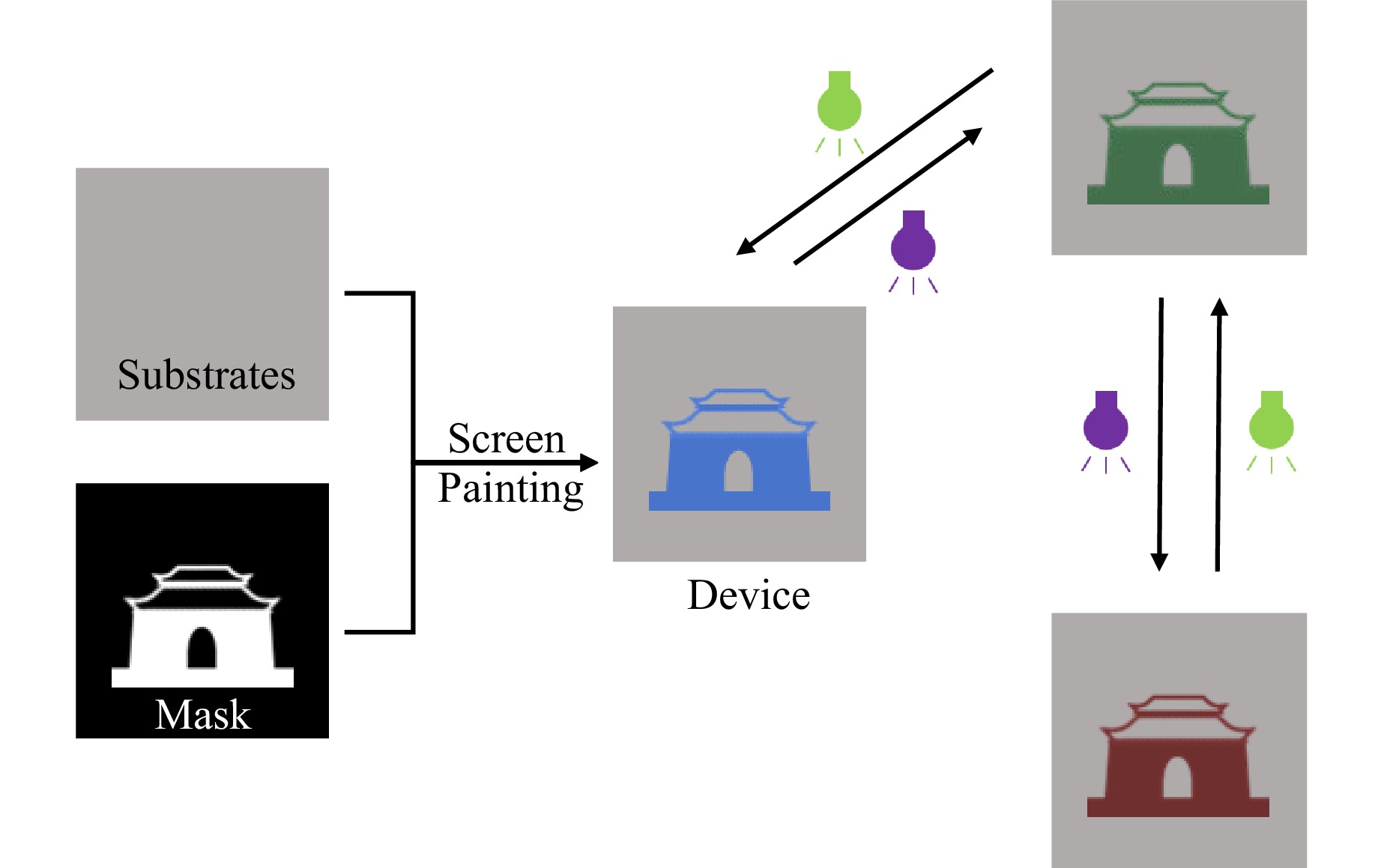
Fig. 1 Schematics of the proposed paintable soft photonic architecture. Photonic architecture with photo programmable multi-stable status constructed by painting on flexible substrate. Here, the intrinsic chiral photo-switch induces a broad range of structural colour variations due to helical pitch expansion. Measured images reproduced from Ref. 20.
Using this method, several studies on material applications such as anti-counterfeiting, information encryption, and smart windows have been conducted. This method demonstrates excellent performance in achieving precise paintability with the advantages of avoiding multicenter chirality, significant helical pitch modulation, and robust thermal stability21. With long-term switching cycles, light-actuated paintable LC photonic devices enable controlling viscosity and resolution, sustaining well-ordered photonic structures, and achieving a robust multi-stable photo-response.
Future research on soft matter photonic crystals may further focus on enhancing the stability, colour richness, and response sensitivity. These novel materials, characterised by their non-toxicity, compact size, and flexible structures, demonstrate significant application potential in areas such as flexible textiles and wearable displays22,23.
Multi-stable patterned devices enabled by soft-matter liquid crystal photonic structures
- Light: Advanced Manufacturing , Article number: 12 (2026)
- Received: 04 December 2025
- Revised: 22 December 2025
- Accepted: 22 December 2025 Published online: 30 January 2026
doi: https://doi.org/10.37188/lam.2026.012
Abstract: Patterned photonic crystals that exhibit structural colours attract considerable attention owing to their exceptional color saturation and variability. A unique paintable helical photonic architecture featuring both multi-stability and dynamic light-actuation is proposed. The method shows great potential for applications in anti-counterfeiting, information encryption, and smart windows.
Rights and permissions
Open Access This article is licensed under a Creative Commons Attribution 4.0 International License, which permits use, sharing, adaptation, distribution and reproduction in any medium or format, as long as you give appropriate credit to the original author(s) and the source, provide a link to the Creative Commons license, and indicate if changes were made. The images or other third party material in this article are included in the article′s Creative Commons license, unless indicated otherwise in a credit line to the material. If material is not included in the article′s Creative Commons license and your intended use is not permitted by statutory regulation or exceeds the permitted use, you will need to obtain permission directly from the copyright holder. To view a copy of this license, visit http://creativecommons.org/licenses/by/4.0/.

 DownLoad: