



-
Nonlinear frequency conversion is at the heart of modern photonics, enabling the creation of new colors of light, but it typically relies on bulky crystals with strict phase-matching requirements or multiple carefully synchronized laser beams1–3. Metasurfaces exploiting nonlocal resonances, particularly quasi-bound states in the continuum (q-BICs), have emerged as compelling alternatives. These engineered nanostructures provide strong local field enhancement and tunable radiative coupling, relaxing the usual constraints of traditional nonlinear optics4–8.
Bound states in the continuum are special optical modes that remain confined even at energies where light typically radiates away9–11. In real devices, imperfections or absorption turn them into quasi-bound states (q-BICs) with very high, but finite, quality factors. These high-Q modes strongly amplify the near-field intensity, greatly enhancing nonlinear interactions.
Previous studies have used q-BICs to enhance second- and third-harmonic generation and demonstrated four-wave mixing, either by coupling q-BICs with Mie resonances or by combining multiple q-BICs using complex metasurfaces that are patterned in two dimensions12–14. However, these approaches often demand sophisticated nanofabrication and rely on precise multi-beam alignment using large optical setups, limiting scalability and practicality outside specialized laboratory environments.
Advancing beyond these approaches, Franceschini et al. designed a high-contrast silicon grating metasurface coated with a thin PMMA layer. This structure simultaneously supports two distinct optical resonances: a telecom-band quasi-bound state in the continuum (q-BIC) and a nearby guided-mode resonance (GMR)15. When illuminated with a single broadband femtosecond pulse, both modes are excited at once. This naturally provides the temporal and spatial overlap that would otherwise require multiple synchronized beams. The nonlinear interaction between the two resonances drives four-wave sum mixing (FWSM), where three input photons combine to generate a higher-frequency output16. As a result, multiple visible peaks are produced from different q-BIC-GMR combinations in a single shot (Fig. 1).
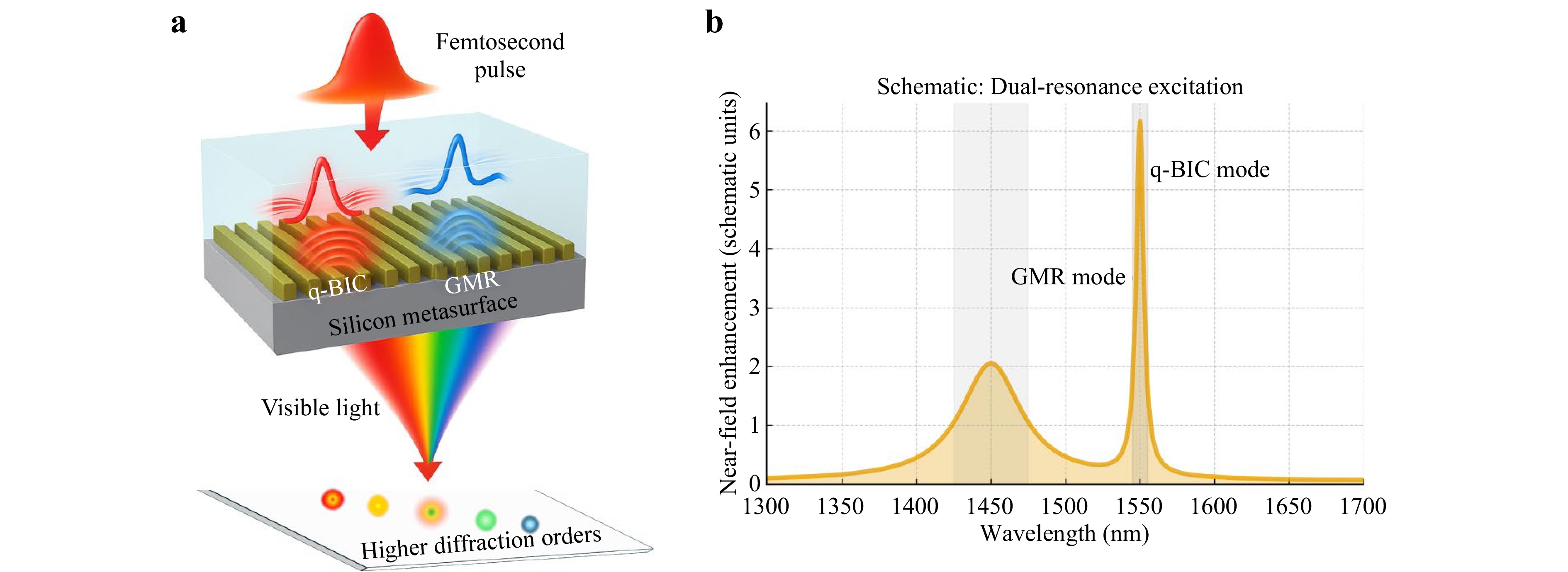
Fig. 1 a Schematic of a high-contrast amorphous-silicon grating with PMMA cladding excited by a single femtosecond pulse, simultaneously driving a q-BIC and GMR whose nonlinear coupling produces multiple signals redistributed into diffraction channels at visible wavelengths. b Spectral response showing the narrow q-BIC and broader GMR resonances whose overlap yields strong near-field enhancement for efficient intrapulse four-wave sum mixing.
Using Fourier microscopy, the authors mapped the angular and spectral distributions of the emitted signals, confirming their origin in the multimode nonlinear interaction. Third-harmonic generation measurements revealed an extraordinary five orders of magnitude enhancement at resonant wavelengths relative to unpatterned silicon, underlining the power of resonance engineering for amplifying nonlinear processes. These results show that a simple, one-dimensional metasurface can act as a compact, alignment-free platform for tunable nonlinear photonics17.
Looking ahead, the results suggest exciting opportunities for dynamically tuning this versatile platform by adjusting the grating geometry, material composition, or cladding properties to control resonance positions and output frequencies. Integration with active materials could enable electrical or thermal reconfiguration of the nonlinear response, leading to tunable nonlinear metasurfaces and compact quantum sources18–21. Furthermore, extending this strategy to other nonlinear phenomena, such as parametric amplification or stimulated Raman scattering, promises to broaden the platform’s range of applications in label-free imaging22, chemical sensing23, and optical signal processing24. The ability to harness multimode interactions on a single, planar platform could also inspire novel photonic circuit elements for ultrafast computing and chip-scale spectroscopy.
In summary, this study reveals how carefully engineered multimode metasurfaces can harness nonlocal resonances to achieve efficient, tunable nonlinear frequency conversion through a simple, alignment-free, intrinsically stable excitation scheme, raising compelling questions about how further control over multimode interactions might redefine the limits of nonlinear optics and integrated photonics.
Resonances in harmony: single-pulse multimode metasurfaces for tunable visible light
- Light: Advanced Manufacturing , Article number: 15 (2026)
- Received: 26 September 2025
- Revised: 20 December 2025
- Accepted: 29 December 2025 Published online: 11 March 2026
doi: https://doi.org/10.37188/lam.2026.015
Abstract: Nonlinear metasurfaces are transforming wavefront control at the nanoscale, offering compact platforms for efficient frequency conversion and all-optical processing. In a recent advance, Franceschini et al. demonstrated a powerful method to generate tunable visible light by exploiting nonlinear coupling between two distinct resonances in an amorphous-silicon metasurface, all driven by a single broadband femtosecond pulse.
Rights and permissions
Open Access This article is licensed under a Creative Commons Attribution 4.0 International License, which permits use, sharing, adaptation, distribution and reproduction in any medium or format, as long as you give appropriate credit to the original author(s) and the source, provide a link to the Creative Commons license, and indicate if changes were made. The images or other third party material in this article are included in the article′s Creative Commons license, unless indicated otherwise in a credit line to the material. If material is not included in the article′s Creative Commons license and your intended use is not permitted by statutory regulation or exceeds the permitted use, you will need to obtain permission directly from the copyright holder. To view a copy of this license, visit http://creativecommons.org/licenses/by/4.0/.

 DownLoad: