



-
Vertical-cavity surface-emitting lasers (VCSELs) have unique properties unattainable by other types of lasers that enable them to be used in a wide range of applications. Their surface emission enables the fabricate of large two-dimensional arrays of laser units. These arrays have been used in several fields, including consumer electronics. For example, smartphone facial recognition relies on near-infrared light emitted by VCSEL arrays1. This is possible due to the low-cost of VCSEL array fabrication and testing. They have also been used in computer mice and in data centers. The short cavity length of VCSELs ensures operation in a single longitudinal mode, but they still support multiple transverse modes when they are designed to have a large aperture to boost their output optical power. One of the key challenges still facing VCSELs that prevent their use in many applications is simultaneously achieving high optical power and single-mode operation.
Conventional VCSELs typically consist of two mirrors (distributed Bragg reflectors) and an oxide aperture that define the cavity. They operate in single mode only when the aperture diameter is below a few micrometers. This limits the achievable optical power from a single VCSEL. Using a VCSEL array is one approach to get more power, but they operate independently (the VCSELs in an array are not mutually coherent). These limitations encouraged researchers to look into unconventional methods to achieve optical feedback that does not promote multi-mode operation. This includes designs based on photonic crystals2, 3, open-Dirac singularities4, and topological insulators and cavities5–8. However, conventional semiconductor lasers are made on rigid III-V semiconductor substrates, hindering their integration in flexible devices.
In a recent article by Wang et al., a topological VCSEL with a flexible structure has been demonstrated9. They used a stack of polymerized cholesteric liquid crystal (PCLC) films and Mylar films to form an optical superlattice in one dimension, as shown in Fig. 1a. The films were on a PET flexible substrate, giving the laser a flexible structure. Each PCLC film is coated with a PM597 gain medium, which supports lasing at a wavelength of 575 nm. Lasing was achieved under pulsed optical pumping (Fig. 1b) with a threshold of 1.5 × 10⁶ W/cm2 (0.47 μJ). This approach does not require lithography. This simplifies the process significantly since other approaches typically require high-resolution lithography (e.g., e-beam lithography) given the short wavelength of optical waves. Moreover, the chirality of cholesteric liquid crystals results in circular polarization of the emitted light, a property that is not trivially achievable in conventional VCSELs. The emitted light in the demonstrated device had left-handed circular polarization.
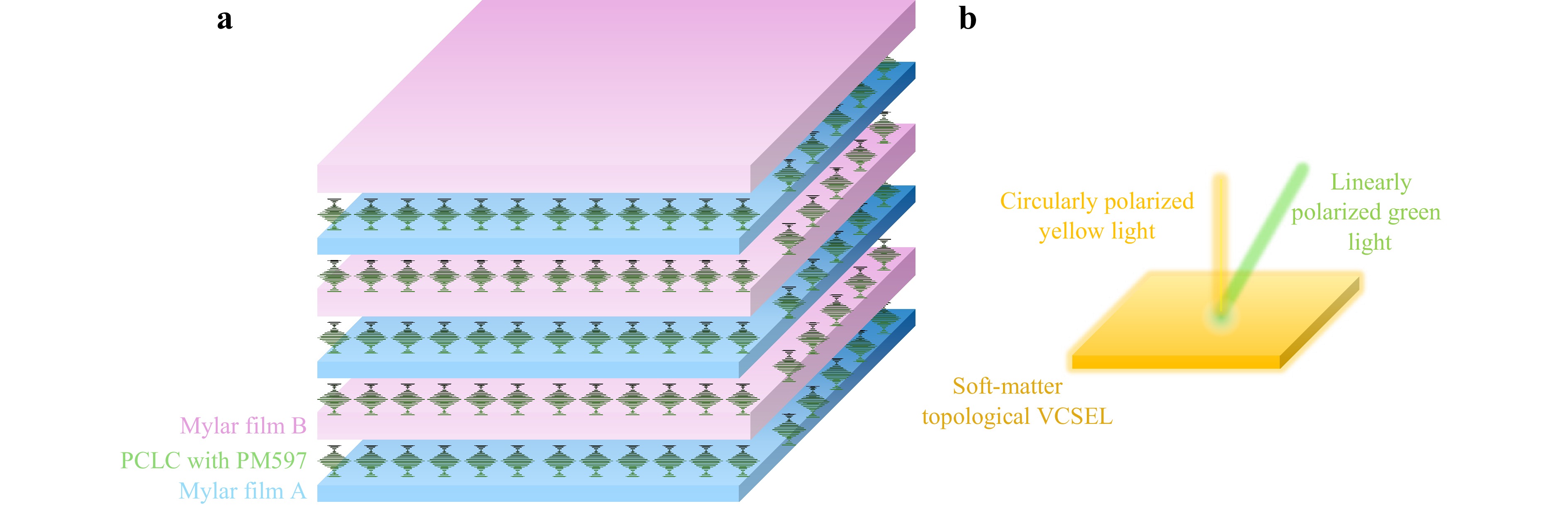
Fig. 1 a The structure of the soft-matter topological VCSEL based on PCLC and Mylar films. b The optical pumping scheme. Circularly polarized light is emitted through linearly polarized pumping9.
The unique features of this flexible topological VCSEL, including the easy manufacturing, flexibility, and circular polarization can enable new applications and open avenues for VCSELs. However, achieving continuous wave (CW) operation and improving the stability of these lasers are challenges that need to be investigated10. Furthermore, while achieving electrical injection in topological lasers and photonic-crystal lasers based on inorganic semiconductors has been demonstrated3, 11, achieving the same in lasers based on PCLC and dye gain media is not as simple. Addressing these challenges is not trivial, but it can pave the way towards low-cost, flexible VCSELs, which would allow for their use in several emerging applications in consumer electronics.
Flexible topological vertical-cavity surface-emitting laser
- Light: Advanced Manufacturing , Article number: 16 (2026)
- Received: 29 September 2025
- Revised: 22 December 2025
- Accepted: 30 December 2025 Published online: 09 March 2026
doi: https://doi.org/10.37188/lam.2026.016
Abstract: A new soft-matter vertical-cavity surface-emitting laser (VCSEL) based on stacked Mylar films and polymerized cholesteric liquid crystal films holds great potential for fabricating flexible lasers, which is sought after in many emerging applications.
Rights and permissions
Open Access This article is licensed under a Creative Commons Attribution 4.0 International License, which permits use, sharing, adaptation, distribution and reproduction in any medium or format, as long as you give appropriate credit to the original author(s) and the source, provide a link to the Creative Commons license, and indicate if changes were made. The images or other third party material in this article are included in the article′s Creative Commons license, unless indicated otherwise in a credit line to the material. If material is not included in the article′s Creative Commons license and your intended use is not permitted by statutory regulation or exceeds the permitted use, you will need to obtain permission directly from the copyright holder. To view a copy of this license, visit http://creativecommons.org/licenses/by/4.0/.

 DownLoad: