






-
In the field of nanophotonics1-3, metasurfaces, consisting of arrays of subwavelength structures known as meta-atoms, have been extensively researched for their revolutionary ability to precisely manipulate wavefronts and control the properties of light such as amplitude, phase, orbital angular momentum, and polarization4-12. These metasurfaces have demonstrated significant potential to enable a wide range of practical applications, including metalenses13-16, beam-steering17,18, cloaking devices19,20, solid-state light detection and ranging (LiDAR) system21,22, and optical encryption devices23-25.
One particularly exciting application of metasurfaces is meta-holography. By accurately controlling the spatial amplitude and phase of light, metasurfaces can be designed to reconstruct holographic images, surpassing bulky optical devices such as spatial light modulators with their compact and efficient design26-28. For instance, Kim et al.29 present meta-holograms based on a titanium dioxide nanoparticle-embedded-resin, achieving a high hologram efficiency of 82%. Various advanced directions in meta-holography have been explored, for example, vectorial holography based on spin-orbit locking, enabling multi-channel holographic image reconstruction30, and real-momentum dual-functional devices based on topological photonic crystals that exploit engineered disorder to encode real-space holographic images while simultaneously preserving momentum-space vortex beams31. Moreover, Asad et al.32 demonstrate a wide-angled chiral metasurface capable of spin- and wavelength-multiplexed holography in the ultraviolet and visible region, achieving a maximum hologram efficiency of 70% in the ultraviolet and 50% in the visible range. However, most meta-holograms based solely on phase modulation face limitations under typical lighting conditions. They often produce trivial reflective images or display featureless, random patterns due to their lack of control over spectral responses29,33,34.
Another notable application of metasurfaces is color printing, where spectral responses of metasurfaces are manipulated to generate high-resolution color displays35,36. Significant progress has been achieved in metasurfaces-based color printing including polarization-multiplexed color printing37, dynamic color display38, and polarization-encoded color image39. For instance, Badloe et al.40 demonstrate electrically tunable structural color prints by integrating Mie-resonant metasurfaces with liquid crystal modulation, enabling photorealistic color gradients and dark blacks for dynamic reflective display and security applications. However, due to the absence of encoded phase information, most color-printing metasurfaces are incapable of reconstructing holographic images.
Some recent works, however, have addressed this limitation by simultaneously controlling both phase and spectral responses, enabling metasurfaces to function dually in color printing and holography41-46. By integrating the dual functionalities of holography and structural color prints, metasurfaces can achieve advanced optical devices capable of encoding a significantly greater amount of information and providing stronger encryption for security measures into a single device compared to conventional methods. For instance, Yoon et al.43 introduce crypto display metasurfaces capable of generating reflective color printing under white light illumination while reconstructing a holographic image when illuminated with coherent light. Their devices display two reflective colors along with a holographic image; however, the hologram reconstruction efficiency is limited to around 10%, and does not exhibit broadband operation. Similarly, another study47 demonstrates metasurfaces capable of displaying three reflective colors, but with hologram efficiency below 5%, further restricting practical applications. Moreover, Wei et al.44 propose a transmissive metasurface design that displays two distinct color prints along with two holographic images. Yet, this approach also suffers from relatively low conversion efficiency, limiting the effectiveness of the holographic output. While a few studies48,49 have demonstrated single-cell metasurfaces that combine color printing and holography, they typically exhibit hologram efficiency below 10%, which remains a major limitation for real-world implementation. Furthermore, Khaleghi et al.50 propose a transmissive hybrid plasmonic-dielectric metasurface that combines color printing and holography, but the two functions are implemented in different material layers, and the study is limited to simulations without experimental realization.
Here, we propose dual-functional metasurfaces that integrate color printing mode and holography mode multiplexing on a single layer dielectric metasurface that provides three distinct printing colors, which are green, brown, and magenta as well as achieves high conversion efficiency to maximize holographic image quality. By using three distinct meta-atoms based on Pancharatnam-Berry (PB) or so-called geometric phase, we can simultaneously modulate both reflectance spectra under white light illumination and spatial phase distribution of single wavelength coherent light. The schematic representation of the dual-functional metasurfaces is illustrated in Fig. 1a. We employ single and double nanorods as our meta-atoms, which spectral response and conversion efficiency can be tuned by adjusting the size of the nanorods, while phase distribution is controlled by varying their orientation. The nanorods are designed to achieve high conversion efficiency at the target wavelength of 640 nm, while also exhibiting unique reflectance spectra for a variety of reflective colors. Moreover, numerical simulations show that among the designed meta-atoms, the highest-performing one achieves a conversion efficiency of up to 90% at the target wavelength. The fabricated samples successfully demonstrate three distinct reflective colors under white light and high-efficiency holography under coherent light. The designed metasurfaces also exhibit broadband characteristics for holography, operating across a broad range of the visible spectrum. By enabling three reflective colors with broadband holographic capability, this dual-functional metasurface enhances information capacity and offers greater flexibility for data encryption. Moreover, high hologram efficiency enables bright, high-contrast image reconstruction even under low-intensity illumination, reducing power requirements and enhancing usability under limited or low-light conditions without sacrificing image quality. These advantages make the proposed metasurfaces a promising platform for applications requiring advanced data security, such as anti-counterfeiting, authentication, and encrypted data storage.
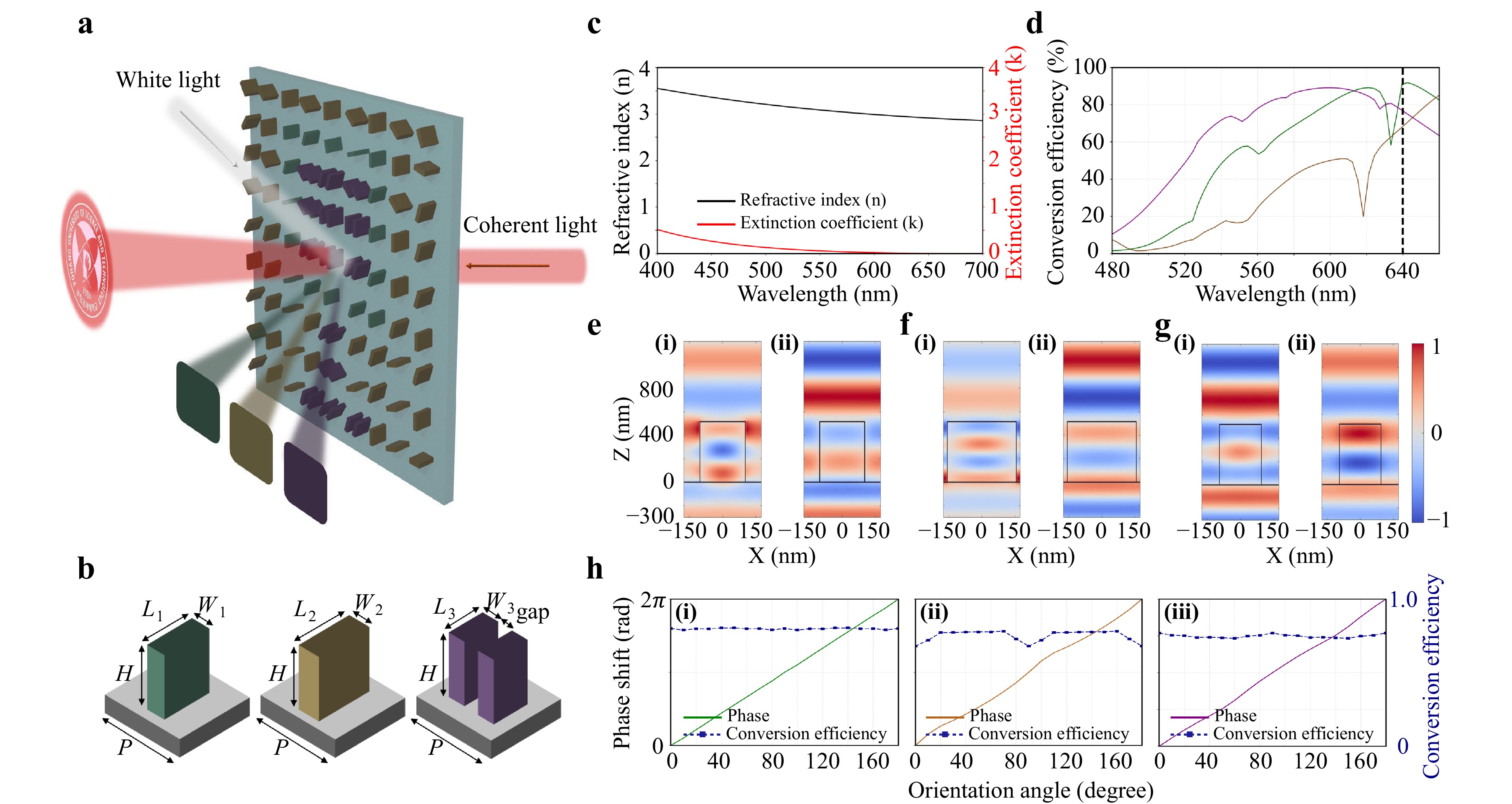
Fig. 1 Design and optical performance of the dual-functional metasurface. a Schematic illustration of the metasurface functionality, showing reflective color generation under white light and holographic image reconstruction under coherent light illumination. b Structural designs of the three meta-atoms, meta-atoms 1, 2, and 3, corresponding to green, brown, and magenta reflective colors, respectively. c Refractive index (n, black) and extinction coefficient (k, red) of hydrogenated amorphous silicon (a-Si:H). d Conversion efficiency of meta-atom 1 (green), meta-atom 2 (brown), and meta-atom 3 (magenta) across the visible wavelength range. e-g Electric field distributions in the xz-plane for meta-atoms 1, 2, and 3, respectively, under (i) x-polarized and (ii) y-polarized illumination. h Simulated phase shift (solid line) and conversion efficiency (dashed line) as functions of the meta-atom orientation angle for meta-atoms (i) 1, (ii) 2, and (iii) 3.
-
In order to achieve a dual-functional capability, every unit cell of the metasurface must satisfy two key requirements. First, their conversion efficiency must be high at the target wavelength (640 nm) to maximize the performance of the holography mode. Second, their spectral responses must be sufficiently distinct to produce different reflective colors. Since the total energy is conserved between reflection and transmission, there naturally exists a trade-off in their efficiencies. In our design, we aim to balance these two aspects by ensuring sufficiently high reflection contrast for color printing while maintaining high conversion efficiency in the transmission channel to support holography. To meet these conditions, anisotropic nanostructures are employed with circularly polarized illumination, enabling PB phase modulation while maintaining identical spectral responses. Phase modulation can be achieved by adjusting the azimuthal angles of the meta-atoms, while their spectral responses can be independently tuned by altering their size, ensuring no mutual interference. We utilize both single and double nanorod designs as our meta-atoms to expand the range of spectral responses, thereby offering a wider selection of colors. Additionally, the single nanorod design allows higher fabrication accuracy by accommodating larger dimensions for the structure.
This work utilizes three types of meta-atoms, referred to as meta-atom 1, meta-atom 2, and meta-atom 3, corresponding to the reflective colors green, brown, and magenta, respectively, as illustrated in Fig. 1b. By adjusting key geometric parameters such as periodicity (P), height (H), length (L), and width (W) of the nanostructures, we optimize their design to achieve high conversion efficiency at 640 nm wavelength and distinct reflectance spectra across all meta-atoms. The optical responses are obtained by using rigorous coupled wave analysis (RCWA) simulations. Meta-atoms 1 and 2 are based on a single nanorod structure, while meta-atom 3 adopts a double nanorod configuration to realize the desired optical response. Every meta-atom has the same P of 350 nm and H of 515 nm, while other structural parameters are different with L1 = 205 nm, W1 = 95 nm, L2 = 315 nm, W2 = 100 nm, L3 = 190 nm, and W3 = 80 nm with a 100 nm gap between the rods. Supplementary Note 1 presents conversion efficiency maps at the target wavelength as a function of L and W. The effect of gap size on the spectral response and conversion efficiency is further investigated in Supplementary Note 2. The values of P and H are selected after sweeping a range of parameters to identify a configuration that performs well for both single and double nanorod. The meta-atoms are made of hydrogenated amorphous silicon (a-Si:H) deposited on a glass substrate. While normal amorphous silicon exhibits high refractive index in the visible wavelength range, its strong optical loss limits diffraction efficiency43. In contrast, a-Si:H incorporates hydrogen to reduce the defect density typically found in amorphous silicon, thereby enhancing its optical properties for visible metasurfaces by lowering optical losses at visible wavelengths51. The optical properties of a-Si:H used in this study are shown in Fig. 1c. The conversion efficiency represents how effectively the incoming right-handed circularly polarized (RCP) light is converted into outgoing left-handed circularly polarized (LCP) light. The outgoing LCP component carries the desired phase information encoded on the metasurface, while the transmitted RCP does not. Therefore, the conversion efficiency is directly linked to the hologram efficiency of the metasurface. Fig. 1d presents the simulated conversion efficiency of meta-atoms 1, 2, and 3 across the visible wavelength range from 480 to 660 nm. A vertical dashed line at 640 nm marks the target wavelength. All three designs exhibit increasing conversion efficiency as the wavelength approaches 640 nm. Meta-atoms 1 and 2 reach conversion efficiencies of 91% and 68% at 640 nm, respectively. Meta-atom 3 achieves 77% at the target wavelength and maintains a broader high-efficiency bandwidth across the visible spectrum. These results confirm that all three meta-atoms are well-optimized for strong polarization conversion at the operating wavelength.
Moreover, to demonstrate that all the meta-atoms behave as half-wave plates, effectively converting incident RCP light into outgoing LCP, we confirm their functionality through finite-difference time-domain (FDTD) simulations at the target wavelength of 640 nm. These simulations evaluate the electric field (E-field) distribution in the xz-plane under both (i) x-polarized and (ii) y-polarized incident light for each meta-atom, as shown in Fig. 1e-g, corresponding to meta-atoms 1, 2, and 3, respectively. The results show a consistent π phase difference between the two polarization states across all designs, confirming that the meta-atoms effectively function as half-wave plates. Moreover, to verify the phase modulation behavior of the meta-atoms based on PB phase principle, we perform RCWA simulations to calculate the phase shift and conversion efficiency as functions of the meta-atom orientation angle at the operating wavelength of 640 nm. As presented in Fig. 1h, all three meta-atom designs (i) 1, (ii) 2, and (iii) 3 exhibit a continuous phase shift covering the full 0–2π range as their orientation angle varies from 0° to 180°. Importantly, the conversion efficiency remains consistently high across all angles, indicating that phase modulation is governed solely by the geometric phase term Φ = 2σφ, where φ is the in-plane rotation angle and σ denotes the helicity of incident circularly polarized light. These results confirm that the meta-atoms provide independent phase control while maintaining high polarization conversion efficiency, which is essential for integrating both holography and color printing functionalities into a single metasurface.
To achieve three distinct color outputs under white light illumination, the meta-atoms are designed to exhibit unique reflectance spectra across the visible range. These spectral responses are calculated using RCWA, and the corresponding structural colors are obtained by performing spectral-to-color conversion over the visible wavelength range of 400–700 nm, based on the simulated reflectance spectra and the CIE 1931 standard observer functions. The spectra-to-color conversion routine is detailed in Supplementary Note 3. Again, to meet the dual requirements of high conversion efficiency at 640 nm and distinct color generation, we employ two types of nanorod configurations. This strategy expands the accessible color space, allowing for more flexible and effective meta-atom selection. The simulated color space resulting from these configurations is presented in Supplementary Note 4. Fig. 2a presents the simulated reflectance spectra of the selected meta-atoms 1, 2, and 3, along with their corresponding colors. Meta-atoms 1, 2, and 3 correspond to green, brown, and magenta, respectively. These colors are specifically adopted because their spectral responses are sufficiently distinct, ensuring clearly distinguishable reflective colors, while also maintaining high conversion efficiency at 640 nm, which is critical for the holography mode. We note that although green, brown, and magenta are demonstrated here, the color scheme can be extended to primary RGB (red, green, and blue) or other choices by tailoring the nanostructure geometries or employing alternative material platforms47,48. Then, we fabricate each metasurface based on the corresponding meta-atom designs. After fabrication of the metasurfaces, we measure the reflectance spectra of each sample using Fourier-transform infrared (FT-IR) spectroscopy. The measured spectra are then converted into colors using the same spectral-to-color conversion procedure. As shown in Fig. 2b, both the simulated (circles) and experimentally measured (stars) chromaticity coordinates are plotted on the CIE 1931 diagram. The differences between the simulated and measured colors are primarily attributed to fabrication-induced variations in meta-atom structural parameters. Process fluctuations during electron beam lithography, development, and etching lead to slight inconsistencies in meta-atom dimensions, even within the same metasurface.
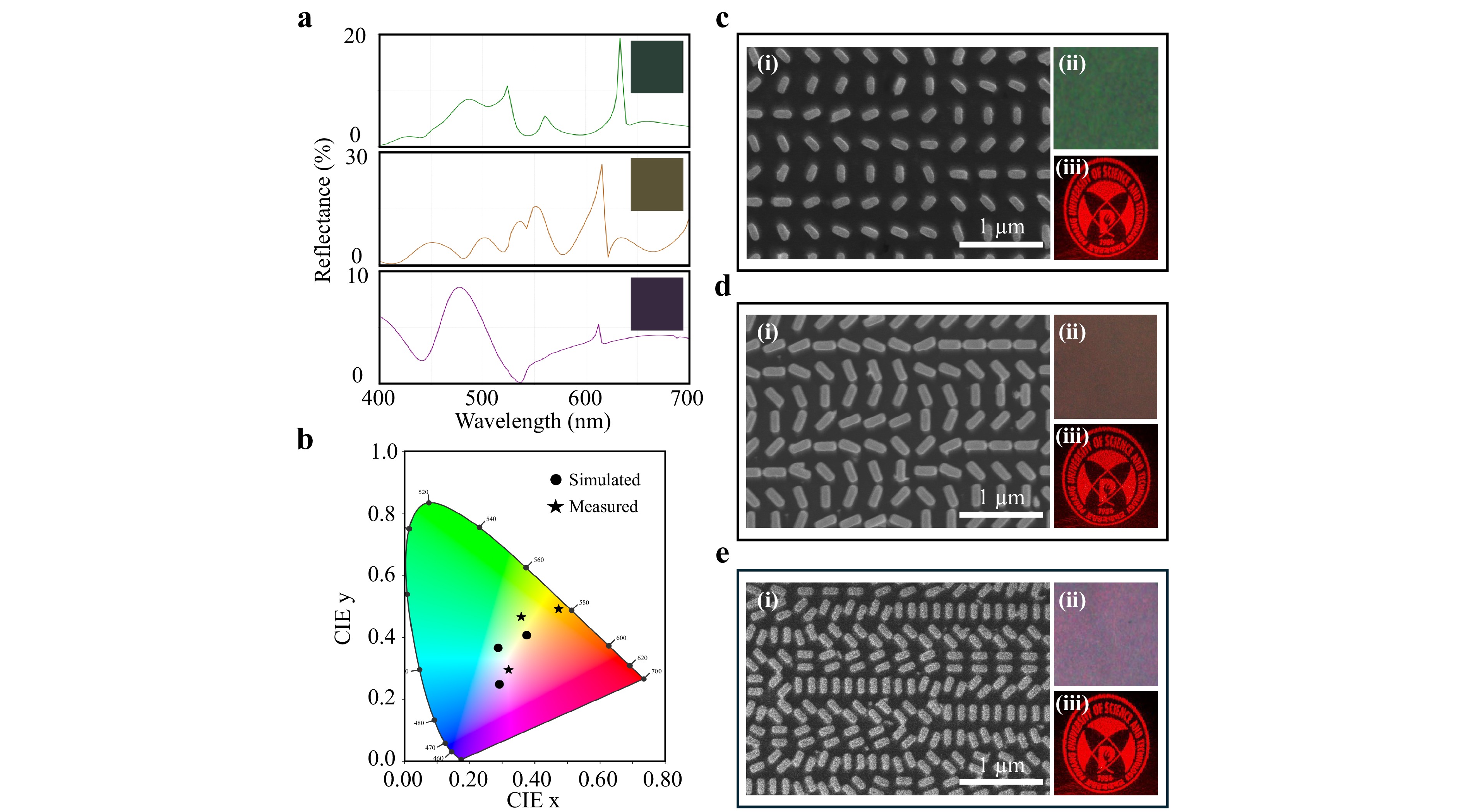
Fig. 2 a Simulated reflectance spectra of meta-atom 1 (top), meta-atom 2 (middle), and meta-atom 3 (bottom). The insets show the resulting structural colors under white light illumination, green, brown, and magenta, respectively. b CIE 1931 chromaticity diagram showing the simulated (circles) and measured (stars) color coordinates for each meta-atom. c-e (i) Scanning electron microscope (SEM) images of the fabricated metasurfaces; (ii) Corresponding optical microscope images showing the structural colors under white light illumination; and (iii) Holographic image reconstructions of the university logo under red laser illumination. The scale bars in the SEM images represent 1 µm.
For the holography mode, we use computer-generated phase-only Fourier holography to encode the holographic image onto the metasurfaces. We design the target holography image of 1,200 × 1,200 pixels of our university logo and encode it using the Gerchberg-Saxton (GS) algorithm (see Supplementary Note 5). The GS algorithm iterates for a thousand iterations to retrieve the simulated holography image. Then, the continuous phase distribution obtained from the algorithm is transformed into a discrete phase distribution by dividing the 0 to 2π phase range into eight equal steps. Next, the meta-atoms are oriented according to the obtained phase distribution. We note that the orientation of the meta-atoms does not have any effect on their spectral responses. Moreover, to mitigate the impact of the zeroth-order beam (ZOB), we implement an off-axis configuration for the designed target holographic image. The ZOB occurs because the conversion efficiency of metasurface is not perfect, meaning that part of incident light remains in the co-polarized state and propagates as undiffracted light, which appears as a bright spot at the center of the Fourier plane. If the hologram's image pixel matches that of the metasurface, the ZOB would appear at the center of the generated holographic image, compromising the image fidelity. The illustration of this overlap is presented in Fig. S5b, Supplementary Note 6. To address this, we reduce the size of the target holographic image and shift it upward, effectively avoiding interference from the ZOB (Fig. S5d, Supplementary Note 6).
Fig. 2c-e showcase the performance of the fabricated dual-mode metasurfaces corresponding to the three meta-atom designs. The size of the metasurfaces is 420 × 420 µm, containing 1,200 × 1,200 pixels for all the samples. Fig. 2c-e correspond to three distinct metasurface designs, with each panel displaying (i) a scanning electron microscope (SEM) image, (ii) an optical microscope image captured under unpolarized white light illumination from a light-emitting diode (LED) representing the color printing mode, and (iii) a holographic image projected under coherent light illumination representing the holography functionality. To obtain the microscopic images, a charge-coupled device (CCD) camera is connected to the eyepiece of the optical microscope. These results show that, despite minor fabrication imperfections, the observed structural colors remain in good agreement with the simulated results. For the holography demonstration, we employ a supercontinuum laser source spanning 400–2,000 nm, combined with a tunable bandpass filter to select specific wavelengths. The metasurfaces are illuminated at 640 nm to reconstruct the encoded holographic image. The generated holographic images are captured as photographs of the projections on a screen. See Supplementary Note 7 for a schematic of the optical experiment set up used to reconstruct a holographic image. It is worth noting that additional polarization optics, such as a second set of quarter-wave plate and linear polarizer, can be employed after the light passes through the metasurface to suppress the co-polarized zero-order component, as demonstrated in previous work32, where both the co- and cross-polarized beams propagate along the same optical axis. However, such a configuration increases optical complexity, making the system bulkier, harder to align, and requiring simultaneous control of both the input and output polarization components to maintain proper polarization filtering. It also poses challenges for integration and miniaturization. In contrast, our off-axis design diffracts the cross-polarized holographic beam upward at an oblique angle, resulting in spatial separation from the zero-order beam. This eliminates the need for extra polarization analyzers, enabling a simpler and more efficient optical setup. To further investigate the effect of incident polarization on hologram reconstruction of our metasurfaces, we conduct additional hologram experiments using RCP, LCP, and LP illumination at the same wavelength. As presented in Fig. S7, the metasurface reconstructs a high-quality holographic image under the designed RCP illumination. When illuminated with LCP light, a similar holographic image appears at a centrosymmetric position due to the geometric phase response of the metasurface. Under LP illumination, which can be decomposed into a superposition of RCP and LCP components, both holographic images appear simultaneously on the screen as symmetric duplicates. These results show that our metasurfaces produce high-quality holographic images under all three polarization states. Importantly, despite the differences in structural color and meta-atom dimensions across the three metasurfaces, the reconstructed holographic images remain nearly identical. This highlights the independent operation of the two functional modes of our devices.
To demonstrate the enhanced information capacity and cryptographic flexibility of our platform, we integrate all three meta-atom designs onto a single metasurface. We design a target image of flowers composed of three distinct colors, as shown in Fig. 3a, where the leaves are assigned to appear green, the background is designated as brown, and the flower center and stem (body) are rendered in magenta. These green, brown, and magenta colors correspond to the measured structural colors of meta-atoms 1, 2, and 3, respectively. To realize this image, we assign each pixel a meta-atom corresponding to its target color. The zoom-in regions highlight areas where different meta-atoms are spatially distributed according to the target colors. For example, the green leaf region is composed of meta-atom 1, while the adjacent magenta region at the center of the flower is realized by meta-atom 3. Similarly, the stem (body) and the adjacent background are assigned with meta-atoms 3 and 2, respectively. This spatial distribution of multiple meta-atoms demonstrates the ability to display multiple colors within a single metasurface. The simulated reflectance spectra shown in Fig. 2a assumes an ideal metasurface modeled as an infinite array using periodic boundary conditions. However, in practice, finite-sized metasurfaces exhibit slight deviations in reflectance spectra, especially when multiple types of meta-atoms are integrated onto the same surface, which limits the array size of each design and leads to subtle variations in the resulting structural colors. To investigate this effect, we perform FDTD simulations by applying perfectly matched layer (PML) boundary conditions along the X and Y axes instead of periodic boundaries. The z-direction boundaries are also set to PML to capture the reflected fields, with the light source incident along the Z axis (Fig. 3b(i)). Then, we simulate finite arrays of meta-atoms, represented by dimensions Nx × Ny, where Nx and Ny denote the numbers of meta-atoms along x and y directions along metasurface, respectively, to investigate how array size influences the resulting structural colors (Fig. 3b(ii)). Specifically, we consider square arrays with Nx = Ny = 2, 4, 8, 16, 32, 64, and infinity to evaluate the effect of increasing metasurface size. Fig. 3c(i-iii) presents the structural colors resulting from different array sizes (Nx × Ny) for meta-atoms 1, 2, and 3, respectively. We note that the colors obtained under infinite periodic boundary conditions in the FDTD simulations show good agreement with the results from RCWA simulations, validating the consistency between the two computational approaches. Moreover, the structural colors are observed to gradually converge as the number of meta-atoms increases for all three designs. Notably, meta-atoms 2 and 3 begin to exhibit distinguishable colors even in relatively small arrays of 4 × 4. Meta-atom 2 produces a recognizable brown hue from 4 × 4 onward and continues to display vivid colors throughout the simulation as the array size increases despite minor variations in hue. Similarly, meta-atom 3 begins to display a dark magenta color at 4 × 4, with a slight bluish tone. In contrast, meta-atom 1, which is designed to produce green, requires a larger array size for accurate color formation, however, it starts to show dark green color at the 64 × 64 arrays. We note that when different types of meta-atoms are integrated in close proximity, the perceived structural colors can be affected by the relative array size ratio of each meta-atom type, as demonstrated in the previous study40. However, in this work, we use sufficiently large arrays of each meta-atom type, so the perceived colors remain unchanged.
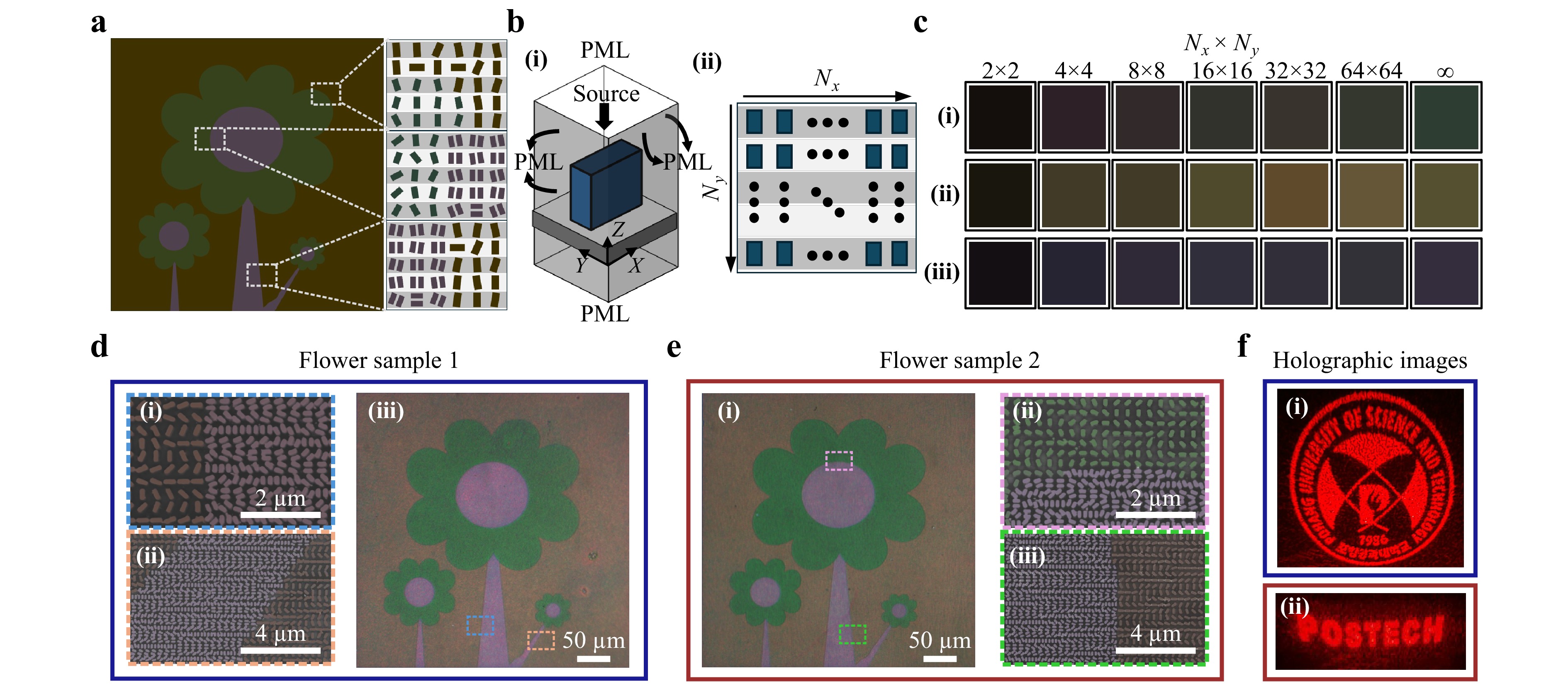
Fig. 3 a Target flower image composed of three colors based on the measured colors of the meta-atoms: green for leaves, brown for background, and magenta for the flower center and stem (body). The right panels show a zoom-in view of the pixel-level meta-atom assignments in the different regions. b FDTD simulation setup for finite metasurface arrays: (i) 3D schematic showing perfectly matched layer (PML) boundary conditions in all directions and a normally incident light source along the -z axis; (ii) Schematic of finite arrays with varying numbers of meta-atoms Nx × Ny. c Simulated structural colors for different array sizes ranging from 2 × 2 to infinity, with rows (i)-(iii) corresponding to meta-atoms 1, 2, and 3, respectively. d Optical and SEM characterization of Flower Sample 1: (i, ii) SEM images of different selected regions showing spatially assigned meta-atoms; (iii) Optical microscope image of the printed color pattern. e Optical and SEM characterization of Flower Sample 2: (i) Optical microscope image of the printed color pattern; (ii, iii) SEM images of different selected regions showing spatially assigned meta-atoms. f Holographic images reconstructed under 640 nm coherent illumination: (i) POSTECH university logo from Flower Sample 1, and (ii) “POSTECH” text from Flower Sample 2. Scale bars: 2 µm and 4 µm for SEM images, 50 µm for optical microscope images.
We fabricate two flower samples by assigning meta-atoms to each pixel according to the target color image. Both samples are designed to produce the same structural color print, while their holographic targets are encoded differently to demonstrate the independent control of the dual modes. Fig. 3d, e highlight the color printing capabilities of the designed metasurfaces, with zoomed-in SEM images from different regions revealing the spatial distribution of distinct meta-atoms corresponding to the target colors. For instance, Fig. 3d(ii) illustrates the spatial transition between two different meta-atom designs, providing a zoomed-in SEM view of the lower stem region, showing the transition between meta-atom 2 (brown) and meta-atom 3 (magenta). The structural colors observed in the optical images match well with the designed target colors in each part of the flower. Moreover, the overall flower patterns in both samples appear nearly identical in color and layout, despite being encoded with different holographic phase profiles. For the holography, Flower Sample 1 is encoded with the POSTECH university logo, while Flower Sample 2 is encoded with the text “POSTECH”. When illuminated with a single-wavelength coherent light at 640 nm using the same supercontinuum laser, the resulting holographic images projected onto a screen are captured and shown in Fig. 3f: (i) corresponds to Flower Sample 1, and (ii) to Flower Sample 2. These results demonstrate that identical structural color prints can be combined with distinct holographic images, highlighting the dual-mode functionality of the metasurface platform.
To demonstrate the broadband characteristics of our metasurfaces, we perform hologram experiments for Flower Sample 1 and Flower Sample 2 across the visible spectrum using the same supercontinuum laser source. The output wavelength is tuned from 480 nm to 640 nm in 20 nm increments using a tunable bandpass filter. The resulting holographic images are shown in Fig. 4a for Flower Sample 1 and in Fig. 4b for Flower Sample 2. These results confirm the broadband performance of both metasurfaces across the visible range. We also measure the hologram efficiency to investigate the performance differences among the various metasurface samples. Hologram efficiency is defined as the ratio of the optical power contained in the reconstructed holographic image to the total incident optical power. Fig. 4c(i) shows the measured hologram efficiency of individual metasurface samples, samples 1, 2 and 3, each composed of a uniform array of meta-atoms 1, 2, and 3, respectively. Hologram efficiency of all samples increases with wavelength, gradually rise across the visible range, with the highest efficiency reaching up to over 30% at the target wavelength (640 nm). In PB phase metasurfaces, this efficiency is strongly correlated with the meta-atom conversion efficiency, as the holographic image is formed by the transmitted cross-polarized light. The measured efficiency trends for each sample closely follow the corresponding meta-atom conversion efficiency curves, all showing a gradual increase with wavelength. Notably, the difference between the simulated and measured efficiencies may arise from residual zeroth-order power. Incomplete polarization conversion leaves a co-polarized component that propagates undiffracted into the zeroth order, which does not carry the designed phase and therefore reduces the fraction of incident power directed into the holographic image. In addition, fabrication imperfections, alignment errors, and wavelength fluctuations can further enhance the relative intensity of the zeroth-order component. To minimize this effect, one can enhance the conversion efficiency of the meta-atom by carefully optimizing the nanostructure geometry and employing improved material design29. Tighter fabrication tolerances can also ensure that the fabricated meta-atoms perform closer to the ideal design, thereby further suppressing residual zeroth-order power. In addition, we benchmark our performance against recent works on dual-functional metasurfaces, which are indicated in Fig. 4c(ii) as colored star markers. We note that a single reference may correspond to multiple markers, each indicating hologram efficiency at a specific wavelength. The results demonstrate that our samples exhibit competitive or superior broadband performance compared to other works, particularly near the target wavelength, further validating the effectiveness of our designs.

Fig. 4 a Broadband holographic images reconstructed from Flower Sample 1, illuminated with a supercontinuum laser tuned from 480 nm to 640 nm in 20 nm steps. b Broadband holographic images reconstructed from Flower Sample 2 under identical illumination conditions. c Measured hologram efficiency across the visible spectrum. (i) Hologram efficiency of individual meta-atom samples, samples 1, 2, and 3, each corresponding to meta-atom 1, 2, and 3, respectively. (ii) Hologram efficiency of Flower Sample 1 and Flower Sample 2 plotted alongside representative data from recent dual-mode metasurface studies for comparison.
-
In conclusion, we propose dual-functional metasurfaces that simultaneously produce three vivid structural color prints under white light illumination and enable high efficiency holography under single wavelength coherent light within a single optical platform. The metasurfaces consist of three types of meta-atoms based on single and double nanorods. Each meta-atom is designed to exhibit a distinct spectral response corresponding to a specific color while maintaining high conversion efficiency for holographic functionality. Meta-atoms 1, 2, and 3 generate green, brown, and magenta colors, respectively, and each demonstrate high conversion efficiency, reaching up to 90% at the target wavelength of 640 nm. GS algorithm is used to encode phase information for holography to assign the orientation of each meta-atom. Then, we demonstrate spatial integration of these meta-atoms by fabricating a metasurface that displays a multicolor pattern, along with an encoded holographic image. The color prints correspond well to the designed colors, while the holograms vary according to the encoded phase design, highlighting the independence of the two functionalities. The devices also show broadband performance, reconstructing holograms across the visible spectrum. Notably, we compare hologram efficiency of our dual-functional devices with recent works, showing that our designs achieve comparable or superior broadband performance, particularly near the target wavelength. Importantly, higher hologram efficiency contributes to better image contrast and brightness while reducing the required source intensity and overall power consumption. This makes the devices more energy-efficient and practical for real-world deployment. This work presents a compact and versatile platform that combines visual aesthetics with information encoding, offering strong potential for advanced applications in data encryption, secure authentication, anti-counterfeiting, and multifunctional display technologies. Future work could explore the use of inverse design strategies based on deep learning52 or advanced optimization methods8 to enable the automated discovery of meta-atom configurations capable of generating on-demand colors with high accuracy.
-
Reflectance spectra of the fabricated metasurfaces are measured by FT-IR, and the microscopic images are captured by a CCD with a white LED. To reconstruct the holographic images, we set up an optical system using a supercontinuum laser (SuperK FIANIUM, NKT Photonics) as the light source. A tunable bandpass filter (LLTF Contrast, NKT Photonics) is placed at the output to select the desired wavelength. The beam passes through a 500 µm iris to adjust its size, followed by a linear polarizer (LPVISE050-A, Thorlabs, USA) and a quarter-wave plate (AQWP05M-600, Thorlabs) to generate right-handed circularly polarized (RCP) light. After passing through the metasurface, the modulated light forms the holographic image, which is projected onto a screen placed in the far field.
-
An in-house rigorous coupled-wave analysis (RCWA) code is used to compute the spectral response and conversion efficiency of the designed meta-atoms. To evaluate half-wave plate behavior and the influence of finite array size on structural colors, a commercial finite-difference time-domain (FDTD) solver (Lumerical FDTD, Ansys Inc.) is employed. Perfectly matched layer (PML) boundary conditions are applied along all axes, with the incident light propagating along the -z direction. Finite arrays consisting of Nx × Ny meta-atoms, where Nx and Ny denote the numbers of meta-atoms along the x and y directions, respectively, are simulated to investigate array-size dependent effects on structural colors.
-
The metasurfaces are fabricated through a conventional electron-beam lithography process. A 515 nm thick a-Si:H film is deposited on a glass substrate using plasma-enhanced chemical vapor deposition (BMR Technology, HiDep-SC). A positive photoresist (ZEP-520A) is spin-coated at 5,000 rpm for 1 minute and baked at 180 °C for 3 minutes. A conductive polymer (Showa Denko, Espacer 300Z) is spin-coated at 2,000 rpm for 1 minute to avoid electron accumulation during exposure. Then, the target pattern is exposed with electron-beam lithography (ELS-BODEN, ELIONIX, acceleration voltage: 50 kV, beam current 10 nA). The exposed pattern is transferred by developing with ZED-N50 at 0°C for 1 minute after removing the conductive layer by dipping in DI water for 1 minute. A 50 nm thick chromium (Cr) layer is deposited using electron-beam evaporation (KVT, KVE-ENS4004). The unwanted Cr layer is immersed in acetone at 60 °C for 1 hour, followed by a dry etch (DMS, silicon/metal hybrid etcher) with Cr as a hard mask. The remaining Cr etching mask is removed by Cr etchant (CR-7).
-
H.K., D.K., and X.L. contributed equally to this work. This work was financially supported by the POSCO-POSTECH-RIST Convergence Research Center program funded by POSCO, and the National Research Foundation (NRF) grant (RS-2022-NR067559) funded by the Ministry of Science and ICT (MSIT) of the Korean government. H.K. acknowledges the POSCO Asia fellowship, and the Yuhan Foundation New Ilhan fellowship. X.L. acknowledges the China Scholarship Council (CSC) fellowship (202306890039). S.H. acknowledges the InnoCORE program (N10250154) funded by the MSIT of the Korean government.
Dual-functional metasurfaces enabling high-efficiency holography and triple-color printing for enhanced optical security platforms
- Light: Advanced Manufacturing , Article number: 22 (2026)
- Received: 10 July 2025
- Revised: 18 December 2025
- Accepted: 05 January 2026 Published online: 29 July 2026
doi: https://doi.org/10.37188/lam.2026.022
Abstract: Metasurfaces, flat optical devices built from nanoscale structures, offer powerful and precise control over light. They have enabled applications such as structural color printing by manipulating spectral responses and holography through precise phase control. Integrating these functions into a single metasurface has gained interest for compact multifunctional platforms. However, most existing dual-mode designs suffer from low hologram efficiency, limiting their practical applications in multifunctional optical systems. Here, we present dual-functional metasurfaces that simultaneously enable three-color structural printing under white light illumination and high-efficiency holography under coherent light. Our design employs three distinct meta-atoms, composed of single and double nanorods, to achieve independent spectral and phase modulations. The metasurfaces produce three distinct reflective colors of green, brown, and magenta and achieve numerical conversion efficiency up to 90% at the 640 nm wavelength. The fabricated devices successfully display desired structural colors under white light and reconstruct holographic images with high efficiency under coherent illumination. The devices also demonstrate broadband performance for holography across the visible spectrum. These results confirm the effectiveness of our design in achieving independent and efficient control of color and holography within a single metasurface. This multifunctional capability offers strong potential for applications in anti-counterfeiting and compact optical data storage.
Research Summary
Dual-functional metasurfaces enable high-efficiency holography and three-color printing
Metasurfaces that tailor light using nanoscale structures are emerging as compact tools for advanced optical displays. Junsuk Rho’s team at POSTECH introduces metasurface designs that perform two distinct functions within a single layer: vivid color printing under white light and high-efficiency holography under laser illumination. The devices use carefully engineered rectangular meta-atoms that simultaneously control the spectral and phase responses. They achieve three distinct reflective colors and broadband, high-efficiency holography, enabling greater information capacity and enhanced versatility in data encoding. These capabilities make the metasurfaces well suited for applications in optical security, anti-counterfeiting, and compact information storage.
Rights and permissions
Open Access This article is licensed under a Creative Commons Attribution 4.0 International License, which permits use, sharing, adaptation, distribution and reproduction in any medium or format, as long as you give appropriate credit to the original author(s) and the source, provide a link to the Creative Commons license, and indicate if changes were made. The images or other third party material in this article are included in the article′s Creative Commons license, unless indicated otherwise in a credit line to the material. If material is not included in the article′s Creative Commons license and your intended use is not permitted by statutory regulation or exceeds the permitted use, you will need to obtain permission directly from the copyright holder. To view a copy of this license, visit http://creativecommons.org/licenses/by/4.0/.

 DownLoad: