




-
Chiral metasurfaces realise optical chirality by introducing nanoscale structural asymmetry, which induces distinct electromagnetic resonance under left- and right-circularly polarised (LCP and RCP) light1,2. These spin-selective interactions originate from the handedness of the structure, with the optical signatures appearing most prominently as circular dichroism (CD). The CD quantifies the differential absorption of LCP and RCP light, thereby providing a direct measure of the geometric asymmetry and resonance behaviour of the chiral metasurface3,4. Because natural chiroptical responses are typically weak, artificially structured platforms are regarded as a practical route for realising strong and controllable CD in optical devices5,6, biosensing7,8, and quantum optics9,10.
The CD of chiral metasurfaces is conventionally assessed using far-field spectroscopy. However, the chiroptical response does not arise uniformly across the structure; instead, it is often governed by asymmetric near-fields that are localised in specific regions11–13, inherently limiting far-field spectroscopy to spatially averaged signals14–16. This makes it difficult to directly disentangle the contribution of subtle geometric asymmetries at the individual meta-atom level to CD, thereby hindering the establishment of clear design principles for engineering CD responses. Accordingly, demonstrating how these localised near-field asymmetries emerge and map onto spectrally resolved far-field CD, remains an important open problem in metasurface-based chiroptics.
This challenge has motivated efforts to directly visualise the local origins of CD at the single meta-atom level. In 2016, Schnell et al. used scattering-type scanning near-field optical microscopy under circularly polarised illumination to map the chiral near-field distributions in spiral antennas and planar metasurfaces with high real-space resolution17. This approach revealed phase-based asymmetries and complex electromagnetic mode structures that were not accessible through far-field measurements, thereby providing insights into the spatial origins of CD. Zu et al. visualised a hidden giant near-field chirality inside a symmetric V-shaped nanoantenna, along with the corresponding chiral radiative local density of states, using circular polarisation (CP)-resolved cathodoluminescence imaging with deep-subwavelength resolution18. This directly demonstrates that interference between the symmetric and antisymmetric modes induces a strong local CP dependence. Zu et al. further used time-resolved photoemission electron microscopy to directly observe the chiroptical response emerging in Au nanorod dimers on the nanometer and femtosecond scales19. Under obliquely incident circularly polarised illumination, the LCP and RCP selectively excite the antisymmetric and symmetric plasmonic eigenmodes, respectively, producing pronounced spectral dichroism. By tracking the femtosecond dynamics, they visualised the spatiotemporal process through which mode separation contributes to CD formation. Although these efforts have advanced our understanding of local-field contributions to CD, the causal relationship between the wavelength- and time-dependent behavior of local chiral near- and far-field CD spectra remains unclear. Recently, a study in Light: Science & Applications reported progress toward resolving this linkage at the single meta-atom level. In particular, Tong et al. combined wavelength-dependent far-field polarimetry with photon-induced near-field electron microscopy (PINEM) imaging, enabling a direct comparison between local near-field chirality and the macroscopic CD response20.
As illustrated in Fig. 1, Tong et al. used PINEM in four-dimensional ultrafast electron microscopy to resolve the local origin of CD in an asymmetric Γ-shaped meta-atom and to probe its spatiotemporal evolution. By decomposing the measured near-field into symmetric and asymmetric components, they directly visualised how the asymmetric component migrated across the meta-atom in real space as the excitation wavelength varied. The observation that local ellipticity exhibits the same dispersive behaviour as far-field CD ellipticity conclusively demonstrates that the asymmetric near-field is the fundamental source of CD. Finite-element simulations further indicate that this asymmetric field arises primarily from an electric quadrupole mode rather than a dipolar response. The authors define a near-field ellipticity based on the relative weight and rotation sense of the symmetric and asymmetric components and show that its wavelength dependence closely follows that of far-field ellipticity, thereby establishing a quantitative connection between localised near-field chirality and far-field CD. These results provide a causal pathway linking local geometry, eigenmode formation, near-field chirality, and far-field CD. In addition, time-resolved measurements show that the asymmetric near-field decays more rapidly than the symmetric one, indicating that CD is governed not only by static geometric asymmetry but also by the ultrafast dynamics of the near-field.
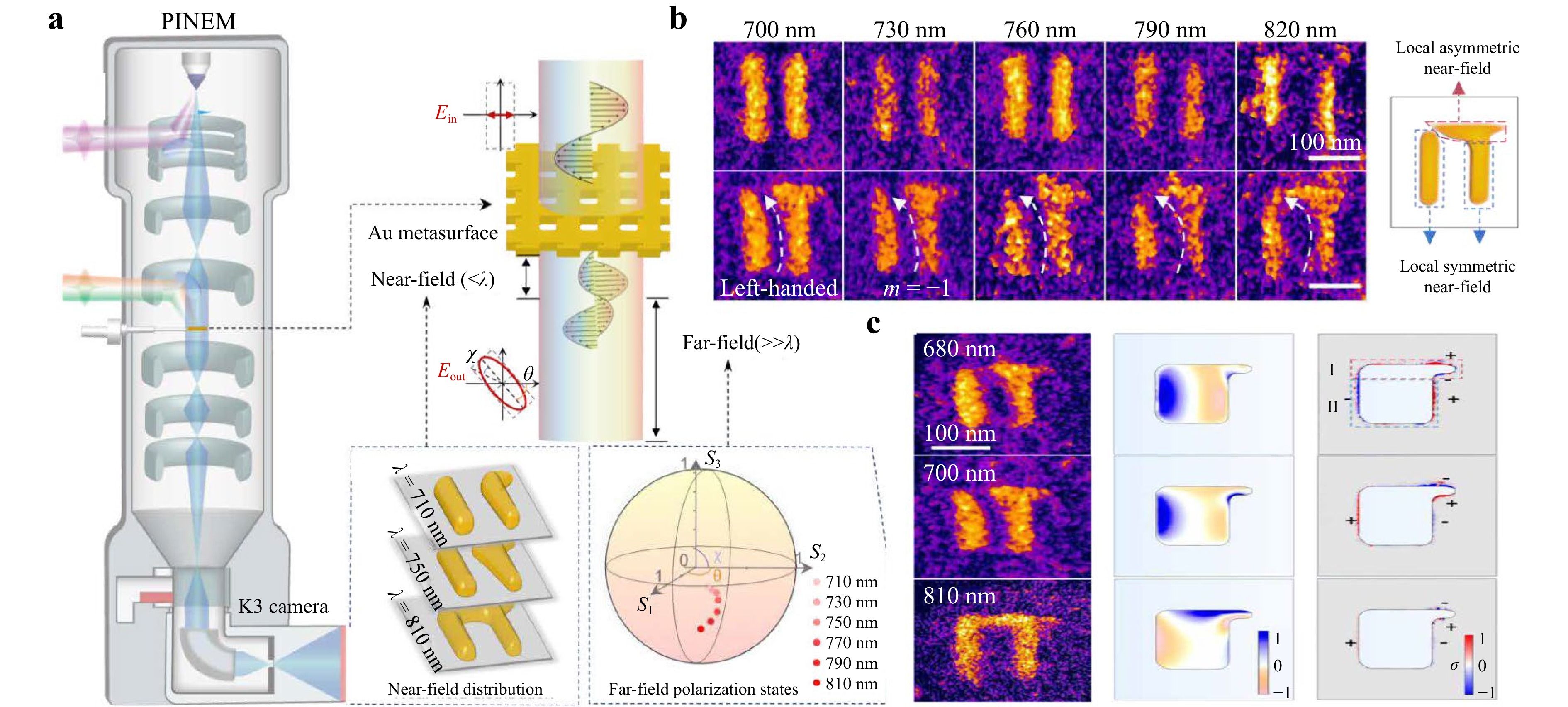
Fig. 1 a Schematic of photon-induced near-field electron microscopy (PINEM) within a 4D ultrafast electron microscope for near- and far-field measurements. b PINEM imaging of localised asymmetric near-field emergence and wavelength-dependent migration in a chiral meta-atom. c Finite-element simulated electric quadrupole mode of the meta-atom. Reproduced and adapted from Ref. 20.
This experimental elucidation represents an important shift in the design paradigm of chiral metasurfaces. By demonstrating that CD is governed not by the average asymmetry of the entire array but by the spatial and spectral characteristics of the localised asymmetric near-fields within individual meta-atoms, this work redirects the design focus toward a more fundamental level of meta-atomic geometry and mode engineering. This understanding is timely because it clarifies the causal link between microscopic geometric chirality and macroscopic CD, thereby supporting the predictive design of chiral metasurfaces in related applications. This insight clarifies that rather than tuning complex array configurations to achieve strong CD at a target wavelength, a far more effective strategy is to precisely control the position of internal hotspots, mode hybridisation, and the contributions of quadrupole modes within each meta-atom. Furthermore, PINEM-based dynamic analysis revealed that the asymmetric near-field decays faster than its symmetric counterpart, indicating that chiral metasurfaces can operate as platforms for ultrafast optical functionalities rather than as merely static structural elements. Such chirality-dependent dissipation provides new degrees of freedom for femtosecond-scale polarisation switching, nonequilibrium chirality control, and time-domain chiroptical modulation.
Ultimately, by establishing a quantitative causal framework that links local geometry, near-field evolution, and far-field response, this work provides a unified foundation for the rational design of chiral light sources21,22, ultrafast polarisation modulators23,24, and advanced biosensing platforms25,26.
HTML
-
This work was supported by the National Research Foundation (NRF) grant (RS-2025-00556856) funded by the Ministry of Science and ICT (MSIT) of the Korean government.

 DownLoad: