



-
Chaos is a complex dynamic state in nonlinear systems characterised by noise-like temporal waveforms that exist widely in various fields. Chaos synchronisation1 is a fascinating phenomenon in which nonlinear oscillators generate correlated complex waveforms through coupling, forming the cornerstone of chaos theory and its applications. Synchronisation in temporal chaotic systems has been investigated extensively, especially in optical systems2,3 with fast time scales, which have shaped many important applications such as high-speed secure communication4–9, fast physical key distribution10,11, and photon information processing12.
The synchronisation of spatiotemporal chaos in spatially extended nonlinear systems has emerged as a pivotal research direction owing to its promise of unleashing richer dynamical behaviours and enabling transformative applications such as parallel secure communication and high-performance computing. Spatiotemporal chaos synchronisation has been experimentally observed in natural systems such as ecological networks13 and chemical reactions14. However, this remains underexplored in artificial systems, which have immense practical potential for advancing chaos-based technologies. Specifically, theoretical studies have predicted that systems such as map lattices15 and optical ring cavities16 can achieve spatiotemporal chaos synchronisation; however, experimental validation is still lacking. Although experimental spatiotemporal chaos synchronisation has only been realised in nonlinear optical systems based on liquid crystal devices17–19, their timescales are too slow to meet the demands of high-speed information transmission and processing applications.
Recently, Mercadier et al. made a major contribution to the experimental realisation of fast spatiotemporal chaos synchronisation in laser systems20. Their experiments used broad-area vertical-cavity surface-emitting lasers (BA-VCSELs) with a circular output aperture of 15-μm diameter, which have multiple transverse modes, longitudinal modes, and two orthogonal polarisation modes, and can generate complex dynamics owing to mode competition21. The two lasers were coupled by unidirectional and polarisation-parallel injections in the master-slave configuration, as shown in Fig. 1. The master laser was operated separately in two different dynamic states: the coexistence of fast irregular oscillation and low-speed polarisation hopping (approximately 100 MHz), and fast chaotic oscillation (spectrum coverage up to 20 GHz). Chaotic, polarisation-hopping, and inverse synchronisations were observed by carefully adjusting the operating current or temperature of the slave laser. The synchronisation coefficients of fast chaos were generally below 0.2, which is far lower than that of polarisation-hopping dynamics. This highlights the challenge of broadband chaos synchronisation being sensitive to laser parameter mismatches.
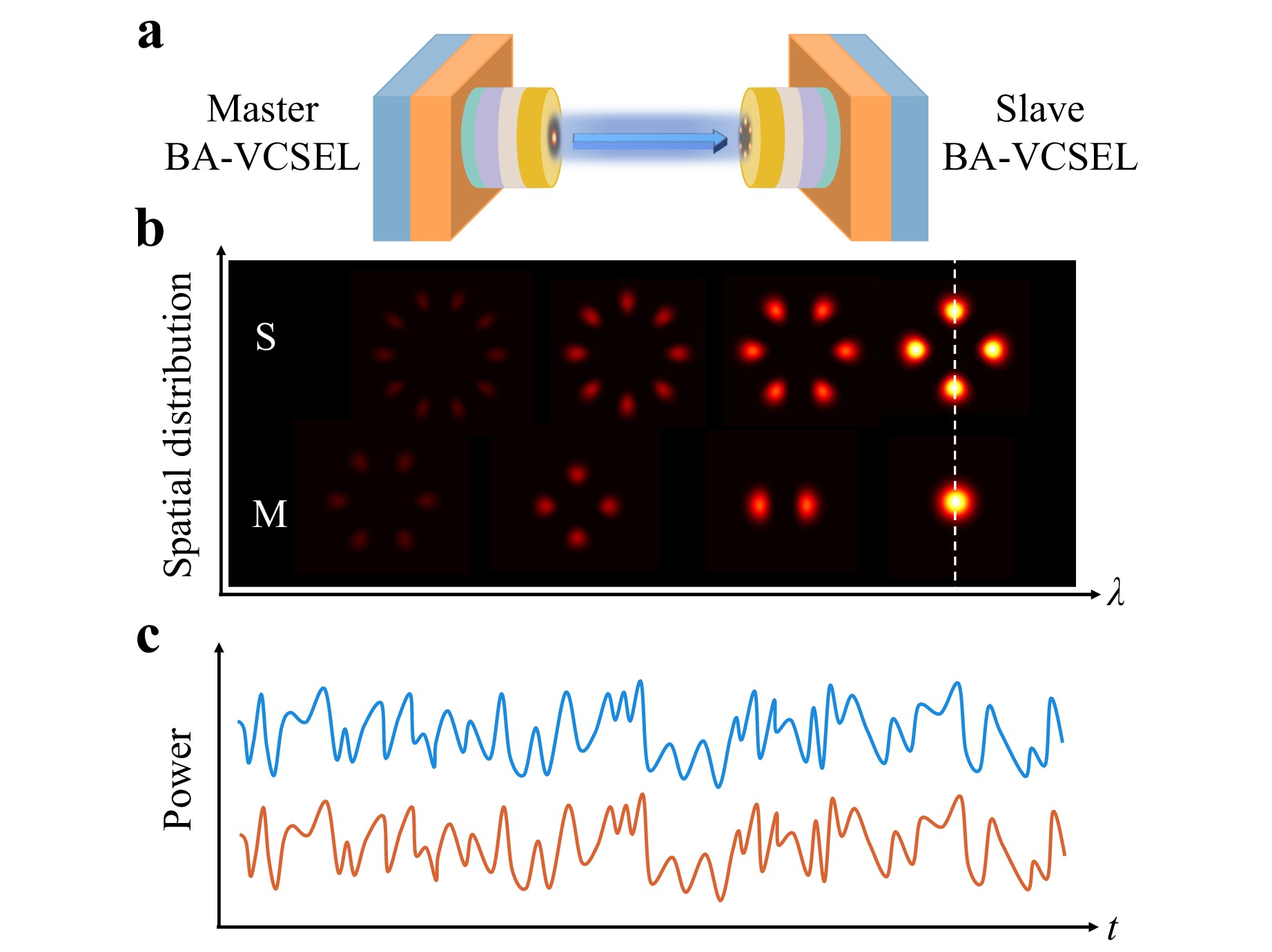
Fig. 1 Spatiotemporal chaos synchronisation of BA-VCSELs in master-slave configuration, achieved as spectral alignment between the dominant transverse modes.
By exploiting the spectral separation characteristics of laser transverse modes, the authors experimentally investigated the effects of the transverse mode wavelength and spatial pattern on the synchronisation quality. A key finding is that the synchronisation of spatiotemporal laser dynamics can be achieved when a strong transverse mode of the master laser spectrally aligns with a transverse mode of the slave laser, even in the absence of identical spatial patterns. Particularly, as the dominant transverse mode of the master laser splits into two distinct spatial orientations that are (anti)symmetric about the symmetry axis, the spectrally aligned transverse modes of the slave laser can be excited in either or both orientations. The strongest synchronisation occurs when both orientations of the slave laser mode are excited. This demonstrates that the spatial patterns of the laser transverse mode also play an important role in chaos synchronisation.
This study provides the first experimental evidence and opens new perspectives for the spatiotemporal chaos synchronisation of lasers. This also suggests that broad-area VCSELs can be an ideal research platform for complex spatiotemporal dynamics owing to their small size and intrinsic dynamics. Further in-depth theoretical investigations and more precise explorations of synchronisation scenarios for coupled spatiotemporal lasers are required. It is also necessary to explore parallel temporal chaos synchronisation involving multiple transverse modes and further study synchronisation in spatial dimensions. The results of this work also highlight the importance of laser design in optimising the chaos synchronisation quality.
This study is also likely to inspire new studies on the application of spatiotemporal laser dynamics, especially in the field of secure communication. Spatiotemporal chaos synchronisation is expected to advance high-capacity secure communication to meet the needs of 5G/6G communication. It is also expected to provide a solution for multi-user secure communication, which is challenging for temporal chaotic systems. Furthermore, secondary research interests, such as long-distance synchronisation22 and flexible mode control of spatiotemporal laser chaos have been stimulated.
Spatiotemporal chaos synchronisation in broad-area lasers
- Light: Advanced Manufacturing , Article number: 43 (2026)
- Received: 28 February 2026
- Revised: 23 March 2026
- Accepted: 24 March 2026 Published online: 17 April 2026
doi: https://doi.org/10.37188/lam.2026.043
Abstract: Experiments on the unidirectional injection of broad-area vertical-cavity surface-emitting lasers demonstrate the synchronisation of fast spatiotemporal chaos and slow polarization-hopping dynamics under conditions of spectral alignment of the dominant transverse modes. These findings pave the way for high-capacity secure communications and massively parallel information processing enabled by spatial division multiplexing.
Rights and permissions
Open Access This article is licensed under a Creative Commons Attribution 4.0 International License, which permits use, sharing, adaptation, distribution and reproduction in any medium or format, as long as you give appropriate credit to the original author(s) and the source, provide a link to the Creative Commons license, and indicate if changes were made. The images or other third party material in this article are included in the article′s Creative Commons license, unless indicated otherwise in a credit line to the material. If material is not included in the article′s Creative Commons license and your intended use is not permitted by statutory regulation or exceeds the permitted use, you will need to obtain permission directly from the copyright holder. To view a copy of this license, visit http://creativecommons.org/licenses/by/4.0/.

 DownLoad: