



-
The past decade has seen rapid progress in reflective display technologies, driven by the demand for energy-efficient operation and improved visibility under ambient illumination1. Yet, as display platforms become increasingly compact and integrated, achieving full-colour modulation at low driving voltage remains challenging2. In many existing architectures, the limitation stems not only from the colour-tunable materials themselves but also from the pixel configurations required to balance colour performance, power consumption, and device miniaturisation. Addressing this architectural constraint is essential for reflective displays suited to emerging near-eye and wearable applications. In particular, RGB subpixel partitioning inherently reduces pixel fill factor and increases routing complexity, thus limiting further miniaturisation.
Among reflective display technologies, liquid crystal platforms have attracted significant attention for achieving superior pixel resolution3. However, they often require high driving voltages and complex subpixel configurations, making downscaling difficult4. To overcome the limitations of multi-subpixel architectures, monopixel reflective display strategies have been explored to generate full-colour output within a single pixel5. Conductive polymers, in particular, have garnered interest owing to their sub-volt operation and substantial refractive index modulation6. However, when employed as standalone colour-modulating layers, their achievable colour gamut remains constrained, limiting practical full-colour implementation. This limitation arises primarily from their reliance on absorption-dominated modulation without resonant phase amplification.
In this issue of Light: Science & Applications, Ko et al. introduced an alternative architectural strategy for monopixel reflective displays based on a reconfigurable Gires-Tournois (r-GT) resonator7. Rather than employing conductive polymers as standalone colour-modulating layers, the authors integrated them into a phase-engineered r-GT cavity. This configuration enhances light-matter interaction and substantially expands the achievable colour tuning range under a subvolt bias within a single pixel. This work demonstrates how resonant cavity engineering can overcome the intrinsic material limitations of electrochromic displays.
As shown in Fig. 1a, the innovation lies in a carefully engineered Au/porous Ge (Pr-Ge)/polyaniline (PANI) trilayer that maximises cavity-enhanced light-matter interaction. The introduction of a lossy porous germanium layer enables near-ideal optical impedance matching, generating sharp resonance features within the r-GT cavity. When a sub-1 V bias modulates the complex refractive index of the 90-nm-thick PANI layer via redox reactions, the sensitized cavity dynamically shifts from a single-mode to a dual-mode resonance. This resonance reconfiguration translates into precise control over the reflected wavelength, enabling high colour purity and broad spectral tunability without resorting to subpixel architectures.
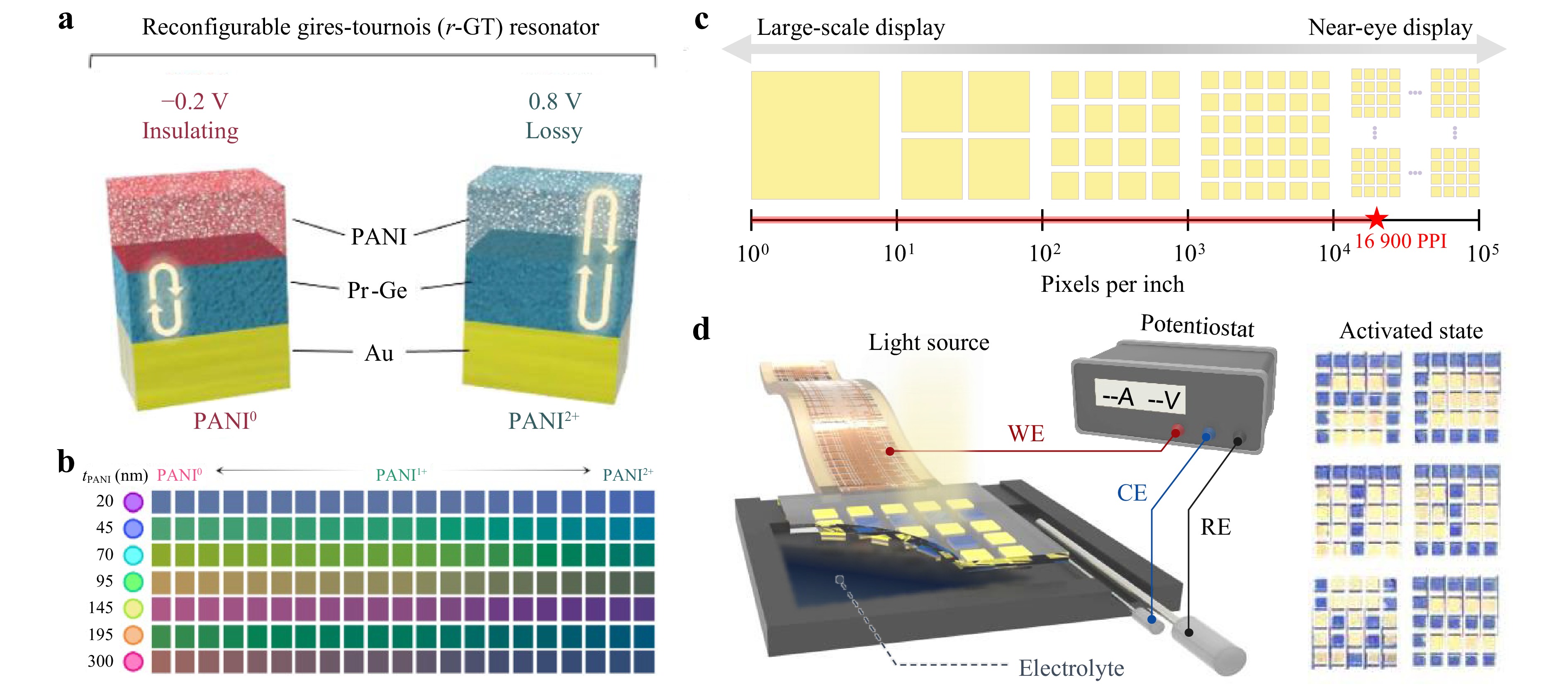
Fig. 1 a Layered architecture of the r-GT resonator (Au/Pr-Ge/PANI) and voltage-dependent optical states of the PANI layer. b Colour palette of the r-GT resonator illustrating full-colour tunability. c Pixel scaling of the r-GT platform toward ultra-high pixel density (~16,900 PPI). d Demonstration of a 5 × 5 addressable pixel array with individually controlled pixels forming the letters “ACTIVE”.
The r-GT platform achieves full-colour modulation within a single micrometre-scale pixel, eliminating the need for conventional RGB subpixel partitioning. The demonstrated hue variation spans over 220° (Δhue ≈ 220.6°), corresponding to 48.1% of the sRGB colour space (Fig. 1b). Such a large hue excursion within a single pixel represents a significant departure from conventional electrochromic systems, which typically operate within limited colour domains. Further optimisation of the lossy layer expanded this coverage to nearly 70%, indicating that cavity engineering, rather than material substitution, can serve as an effective route towards broader colour gamuts in electrochromic systems.
A particularly notable aspect of the r-GT resonator is its intrinsically low power requirement. Operating below 1 V, which is compatible with standard CMOS circuitry, the system requires minimal energy to induce substantial colour shifts. Moreover, the metastable redox states of PANI enable a memory-in-pixel function, allowing the device to retain its optical state without continuous bias. This bistable behaviour reduces the driving energy and yields up to 7.2-fold lower power consumption compared with emissive LED displays.
A longstanding challenge in electrochemical photonic devices is structural degradation under acidic conditions8. Ko et al. addressed this issue through a self-passivating layer formed during initial operation, which effectively protected the internal structure from electrolyte-induced corrosion. This strategy enables stable, reversible switching without compromising structural integrity, thereby improving the long-term stability of electrochemical resonant platforms.
The r-GT architecture also demonstrates impressive scalability and electrical addressability. Pixels can be patterned from centimetre-scale devices to 1.5-µm elements, corresponding to densities approaching 16,900 PPI (Fig. 1c). A 5 × 5 actively addressed array (Fig. 1d) confirms independent pixel control through selective voltage application, enabling dynamic colour pattern generation. Such compatibility with active-matrix driving schemes is essential for high-resolution near-eye microdisplay systems9.
Ko et al. recast monopixel reflective displays as architecturally engineered resonant systems rather than purely material-driven electrochromic devices. By integrating electrochemical modulation within a phase-controlled cavity, this work simultaneously addresses colour tunability, low-voltage operation, and pixel miniaturisation. As reflective displays move toward actively addressed, near-eye-integrated platforms, such cavity-informed design strategies expand the conceptual toolkit beyond traditional subpixel approaches. Future efforts may explore integration with CMOS backplanes, improved colour gamut optimization, and long-term operational stability, positioning resonant monopixel architectures as promising candidates for next-generation reflective microdisplays. Beyond microdisplays, the combination of sub-1 V electrochemical tuning and cavity-enhanced phase control also inspires ultra-low-power adaptive optical skins and wearable information interfaces.
Subpixel-free full-colour reflective displays via sub-1 V redox modulation
- Light: Advanced Manufacturing , Article number: 44 (2026)
- Received: 09 March 2026
- Revised: 23 March 2026
- Accepted: 24 March 2026 Published online: 17 April 2026
doi: https://doi.org/10.37188/lam.2026.044
Abstract: A vibrant, full-colour monopixel reflective display has been developed using a conductive polymer integrated within a Gires-Tournois resonator. By embedding the electrochromic medium inside a phase-engineered cavity, the platform enables sub-volt operation while substantially broadening the colour-tuning range within a single pixel. This architecture reconciles colour versatility with energy-efficient operation and scalability towards micrometre-scale reflective microdisplays.
Rights and permissions
Open Access This article is licensed under a Creative Commons Attribution 4.0 International License, which permits use, sharing, adaptation, distribution and reproduction in any medium or format, as long as you give appropriate credit to the original author(s) and the source, provide a link to the Creative Commons license, and indicate if changes were made. The images or other third party material in this article are included in the article′s Creative Commons license, unless indicated otherwise in a credit line to the material. If material is not included in the article′s Creative Commons license and your intended use is not permitted by statutory regulation or exceeds the permitted use, you will need to obtain permission directly from the copyright holder. To view a copy of this license, visit http://creativecommons.org/licenses/by/4.0/.

 DownLoad: