



-
Next-generation quantum devices such as chip-scale atomic clocks, optical gyroscopes, and magnetometers are reshaping the future of positioning, navigation, and timing (PNT) systems, as well as precision metrology1,2. These highly sensitive quantum sensors impose rigorous requirements on their light sources, specifically ultranarrow linewidths, robust single-mode emission, and high levels of system integration. Vertical-cavity surface-emitting lasers (VCSELs) have emerged as promising candidates for these applications because of their ultralow threshold currents, excellent beam quality, and planar architectures that enable cost-effective and wafer-scale manufacturing. VCSELs are fundamentally limited by their short physical cavity lengths, which leads to high round-trip losses and short photon lifetimes within the cavity, resulting in emission linewidths exceeding 100 MHz3.
Over the past decade, tremendous efforts have been made to narrow the linewidth, but this has often compromised practical applications. For example, conventional strategies typically rely on external components such as microring resonators or bulk optical cavities to reduce the linewidth4, resulting in bulky and complex systems that are highly sensitive to environmental vibrations5. An alternative approach is to extend the VCSEL’s internal cavity length, which however, encounters a fundamental limitation known as the FSR (free spectral range) wall (the shrinking of the free spectral range)6.
A recent study by Tang et al. made a major contribution to overcoming the bottlenecks by completely abandoning the bulky external feedback components7. The researchers ingeniously embedded a low-loss "passive cavity" directly into the thick bottom n-type distributed Bragg reflectors (DBRs) of a VCSEL operating at 894.6 nm corresponding to the caesium D1 transition line, which is shown in Fig. 1a. This architecture was designed to extend the optical path within the cavity while avoiding the introduction of nonradiative recombination centres. The underlying microscopic mechanism is further revealed in Fig. 1b, where a precise match between the standing-wave distribution of the electric field distribution and the refractive index is observed. By carefully setting the passive cavity length to 4.5 wavelengths (4.5$ \lambda $), the antinode of the standing wave is aligned well with the quantum wells to maximise the optical gain. In contrast, the node coincides with the oxide aperture to minimise the optical loss. More importantly, a cylindrical waveguide structure with transverse optical confinement was achieved in the oxide-confined VCSELs, which significantly reduces the effective refractive index difference ($ \Delta {n}_{\rm{eff}} $) inside and outside the oxide aperture8. A small $ \Delta {n}_{\rm{eff}} $ is essential for enhancing the diffraction loss of higher-order transverse modes and effectively suppressing their lasing. As a result, this strategy bypasses the multi-mode competition caused by the FSR wall, while simultaneously extending the effective cavity length.
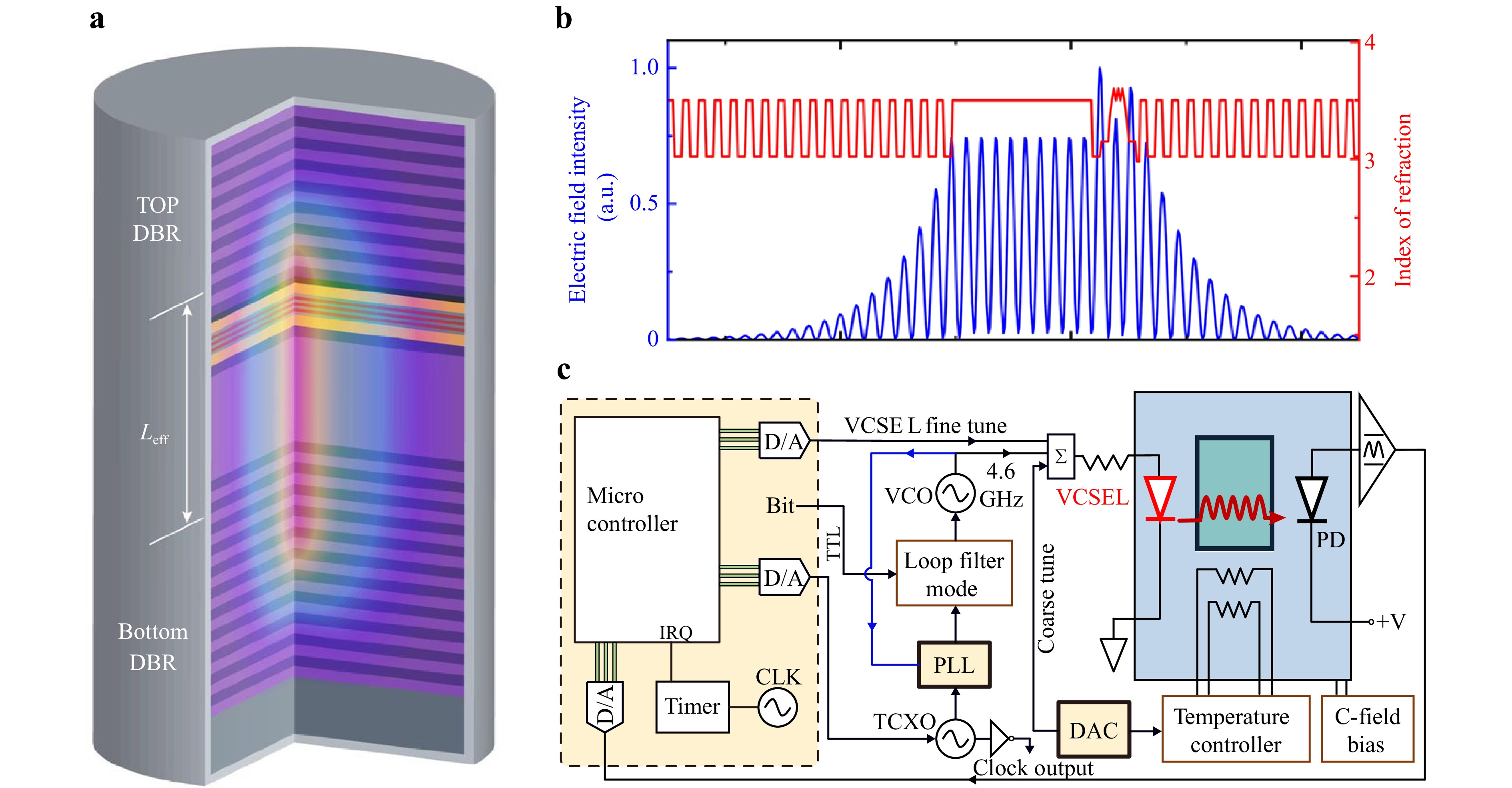
Fig. 1 a 3D structural schematic of the device, illustrating the passive cavity layer embedded in the bottom DBR, the oxide confinement layer, and the quantum well active region. b Refractive index profile (red line) and standing wave electric field intensity (blue line) along the longitudinal direction of the device. The presence of the passive cavity redistributes the optical field, extending the effective cavity length and suppressing higher-order modes. c Schematic of the caesium vapour-cell CPT atomic clock system testbed based on this VCSEL. Serving as the core light source, the laser directly drives the physics package, achieving a highly stable frequency output. Reproduced and adapted from Ref. 7.
They further constructed a miniature caesium vapour cell coherent population trapping (CPT) atomic clock testbed. In this closed-loop system, the 894.6 nm laser emitted from the VCSEL passes directly through the caesium atomic vapour cell, in which the atomic quantum transition signal is utilised as feedback to lock the microwave frequency. Owing to the low beam-divergence angle (~7°) and ultranarrow linewidth (~1 MHz) realised in the VCSEL without external frequency stabilisation, both the complexity and footprint of the optical system are drastically reduced. Furthermore, the researchers strategically implemented a −12.1 nm "gain-cavity detuning" design, ensuring that the gain peak remains aligned with the cavity mode even at elevated temperatures, e.g., 95 °C, required for atomic clock operation. This compact atomic clock achieves an extremely low Allan deviation of 1.89 × 10⁻¹² τ−1/2 at the flicker noise floor, with 10,000 s tracking tests showing frequency stability that significantly outperforms state-of-the-art VCSEL-driven atomic clock systems of a similar class9–13.
From a broader perspective, this study extends beyond setting record-breaking performance metrics. This demonstrates that an advanced monolithic micro-nano optical design, specifically the precise manipulation of the internal standing wave field and refractive index distribution, can push the coherence of semiconductor lasers to new limits without compromising system integration and manufacturability. As the demand for compact and low-power quantum-sensing networks grows rapidly, this passive-cavity-embedded VCSEL architecture, offering both high performance and scalability, is promising for paving the way for next-generation precision timing and quantum metrology technologies from the lab to practical applications.
A 1-MHz VCSEL for compact atomic clocks
- Light: Advanced Manufacturing , Article number: 47 (2026)
- Received: 09 March 2026
- Revised: 25 March 2026
- Accepted: 28 March 2026 Published online: 30 April 2026
doi: https://doi.org/10.37188/lam.2026.047
Abstract: A 2026 study introduced a transformative design for vertical-cavity surface-emitting lasers (VCSELs), achieving a dramatic narrowing of the intrinsic linewidth to approximately 1 MHz without relying on external optical feedback. This performance is enabled by the monolithic integration of a precisely engineered passive cavity that strategically tailors photon lifetime while suppressing mode competition. The resulting architecture delivers an ultra-compact, scalable, and inherently stable coherent light source, representing a significant advance for chip-scale atomic clocks and quantum sensing technologies.
Rights and permissions
Open Access This article is licensed under a Creative Commons Attribution 4.0 International License, which permits use, sharing, adaptation, distribution and reproduction in any medium or format, as long as you give appropriate credit to the original author(s) and the source, provide a link to the Creative Commons license, and indicate if changes were made. The images or other third party material in this article are included in the article′s Creative Commons license, unless indicated otherwise in a credit line to the material. If material is not included in the article′s Creative Commons license and your intended use is not permitted by statutory regulation or exceeds the permitted use, you will need to obtain permission directly from the copyright holder. To view a copy of this license, visit http://creativecommons.org/licenses/by/4.0/.

 DownLoad: