






-
Since the advent of optical tweezers in 19701, researchers have conducted extensive systematic studies to expand their manipulation degrees of freedom2. As optical tweezers have deeply integrated with spatial light-field modulation technologies2, they have overcome the limitations of conventional static trapping and gradually evolved into programmable manipulation platforms capable of multi-degree-of-freedom transport3, microrotor actuation4, and particle sorting5. They have become transformative tools for exploring the behaviour of matter at microscopic and mesoscopic scales6–8. Among these developments, programmable particle transport based on spatial light-field modulation is a core approach to achieving precise spatial positioning and dynamic migration of particles7–9. Thus, it provides essential support for microstructure assembly10, investigation of interparticle interactions9, and directional transport of matter at the microscale4. By flexibly manipulating light-field parameters such as intensity11, polarization12, and phase13, researchers have achieved the multi-degree-of-freedom transport of various particle types and successfully applied these techniques in biomedical contexts14–17. Notably, phase-gradient force (PGF)-based methods exhibit distinct advantages in generating two- and three-dimensional trajectories and enabling coordinated transport of multiple particles16,18. They have inspired the development of various algorithms for designing particle transport trajectories3. Nevertheless, existing algorithms remain limited: particle transport trajectories are constrained by parametric equations; therefore, achieving complex or highly customized trajectories is challenging19,20. Moreover, scalar diffraction modelling frameworks cannot adequately account for polarization evolution and longitudinal field distribution under tightly focusing conditions, which restricts the accuracy of light-field reconstruction19–21. Therefore, tightly focused structured light-field design methods that combine high modelling accuracy, trajectory flexibility, and transport stability, thereby overcoming current limitations in physical modelling and practical light-field engineering applications, are urgently required.
Recently, deep learning (DL), owing to its outstanding nonlinear modelling capabilities and autonomous feature extraction, has demonstrated a broad application potential in the field of optical tweezers22. Relevant studies have applied DL to particle tracking23, classification24, force-field calibration25, prediction of physical properties26, optical force computation27, and optical tweezer control28. Supervised end-to-end convolutional neural networks have further enabled the inverse design of structured vortex beams post-training29. However, most DL strategies remain purely data-driven, resulting in an excessive reliance on training data and limited generalizability30. In contrast, physics-enhanced neural networks (PNs) integrate complete physical models with deep-image priors31, enabling the rapid generation of high-precision computer-generated holograms (CGHs) for 3D light-field manipulation32. By constraining networks with scalar/vector diffraction theory, PN outputs inherently comply with physical laws, thereby enhancing interpretability29,33. Nevertheless, when single-prior network frameworks are applied to the ill-posed inverse design of particle-transporting structured fields, reconstruction planes frequently exhibit speckle noise and nonuniform phase gradients30,34, thus failing to ensure stable particle transport. Recent advances in computational imaging have highlighted a promising approach: multi-prior PNs, which have demonstrated remarkable potential for addressing the inverse problem in digital holography30. Such frameworks can achieve high-resolution, twin-image-free phase retrieval through the multi-prior integration of physical models, sparsity constraints, and deep-image priors within untrained neural networks. To the best of our knowledge, the application of such DL approaches in the field of optical tweezers remains primarily limited to measurement and control tasks22, and they have not yet been employed in the design of particle transport trajectories35.
In this paper, a multi-prior physics-enhanced neural network (MPPN) based on Richards-Wolf (RW) vector diffraction theory (MPPN-RW) is proposed36. Unlike scalar or paraxial approximations, MPPN-RW rigorously accounts for polarisation effects and vectorial field components under high-numerical-aperture (NA) focusing via the RW equations, which can ensure physically accurate modelling of tightly focused light fields36. Moreover, beyond the physical forward model, the MPPN-RW framework additionally incorporates phase-periodicity, light-field smoothness, and deep-image priors within a training-free deep neural network to jointly optimise CGHs. Specifically, the smoothness prior suppresses local intensity spikes along transport paths and speckle artefacts in the surrounding regions, whereas the phase-periodicity prior enforces uniform phase gradients. Simultaneously, a vortex-phase adaptive superposition algorithm enables the flexible modulation of topological charges along arbitrary particle-transport paths, permitting controllable transport velocities. Given any target trajectory pattern, including asymmetric or irregular types, MPPN-RW directly generates the corresponding CGHs that precisely reconstruct particle-transport trajectories under tight focusing. Comparative simulations and experiments were used to systematically benchmark MPPN-RW against state-of-the-art methods, and the results validated its superior performance and effectiveness.
-
To comprehensively evaluate the efficacy and superiority of our proposed MPPN-RW method, we conducted benchmark comparisons of it against three established approaches, namely deep-learning-based computer-generated holography (DeepCGH), random phase-based discrete inverse Fourier transform (RP-DIFT) hologram generation, and the random-phase equidistant-sampling-optimized generalized perfect optical vortex (RPESO-GPOV) method19,20,32. We constructed a representative optical conveyor-belt system featuring geometrically complex pear-shaped and flower-shaped transport trajectories defined by custom parametric equations. This framework enabled precise control over the light-field geometry. A fixed topological charge (l = 25) was used to encode the vortex phase structure and generate tailored optical forces for directional particle propulsion along the prescribed paths. Each method was subjected to a systematic quantitative assessment of its accuracy in reconstructing both the intensity and phase distributions of the target light field.
Fig. 1 presents the reconstruction results for the pear-shaped and flower-shaped optical conveyor belts using the four holographic methods. Fig. 1a shows a qualitative comparison of the light fields reconstructed using the different methods. Crucially, MPPN-RW generated significantly more uniform intensity distributions with minimal fluctuations and effectively suppressed sidelobes. Specifically, the first-order sidelobe-to-main-lobe intensity ratios for DeepCGH, RP-DIFT, RPESO-GPOV, and MPPN-RW were 0.2319, 0.1758, 0.2032, and 0.0291, respectively37, with MPPN-RW exhibiting the strongest sidelobe suppression. Moreover, the method consistently preserved the integrity of the encoded spiral phase structure throughout the optimisation process, thereby achieving superior fidelity in the optical-field reconstruction. The quantitative evaluation in Fig. 1b shows two metrics derived from transport-path intensity sampling: the coefficient of variation (CV) of the intensity and the standard deviation (STD) of adjacent phase differences38,39. Physically, a lower-intensity CV suppresses fluctuations in the local gradient force along the transport path, whereas a lower-phase STD ensures smooth and continuous optical force directions. Together, these effects mitigate particle stagnation and reduce trajectory deviations, particularly in the high-curvature regions of the conveyor belt. The relationship between the field uniformity metrics and transport stability is further analysed in Supplementary Fig. S6. Among the methods studied, MPPN-RW achieved the lowest values for both metrics, indicating the effective suppression of local intensity spikes and enhanced global smoothness (intensity uniformity was quantified by the CV of the sampled intensity along the trajectory, whereas phase uniformity was quantified by the STD of adjacent phase differences). Compared with the deep-learning-based DeepCGH method, MPPN-RW achieved an approximately 2.9-fold improvement in intensity uniformity and an 8.5-fold improvement in phase uniformity. Compared with the conventional RP-DIFT method, the corresponding enhancements were approximately 9.3-fold and 6.1-fold. Even when compared with the state-of-the-art RPESO-GPOV method, MPPN-RW exhibited notable gains, with an approximately 2.7-fold increase in intensity uniformity and 2.0-fold enhancement in phase uniformity.
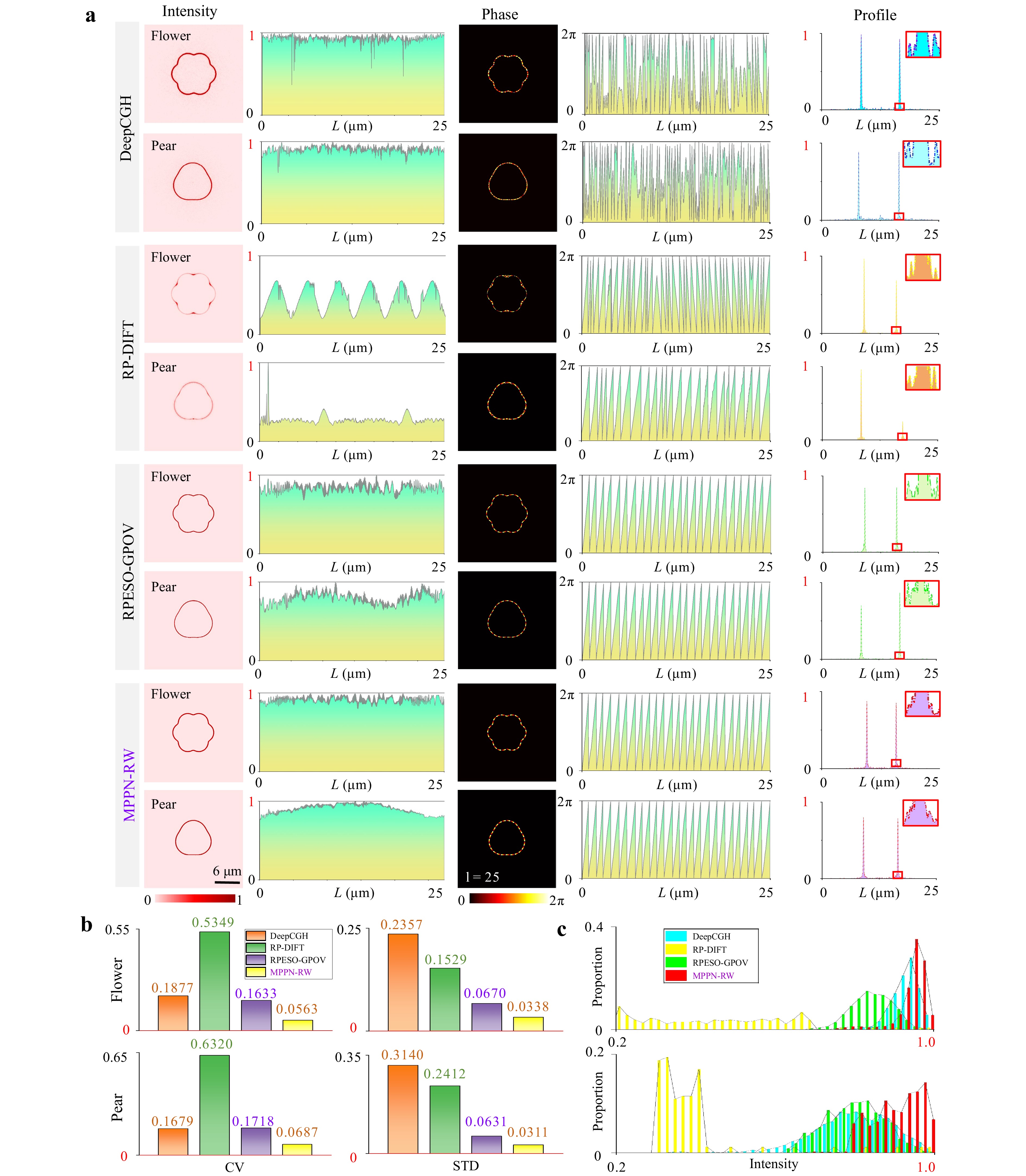
Fig. 1 Evaluation of optical conveyor-belt generation using different methods. a Qualitative comparison of the reconstructed intensity and phase profiles, as well as sidelobe suppression effectiveness, for optical fields propagating along closed-loop pear-shaped and flower-shaped trajectories under the DeepCGH, RP-DIFT, RPESO-GPOV, and MPPN-RW methods (topological charge l = 25). The intensity for all methods was normalized to an ideal value of 1 for easier comparison. b Quantitative assessment of light-field uniformity using two metrics: coefficient of variation (CV) and standard deviation (STD). c Light-field intensity distribution and proportion reconstructed by different methods.
Furthermore, Fig. 1c depicts the normalised intensity histograms under a normalized 1 W total optical power, revealing a fundamental contrast: while DeepCGH, RP-DIFT, and RPESO-GPOV exhibited broad, dispersed distributions, MPPN-RW concentrated the intensity values near unity. This pronounced intensity clustering signified a significantly enhanced optical energy utilisation, which is a critical requirement for maintaining continuous stable optical forces along predefined trajectories. The consistent performance demonstrated across both pear-shaped and flower-shaped configurations validated the effectiveness of the MPPN-RW framework in achieving high-fidelity structured light-field reconstruction, thereby enabling precise optical trapping and reliable particle manipulation capabilities.
To establish the generalisability of the MPPN-RW framework beyond analytically defined trajectories, we reconstructed optical conveyor belts with arbitrary non-parametric geometries using three representative free-form shapes (letters ‘C’, ‘A’, and ‘S’) defined exclusively through discrete contour data without analytical expressions. Fig. 2a presents these reconstructions, with rows corresponding to each geometry displayed from left to right: the reconstructed tightly focused field intensity, trajectory-sampled intensity profiles, phase distributions, and transport-path unwrapped phase profiles. Consequently, such arbitrary-shape reconstructions, which are unachievable by conventional integral-based algorithms, demonstrate the capacity of MPPN-RW to maintain uniform intensity distributions and smoothly varying vortex phases, even in highly complex topologies. This method preserves consistent phase gradients essential for stable optical forces while eliminating discontinuities and local intensity spikes despite varying path lengths, thereby validating its robustness in generating high-fidelity structured light for arbitrary particle transport through multi-prior and physics-enhanced learning. Additionally, pure phase modulation inherently produces diffraction sidelobes in the reconstructed light field, which can create dark regions between the main lobe and sidelobes where metallic particles become stably trapped through balanced scattering and gradient forces, enabling orbital motion. We validated the optical manipulation capability through full-field simulations under experimental conditions, quantifying the trapping performance via time-averaged optical forces calculated using Maxwell’s stress tensor surface integration over particle boundaries40. Fig. 2b illustrates the transverse optical forces on a gold sphere at the focal plane of the conveyor belt, with arrows denoting the force direction/magnitude against the background intensity distribution (accompanied with an 8× magnified view). Opposing forces flanking the main lobe enabled trapping, with the quantitative analysis results in Fig. 2c showing the field intensity Itol (red curve) and horizontal and vertical forces Fx (purple curve) and Fy (green curve), respectively. Equilibrium positions occurred at x1 = 7.5 μm and x2 = 8.0 μm, where the non-zero Fy (correlated with topological charge) induced particle rotation about the beam axis. The axial scattering force Fz (yellow curve) lacked equilibrium but was counterbalanced experimentally by the cover-glass pressure and particle gravity, enabling stable in-plane motion.
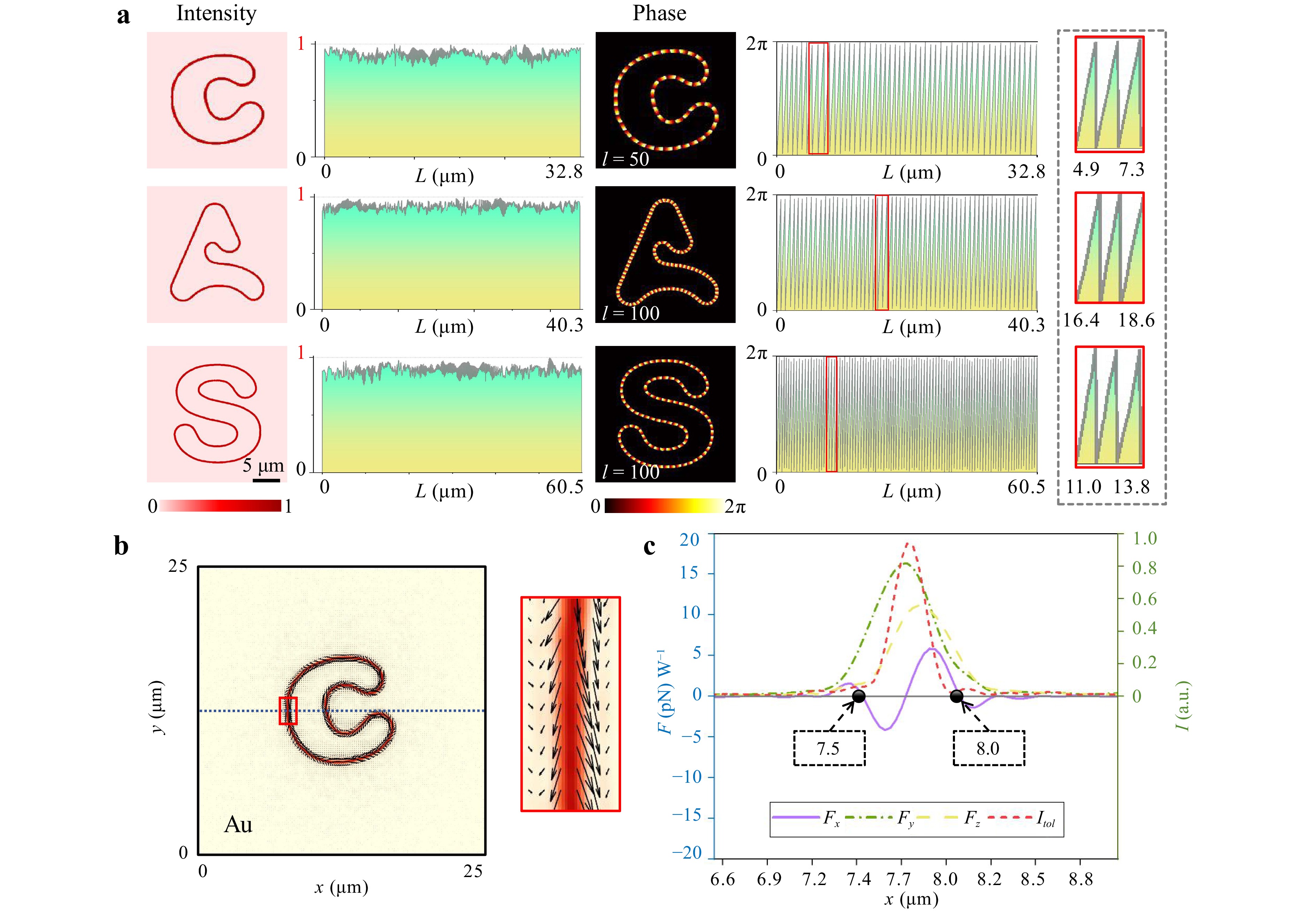
Fig. 2 Numerical results of light-field reconstruction and phase control along arbitrary free-form trajectories using the proposed MPPN-RW method. a Reconstruction results for three representative non-parametric transport paths shaped as the letters ‘C’, ‘A’, and ‘S’. b Transverse optical force exerted on a gold particle (R = 0.5 μm) in a background of light-field intensity with topological charge l = 50. Arrows indicate the direction and magnitude of the force. The inset provides an enlarged view of the force distribution within the delineated red box region. c Profiles of the optical forces along the x-direction at the centre of the red box region in b, with black points representing the trapping positions.
-
To rigorously validate the flexible and stable manipulation capabilities of optical conveyor belts generated by the MPPN-RW framework, we experimentally implemented pear-shaped and flower-shaped optical conveyor belts to achieve precise rotational and translational control of gold particles (~1 μm in diameter) under continuous-wave laser illumination at a power of 3 W (all the experiments were conducted using the same parameters). In Fig. 3, the leftmost column presents the reconstructed light fields obtained from each method, clearly indicating that the proposed MPPN-RW achieved superior light-field uniformity. The subsequent columns depict time-lapse sequences over a full transport cycle, whereas the rightmost column provides temporally colour-coded visualisations that intuitively reveal the dynamic interactions between light fields and particle trajectories. To further characterise the spatiotemporal behaviour, we extracted particle positions at equidistant time intervals, we synthesised and composite images using chromatic encoding to represent the temporal progression. These visual results demonstrated that MPPN-RW can achieve smoother and more stable particle transport along complex paths, whereas RP-DIFT and RPESO-GPOV frequently exhibit trajectory deviations or stagnation events, particularly at inflection points (Visualisation 1).
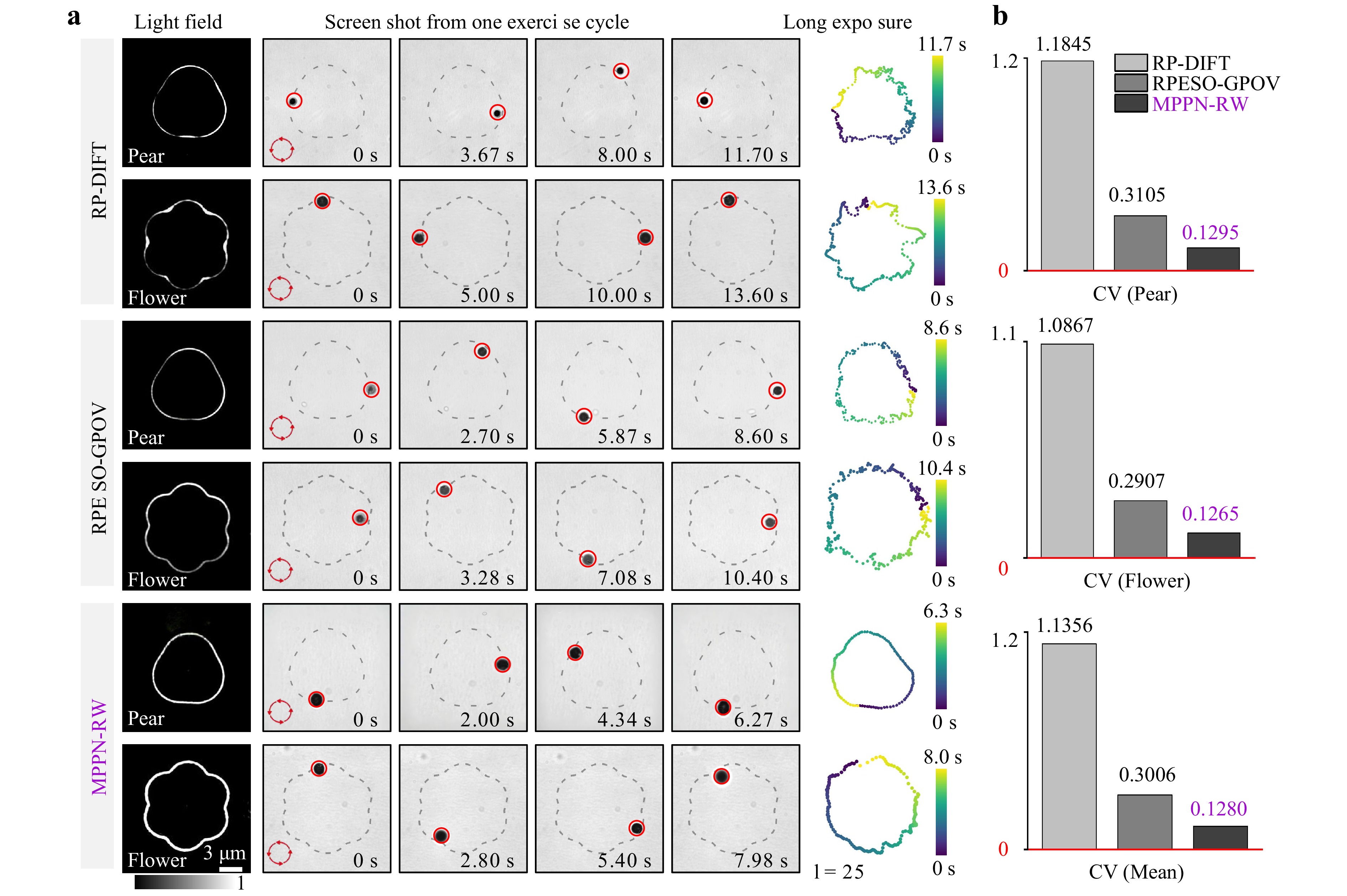
Fig. 3 Experimental demonstration of particle transport along complex optical trajectories using different light-field generation methods (l = 25). a Optical conveyor belts with pear- and flower-shaped trajectories reconstructed using three methods: RP-DIFT, RPESO-GPOV, and the proposed MPPN-RW, respectively (Visualisation 1). The first column shows the light fields of each target shape. The middle columns present time-lapse snapshots capturing a single exercise cycle of gold particle transport (~1 μm diameter). The rightmost column illustrates the temporally color-coded particle trajectories, highlighting the evolution over time. These trajectories were captured using time-lapse long-exposure imaging, which integrated the particle positions over time to visualize their motion paths. b Experimental quantitative evaluation of the reconstructed optical conveyor-belt fields using the three different methods.
Gold particles were selected for the initial experimental validation because of their strong optical response and high scattering efficiency, which enabled clear visualisation of transport dynamics and provided a robust assessment of the core functionality of the method. Furthermore, as shown in Supplementary Fig. S3 and Visualisation 2, optical conveyor belts generated by the MPPN-RW method can also effectively trap and transport polystyrene (PS) microspheres, silica (SiO2) particles, and yeast cells. Collectively, these results demonstrated the broad generality and applicability of the proposed method to diverse particle types.
In addition to the qualitative analysis, a quantitative evaluation was conducted (Fig. 3b) to assess the reconstructed optical conveyor belts obtained using the three methods in terms of the CV. The results indicated that MPPN-RW achieved an impressive 8.9-fold improvement in intensity uniformity compared with that of the conventional RP-DIFT method. Moreover, it demonstrated a 2.3-fold improvement over the state-of-the-art RPESO-GPOV method. These findings indicated that MPPN-RW not only excels in trajectory fidelity and motion stability but also consistently outperforms the baseline methods in terms of light-field uniformity and energy utilisation. Remarkably, even in high-curvature or non-convex regions, MPPN-RW maintained a uniform particle velocity and precise positional tracking, further demonstrating its robustness and adaptability for complex free-form particle manipulation tasks.
In addition, to further validate the practical feasibility, robustness, and generalisation capability of the MPPN-RW approach for arbitrarily shaped optical conveyor-belt designs, we implemented a series of complex transport trajectories. These included non-parametrically defined freeform shapes, such as the letters ‘C’, ‘A’, and ‘S’, to systematically evaluate the versatility and manipulation accuracy of the MPPN-RW method. As shown in Fig. 4b, single gold particles with diameters ranging from 0.to 1.2 μm were reliably trapped and directionally guided along the predefined paths (Visualisation 3). The dynamic motion of the particles was captured in real time using a visualisation microscope. The corresponding time-stamped image sequences consistently confirmed smooth and stable transport across all trajectories, with no significant deviations or trapping instabilities observed during manipulation. As shown in the time-displacement plot in Fig. 4(c) (where the slope corresponds to velocity), gold particles transported along the ‘C’, ‘A’, and ‘S’-shaped optical conveyor belts exhibited average velocities of 3.79, 8.16, and 5.08 μm s−1, respectively. These results demonstrated that all three conveyor-belt configurations enabled relatively uniform particle transport, reflecting the high intensity and phase uniformity of the reconstructed optical fields. Notably, even for complex and highly non-convex shapes such as the letter ‘S’, the generated optical forces remained smooth and sufficiently directional, enabling uninterrupted and high-fidelity transport. This reflected the force-consistent nature of the reconstructed light fields and the precise phase modulation achieved using our framework.
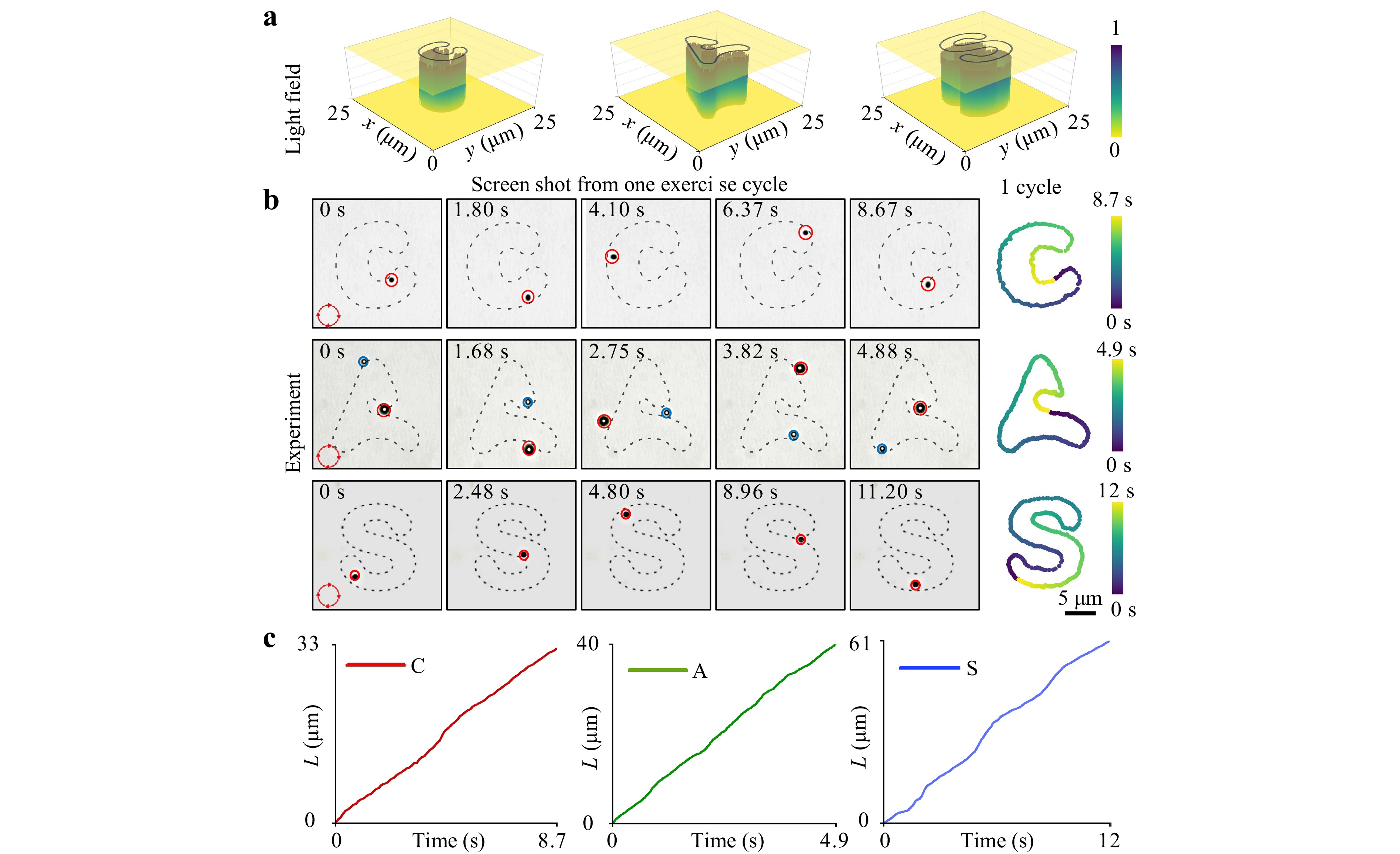
Fig. 4 Experimental demonstration of particle transport along complex optical trajectories using different light-field generation methods (l = 25) (Visualisation 3). a Mapping of optical conveyor belt captured by plane mirror method. b Single-shot and time-lapse images of 1 μm-diameter gold particles manipulated by optical conveyor belts. c Time displacement diagram of transmitting gold particles.
To further assess the scalability and robustness of the MPPN-RW framework, we applied it to a long-distance, highly complex trajectory corresponding to the hand-drawn Chinese character for ‘light’ as well as an arbitrary, non-closed freeform curve ‘6’, as shown in Fig. 5. The framework effectively generated corresponding holograms. The reconstructed light fields enabled controlled transport of gold microparticles along both complex trajectories and non-closed curves, with the particle path shaped into the character for ‘light’ spanning approximately 84.5 μm (Visualisation 4). During long-distance transport, minor fluctuations in particle motion were observed; the stability is detailed in the Supplementary Materials. Despite these slight perturbations, the particles remained stably confined and were continuously transported along the predefined trajectories without any noticeable trapping failure or deviation. This experiment further demonstrated the versatility and reliability of the method for achieving high-precision optical manipulation over long spatial scales and along arbitrary transport trajectories.
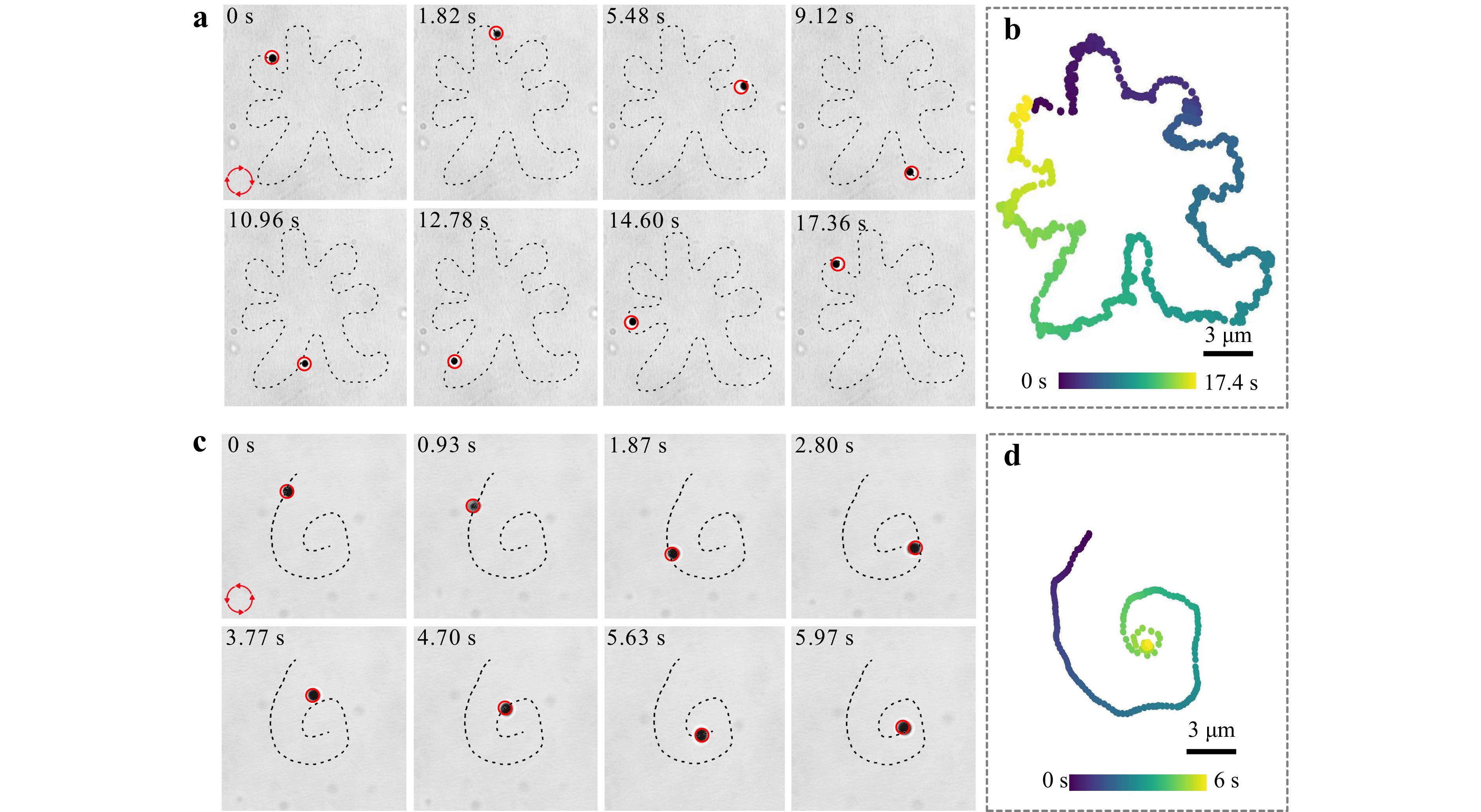
Fig. 5 Long-distance transport of ~1 μm-diameter gold microparticles along the arbitrary and complex optical trajectories (Visualisation 4): a Trajectory shaped into the Chinese character for ‘light’ (topological charge l = 150) and b non-closed, freeform curve shaped into ‘6’, respectively.
These results demonstrated the ability of MPPN-RW to maintain a uniformly distributed intensity and smoothly varying vortex phases even in complex geometries, preserving the essential spatial fidelity and consistent phase gradients for stable optical forces. Moreover, the reconstructed light fields exhibited no discontinuities or local intensity spikes despite the geometric complexity and variable path lengths, confirming the robustness of generating high-fidelity structured light for arbitrary particle transport paths.
-
In this study, we devised the MPPN-RW method, which is a physics-informed framework for generating arbitrary optical transport trajectories under high-NA focusing. The method is based on RW vector diffraction theory, which rigorously accounts for polarisation effects and vectorial field components to achieve physically accurate modelling of tightly focused light fields. By incorporating four complementary priors within an untrained deep neural network, namely, the physical model involving phase-periodicity, smoothness, and deep-image priors, MPPN-RW can directly reconstruct holograms from target intensity distributions with high precision without relying on analytical parameterisations or large datasets. Numerical simulations and experimental results demonstrated that MPPN-RW can generate arbitrary complex and high-curvature optical trajectories, including symmetric structures, irregular forms, and non-closed curves, without parametric equations. Compared with the conventional RP-DIFT method, it can achieve an improvement of more than 8.9 times in intensity uniformity and more than 6.1 times in phase uniformity. Even when compared with the state-of-the-art RPESO-GPOV method, it achieves an approximately 2.3-fold improvement in intensity uniformity and a 2.0-fold enhancement in phase uniformity, indicating that it significantly enhances the stability and reliability of particle transport. These results demonstrate the robustness, adaptability, and generalisability of the MPPN-RW framework, establishing it as an efficient and versatile platform for applications, such as programmable particle transport, targeted delivery, adaptive microrobotics, and reconfigurable optical trapping. Additionally, this technology provides an important foundation for further investigating the role of transverse spin–orbit coupling and the resulting optical lateral forces in guiding long-range particle transport41,42, as well as for extending research into three-dimensional microparticle manipulation.
-
When a normalised CGH is loaded onto a spatial light modulator (SLM), the encoded phase distribution is denoted as ΦCGH. The phase distribution Φ is given by
$$ {\boldsymbol\varPhi }=\exp \left(i\cdot {\boldsymbol{\varPhi }}_{\text{CGH}}\right) $$ (1) A high-NA objective lens is often employed for tight focusing. Under such conditions, the light field near the focal region can be precisely modelled using the RW vectorial diffraction theory integral:36
$$ \boldsymbol{E}(\boldsymbol{\varPhi })=\frac{-ikf}{2\text{π}} \int\nolimits_{0}^{{\theta }_{m}} \int\nolimits_{0}^{2\text{π}} {\boldsymbol A}(\theta )\boldsymbol{\varPhi }(\theta ,\phi ){\boldsymbol\varepsilon }(\theta ,\phi )\exp ({i}{\boldsymbol k}\cdot {\boldsymbol r})\sin \theta \text{d}\phi \text{d}\theta $$ (2) Here, A(θ) denotes the amplitude apodization function describing the incident field’s amplitude distribution, whereas Φ(θ, ϕ) represents the input phase distribution. The unit polarisation vector ε(θ, ϕ) specifies the polarisation in each angular direction. The polar angle θ and azimuthal angle ϕ define the spherical coordinate system. k = 2π/λ is the wavenumber in the imaging medium (with wavelength of λ), f is the objective’s focal length, and θm = arcsin(NA/n) is the maximum convergence angle determined by the NA and immersion medium refractive index n. Vectors k and r correspond to the wavevector and the position vector of the observation point, respectively. Assuming that the system satisfies the sine condition and ensures accurate angular-to-spatial mapping in the focal field, the forward model transforming the input CGH into a tightly focused light field is rigorously expressed as follows:
$$ ({{\boldsymbol I},{\varphi }})={F}_{\zeta }\left\{{\boldsymbol{\varPhi }}_{\text{CGH}}\right\} $$ (3) where I = |E(Φ)|2 and φ = angle[E(Φ)] denote the intensity and phase distributions of the focused light field, respectively. The set ζ encompasses all physical parameters in the RW forward model, whereas Fζ{.} denotes the forward-mapping function from the input hologram to the resulting focal-plane intensity and phase profile. The objective of this study is to construct the inverse mapping Fζ-1{.}, which reconstructs the input CGH from a specified target light field defined by its intensity and phase. This inverse problem is formally expressed as
$$ {{\boldsymbol\varPhi }}_{\text{CGH}}=F_{\zeta }^{-1}\left\{{{\boldsymbol I},\mathbf{\varphi }}\right\} $$ (4) -
DL has been widely employed in light-field modulation because of its ability to rapidly and accurately reconstruct holograms corresponding to target light fields. Conventional DL approaches typically rely on supervised learning, requiring large-scale datasets of labelled hologram–light-field pairs DTrain = {(In, ΦCGH, n), n = 1, 2, …, N} for model training. The neural network mapping function ${\boldsymbol g}^p_{\rm{Typical}} $ learned from such data can be expressed as
$$ {\boldsymbol g}_{\text{Typical}}^{{p}}=\underset{p\in \Theta }{\mathrm{argmin}}\left|\left|{\boldsymbol g}_{\text{Typical}}^{{p}}\left({{\boldsymbol I}}_{n}\right)-{\boldsymbol{\varPhi }}_{\text{CGH,}}{}_{n}\right|\right|_{2}^{2} $$ (5) where $ {\boldsymbol g}_{\text{Typical}}^{p} $ (typically parameterised by weights and biases p∈Θ) represents the specific architecture and mapping relationship of the network. The performance of conventional DL models is heavily dependent on the quantity and quality of the training data. In typical DL-based holography applications, training sets may comprise thousands or more paired samples. Through extensive training, the model learns a mapping function from the target light fields to the corresponding holograms, enabling a rapid post-training inference. However, collecting such large-scale datasets is prohibitively time-consuming in both simulations and experiments, and it often requires diverse target light-field patterns and their corresponding holograms. Moreover, these models often exhibit limited generalisation capabilities, particularly when encountering out-of-distribution or previously unseen light fields.
Unlike conventional supervised learning paradigms that require extensively labelled datasets, PNs eliminate the dependence on ground-truth holograms by directly embedding forward physical models into the optimisation framework. Rather than relying on explicit supervision, PNs harness the synergistic interplay between physical propagation models and network architectures to implicitly encode the priors governing light-field formation. This enables end-to-end inverse design of ΦCGH from arbitrary target light-field distributions without training data. Thus, the inverse problem is formulated as
$$ {\boldsymbol g}_{\text{PN}}^{p}=\underset{p\in \Theta }{\mathrm{argmin}}\left|\left|{{\boldsymbol I}}_{0}-{F}_{\zeta }{\boldsymbol g}_{\text{PN}}^{{p}}\left({{\boldsymbol I}}_{0}\right)\right|\right|_{2}^{2}=\underset{p\in \Theta }{\mathrm{argmin}}{\mathcal{L}}_{\rm{Deep{\text-}RW}} $$ (6) This approach eliminates per-sample retraining requirements by iteratively updating network parameters Θ through minimisation of the discrepancy between the reconstructed light field derived from the estimated ΦCGH and target light field. Upon convergence, the optimised mapping function $ {\boldsymbol g}_{\text{PN}}^{p} $ generates the desired ΦCGH. However, when PNs are exclusively applied to optical conveyor-belt generation for particle transport, significant speckle noise typically degrades the reconstructed light fields. These artefacts can generate unintended optical traps that compromise the manipulation precision. To address this limitation, we introduce a composite smoothness prior comprising dual regularisation mechanisms: local constraints R(I) to suppress high-frequency artefacts and global constraints Var(I) to ensure energy uniformity. Specifically, we impose FFDNet regularisation, a pretrained denoised network43, on the reconstructed intensity distribution I, which penalises sharp spatial gradients to reduce speckles while preserving structural features. Complementing this, a global variance regularisation term enforces statistical homogeneity across the intensity profile, thereby preventing excessive energy concentrations. Thus, the combined smoothness prior is formulated as follows:
$$ {\mathcal{L}}_{\text{Smoothness}}=R\left({\boldsymbol I}\right)\text{+Var}\left({\boldsymbol I}\right) $$ (7) This prior enforces physically consistent optical energy distributions, effectively suppressing anomalous intensity peaks, while promoting spatial uniformity across the reconstructed field. However, in particle-transport applications, uniform intensity distributions merely confine particles along predefined trajectories without inducing directional motion. To achieve controlled transport, we introduce a tailored vortex phase overlay to the intensity profile to impart a precise optical momentum for particle propulsion. As illustrated in Fig. 6, our trajectory-informed phase synthesis method automatically generates the target phase distributions directly from the desired light-field intensity pattern. Crucially, the topological charge of the vortex phase is fully programmable, serving as a critical parameter governing both the transport directionality and particle velocity through orbital angular momentum transfer.
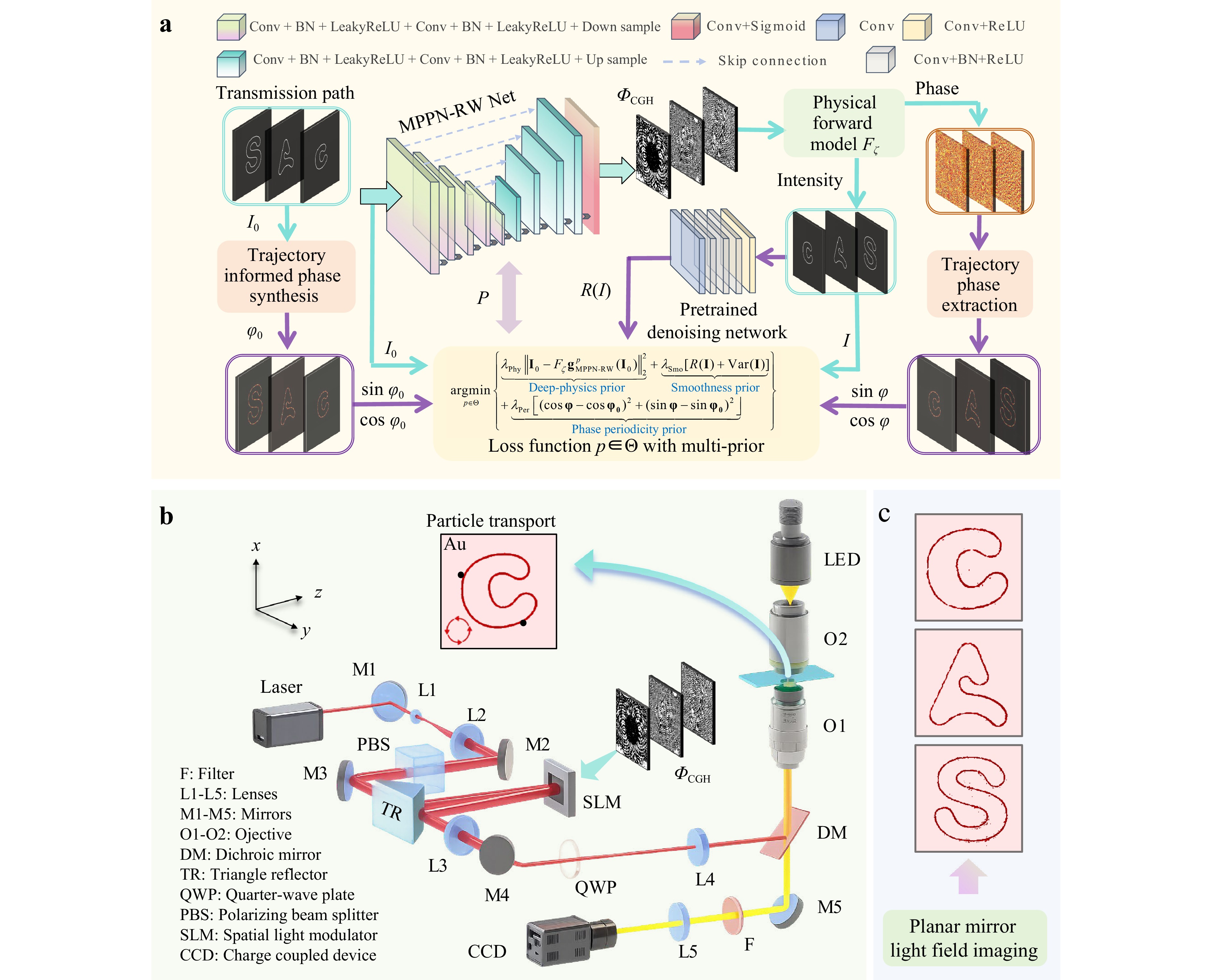
Fig. 6 Operating principle of the MPPN-RW method. a DL workflow and network architecture of MPPN-RW. The target light field I0 is generated through either manual trajectory design or numerical modelling, whereas its corresponding phase distribution φ0 is automatically derived via the trajectory-informed phase synthesis method. These dual inputs are processed by the MPPN-RW framework to generate ΦCGH through optimization incorporating multiple prior-based loss functions that enforce intensity smoothness and phase-periodicity constraints. b Schematic optical layout of the holographic optical tweezers system designed for particle transport. c Intensity profiles of the optical conveyor belts for particle transport are captured via the plane mirror reflection method.
In optical phase modulation, the inherent 2π-periodicity of the optical phase introduces unique optimisation challenges for neural networks. Conventional loss functions, such as the mean squared error (MSE) or ℓ-1 norm, when applied directly to phase values defined on the interval [0,2π), cannot account for phase periodicity. Consequently, artificial boundary discontinuities occur at the periodic wrapping point, where phase values of 0 and 2π are physically equivalent. These discontinuities can impede stable network convergence and induce phase artefacts near wrapping boundaries. To overcome this limitation, we introduce a cosine similarity loss that intrinsically encodes phase periodicity by representing each phase value φ through its unit circle embedding coordinates. The loss is then defined as the squared Euclidean distance between the predicted and ground-truth phase vectors in the 2D circular embedding:
$$ {\mathcal{L}}_{\text{Phase}}={\boldsymbol E}\left[{\left(\cos {\mathbf{\varphi }}_{\text{Pred}}-\cos {\mathbf{\varphi }}_{\text{True}}\right)}^{2}+{\left(\sin {\mathbf{\varphi }}_{\text{Pred}}-\sin {\mathbf{\varphi }}_{\text{True}}\right)}^{2}\right] $$ (8) This formulation mathematically corresponds to minimising the squared chordal distance between points on the complex unit circle LPhase ∝ 1 − cos(φPred − φTrue). Thus, it precisely quantifies angular deviations while inherently preserving phase periodicity. The expectation operator E[·] denotes spatial or ensemble averaging, ensuring statistical consistency of phase predictions across the domain. In addition to theoretical rigor, the cosine loss provides physically meaningful gradients at phase discontinuities and maintains coherence with the principles of wave optics. Consequently, it establishes a robust physics-informed prior for learning-based optical applications including holography, phase retrieval, and structured light synthesis.
Ultimately, the MPPN-RW framework integrates four complementary priors, namely the physical-consistency prior based on the RW vector diffraction theory, optical field-intensity smoothness prior, phase-periodicity prior, and deep-image prior (the roles of each prior are systematically validated through ablation studies shown in Fig. S1). These priors not only fulfil distinct functions individually but also function synergistically to construct stable, uniform, and physically meaningful optical transport fields, thereby forming a unified composite optimisation objective:
$$ {\boldsymbol g}_{\text{MPPN-RW}}^{p}=\underset{p\in \Theta }{\mathrm{argmin}}\left\{{\lambda }_{\text{Phy}}{\mathcal{L}}_{\text{Deep-RW}}+{\lambda }_{\text{Smo}}{\mathcal{L}}_{\text{Smoothness}}+{\lambda }_{\text{Per}}{\mathcal{L}}_{\text{Phase}}\right\} $$ (9) Among them, λPhy, λSmo, and λPer serves as key proportionality coefficients to balance the ℓ-2 norm of LRW, LSmoothness, and LPhase. In practice, these coefficients are determined empirically via a few preliminary experiments and fixed for all subsequent reconstructions, ensuring stable convergence and eliminating the need for case-by-case tuning (details on selecting the weighting coefficients are provided in the Supplementary Materials). The workflow diagram of the MPPN-RW method is shown in Fig. 6a. The core MPPN-RW architecture adopts a U-Net framework44, leveraging its established generalisation capabilities for inverse problems. This encoder–decoder network extracts multi-scale diffraction features through progressive downsampling in the encoder pathway, and then it reconstructs physically consistent phase holograms via the decoder using upsampling with skip-connected feature fusion. The critical components include 3 × 3 convolutional blocks with batch normalisation and LeakyReLU activation, stride-2 convolutional layers for spatial downsampling, transposed convolutional blocks with BN and LeakyReLU for feature upsampling, and lateral skip connections that preserve fine structural details. A Sigmoid activation constrains the final phase output of the network to within the range [0,1]. Implemented in Python 3.8.19 using PyTorch 2.0.1, the network parameters were optimized for approximately 4,000 iterations (~10 min) using the Adam optimizer (learning rate = 0.001) for each target on a workstation equipped with an Intel Xeon W-2223 CPU (32 GB RAM) and NVIDIA T1000 GPU. Supplementary Fig. S4 shows the detailed convergence curves, along with the corresponding explanations.
-
The proposed optical conveyor belts enabling particle transport were generated based on the holographic optical tweezer system, as shown in Fig. 6b. The linearly polarised beam with wavelength λ = 1,064 nm was output from a continuous-wave fibre laser (VFLS-1064-B-SF-HP, Connet Laser Technology Co., Ltd., China) with power adjustable from 0 to 5 W. The linearly polarised beam was expanded using a telescope system consisting of convex lenses L1 (f = 25 mm) and L2 (f = 75 mm) to form a parallel beam. After passing through a polarising beam splitter (PBS), the input beam became horizontally polarised. A 96° isosceles triangle reflecting (TR) prism was employed to couple the incident beam onto the SLM (1,920 × 1,080 pixels, 8 μm pixel pitch; PLUTO-2-NIR-049, Holoeye Photonics AG, Germany), loaded with a pre-designed CGH. A 4f optical system comprising two lenses (L3 and L4, each with a focal length of 250 mm) was employed to relay the SLM plane to the back focal plane of the objective lens (O1; 100×, NA 1.45, oil immersion; CFI Plan Apo, Nikon Inc., Japan). A quarter-wave plate (QWP) was inserted to convert the linearly polarised illumination into circularly polarised light. Subsequently, a tightly focused optical conveyor belt was produced at the focal plane of the objective lens. The O1 was also employed for the object imaging. A CCD camera (2,048 × 2,048 pixels, pixel pitch: 5.5 µm, Point Grey GS3-U3-41C6M-C, FLIR System Inc., USA) was used to monitor and record the manipulation process, with a near-infrared filter (F: MEFH10-1000SP, cutoff wavelength: 1,000 nm, Lbtek Inc., China) positioned in front of it to eliminate residual laser light passing through the dichroic mirror (DM: DM10-805SP, cutoff wavelength: 805 nm, Lbtek Inc., China).
-
This research was supported by the National Natural Science Foundation of China (62275267, 12204380, 62335018, 12127805), National Key Research and Development Program of China (2021YFF0700303, 2022YFE0100700), and Youth Innovation Promotion Association, CAS (2021401).
Multi-prior physics-enhanced neural network for high-fidelity arbitrary-path optical particle manipulation
- Light: Advanced Manufacturing , Article number: 51 (2026)
- Received: 23 December 2025
- Revised: 01 April 2026
- Accepted: 02 April 2026 Published online: 28 April 2026
doi: https://doi.org/10.37188/lam.2026.051
Abstract: Phase gradient force-driven particle transport provides a powerful route for steering microparticles along prescribed trajectories. However, conventional designs typically rely on explicit parametric equations to define optical paths, which limits flexibility and often leads to phase-design errors that degrade field uniformity and transport stability. Although physics-enhanced neural networks (PNs) have recently emerged as a promising tool for light-field manipulation, existing approaches are largely built on scalar diffraction models and therefore fail to fully capture the vectorial nature of tightly focused fields. Moreover, relying solely on a single PN prior to solve ill-posed inverse problems often leads to suboptimal solutions and nonuniform phase gradients. Here we introduce MPPN-RW, a multi-prior physics-enhanced neural network built on Richards-Wolf vector diffraction theory. By embedding the physical forward model, phase periodicity, smoothness regularization, and deep image prior into an untrained deep neural network, MPPN-RW jointly optimizes phase holograms for incident-field modulation. Experiments show that the proposed framework generates arbitrarily complex optical trajectories without parametric equations, while improving intensity uniformity and phase uniformity by factors of 8.9 and 6.1, respectively, over conventional methods. These advances markedly improve the flexibility and robustness of optical particle transport and establish a versatile strategy for microscale particle-transport applications.
Research Summary
AI-based Arbitrary-path optical particle manipulation
Researchers developed a multi-prior physics-enhanced neural network (MPPN-RW) that generates high-fidelity holograms for directing microscopic particles along arbitrary paths. Unlike conventional methods, MPPN-RW accounts for vector diffraction, polarization, and phase effects under tightly focused conditions, ensuring uniform intensity and smooth phase gradients. Experiments demonstrated precise transport of gold, polystyrene, silica, and yeast particles along complex trajectories, including non-closed curves, with enhanced stability and energy efficiency. This framework enables flexible, high-precision optical manipulation without relying on analytical equations or large datasets, opening avenues for programmable particle transport, adaptive microrobotics, and reconfigurable optical trapping.
Rights and permissions
Open Access This article is licensed under a Creative Commons Attribution 4.0 International License, which permits use, sharing, adaptation, distribution and reproduction in any medium or format, as long as you give appropriate credit to the original author(s) and the source, provide a link to the Creative Commons license, and indicate if changes were made. The images or other third party material in this article are included in the article′s Creative Commons license, unless indicated otherwise in a credit line to the material. If material is not included in the article′s Creative Commons license and your intended use is not permitted by statutory regulation or exceeds the permitted use, you will need to obtain permission directly from the copyright holder. To view a copy of this license, visit http://creativecommons.org/licenses/by/4.0/.

 DownLoad: