



-
Seawater desalination has become central to global water security, particularly in arid coastal regions. However, the field is at a crossroads; dominant industrial technologies such as reverse osmosis and multistage flash distillation remain inherently energy-intensive and are further burdened by the challenge of brine management1,2. The generation of concentrated brine streams not only reduces the overall water recovery ratio, but also necessitates costly disposal strategies to mitigate the ecological risks of hypersaline discharge into marine ecosystems. These economic and environmental liabilities have catalysed a paradigm shift toward zero liquid discharge (ZLD) architectures, which are systems designed to eliminate liquid waste by converting solutes into harvestable resources.
Solar-driven interfacial evaporation has emerged as a disruptive candidate for decentralised ZLD, fundamentally redefining the thermodynamics of steam generation. By localising solar-to-thermal conversion at the air–water interface, this approach bypasses the energy inefficiencies of heating bulk water volumes, enabling high-flux vapour generation without grid reliance3–5. Yet, the transition from laboratory prototypes to real-ocean deployment faces a formidable “mineral bottleneck”. While many studies have reported stable performance using simplified NaCl solutions, natural seawater contains a complex matrix of multivalent ions, such as Li+, Mg2+ and Ca2+. These ions facilitate the formation of dense, nonporous mineral crusts distinct from the porous structures of pure salts, which rapidly obstruct hydraulic pathways, accelerate surface fouling, and suppress evaporation rates during continuous operation.
In a recent study6, Tang et al. addressed this long-standing bottleneck by introducing an additive-free, brine-discharge-free solar-thermal interfacial crystalliser. The system is based on a nanostructured, superwicking black metal (SWBM) surface fabricated via femtosecond laser processing (Fig. 1a). Unlike conventional absorbers that succumb to salt accumulation, this laser-structured metallic interface synergistically couples near-perfect broadband solar absorption with ultrafast capillary transport. This dual functionality enables the system to direct crystallisation kinetics away from the active evaporation zone, maintaining a pristine interface even during continuous operation with raw ocean water. Remarkably, the platform achieves stable evaporation rates of approximately 1.76 kg·m−2·h−1 under 1-sun illumination, while simultaneously sequestering salts as solid deposits rather than returning concentrated brine to the feed reservoir.
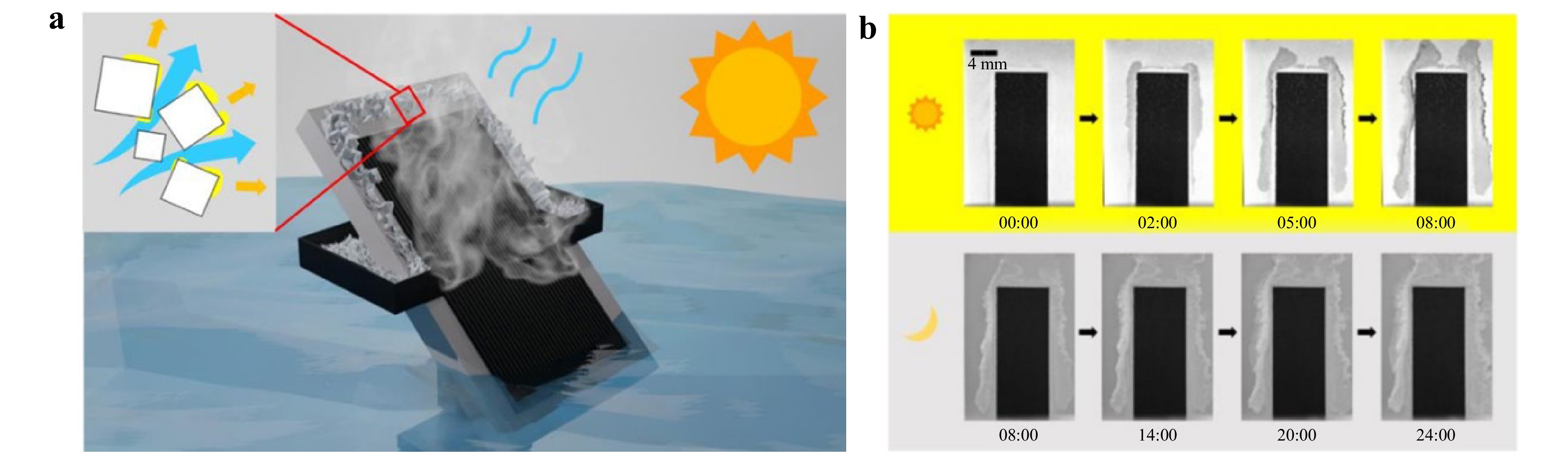
Fig. 1 Spatially controlled crystallisation keeps the solar evaporation interface clean. a Schematic representation of the additive-free, brine-discharge-free solar-thermal interfacial crystalliser, built on a nanostructured superwicking black metal (SWBM) surface fabricated by femtosecond-laser processing6. b Time-lapse images of the optimised SWBM-1.2 surface show that salt progressively accumulates in these passive regions under one-sun illumination (top) and remains there during the subsequent dark period (bottom), rather than re-dissolving into the reservoir6.
The conceptual breakthrough of this study lies in the sophisticated spatial control of mineral precipitation. The proposed architecture exploits a fundamental mass-transport phenomenon. During evaporation, liquid loss is most intense at the periphery of the wetted region, triggering an outward capillary flow that enriches solutes at the boundary, a manifestation of the classic ‘coffee-ring effect’7. As the local concentration exceeds the solubility limit, nucleation is initiated in these peripheral zones. Subsequently, crystallisation propagates outwards through ‘salt creep’, a process in which thin liquid films wick through the interstices of existing porous crystals to sustain further growth away from the central photothermal area8.
These coupled interfacial processes effectively transform the peripheral passive regions into dedicated crystallisation zones, thereby creating a self-cleaning evaporator that operates in a steady state. This strategy stands in stark contrast to previous salt-rejection methodologies9–11 that rely on transient mechanisms, such as nighttime redissolution or periodic hydraulic rinsing. By preventing brine backflow to the feed reservoir, the SWBM-1.2 surface preserves the thermodynamic driving force for evaporation. Time-lapse imaging provided by Tang et al.6 visually substantiated this behaviour, capturing the progressive outward migration of salt under illumination and, crucially, the persistence of the harvested solids during dark periods (Fig. 1b). This lack of redissolution is a key prerequisite for transforming a desalination unit into a mineral-harvesting refinery. This distinction is fundamental for realising true ZLD desalination. In conventional ‘salt-rejecting’ solar evaporators9,12–14, solutes are typically managed through transient migration; salts temporarily move away from the high-temperature zone but eventually redissolve into the bulk feed. This cycle progressively increases the salinity of the reservoir, delaying the inevitable formation of concentrated brine. In contrast, the SWBM platform ensures that salt is retained as a harvestable solid phase. By sequestering minerals in real time, the system maintains a nearly constant reservoir salinity, achieving a more rigorous form of ZLD, where dissolved salts are permanently removed from the water cycle during freshwater production rather than simply being recirculated.
-
The broader significance of this work lies in its reframing of seawater; it is no longer viewed merely as a challenging feedstock for desalination but as a vast, distributed reservoir of dissolved mineral resources3,15. Although this study focused on the bulk collection of mixed salts, the architecture provides a foundational platform for high-purity mineral mining. By integrating selective ion-capture materials or electrochemical separation modules, future iterations of this technology could enable the targeted recovery of strategic species, such as lithium, magnesium, or uranium, concurrently with water production. Such a multifunctional approach could transform the economics of desalination and the environmental burden of brine disposal into a profitable stream of industrial raw materials.
Looking ahead, the transition from laboratory demonstration to industrial-scale deployment requires addressing several critical engineering challenges. Although femtosecond-laser surface structuring offers unprecedented control over capillary geometry and optical absorption, its throughput and manufacturing costs must be evaluated for large-area deployment. Potential alternatives such as scalable roll-to-roll texturing or chemical etching may be required to achieve economies of scale. Furthermore, the long-term mechanical and chemical stability of these nanostructured interfaces under corrosive and biofouling-rich conditions in real marine environments remains an open question. Nevertheless, the progress reported here6 demonstrates that engineering the interfacial crystallisation pathway is as important as engineering the photothermal material itself. By successfully decoupling evaporation from fouling, this work paves the way for a new generation of solar-thermal refineries that meet society's increasing demands for both clean water and sustainable mineral resources.
Beyond desalination: solar-thermal interfaces for mineral mining
- Light: Advanced Manufacturing , Article number: 58 (2026)
- Received: 22 March 2026
- Revised: 05 April 2026
- Accepted: 07 April 2026 Published online: 10 June 2026
doi: https://doi.org/10.37188/lam.2026.058
Abstract: Solar-thermal interfacial evaporation provides an energy-efficient solution for decentralised desalination. However, its practical application with real seawater is hindered by salt accumulation and brine discharge. In a recent study, a laser-nanostructured, superwicking metallic interface that fundamentally decouples evaporation from crystallization was demonstrated. By using directional capillary transport to direct mineral growth away from the photothermal active zone, this platform enables stable, high-flux desalination of raw ocean water while allowing for nearly complete salt harvesting. This work marks a pivotal shift toward zero-liquid-discharge systems, redefining seawater as both a water source and harvestable reservoir for the circular mineral economy.
Rights and permissions
Open Access This article is licensed under a Creative Commons Attribution 4.0 International License, which permits use, sharing, adaptation, distribution and reproduction in any medium or format, as long as you give appropriate credit to the original author(s) and the source, provide a link to the Creative Commons license, and indicate if changes were made. The images or other third party material in this article are included in the article′s Creative Commons license, unless indicated otherwise in a credit line to the material. If material is not included in the article′s Creative Commons license and your intended use is not permitted by statutory regulation or exceeds the permitted use, you will need to obtain permission directly from the copyright holder. To view a copy of this license, visit http://creativecommons.org/licenses/by/4.0/.

 DownLoad: