




-
Green light is central to applications spanning quantum photonics1, underwater communication2, optical clocks3, and biomedical sensing4. However, integrated green light sources remain a persistent bottleneck because no suitable semiconductor gain medium efficiently covers this wavelength range, resulting in the so-called "green gap"5. These challenges in achieving efficient direct semiconductor emission at green wavelengths motivate frequency conversion as a practical route to bridge this gap6. Optical parametric oscillation based on $ \chi^{(3)} $ four-wave mixing can access this spectral range7, but it typically compromises simplicity and efficiency. Alternatively, SHG provides a direct route for frequency conversion, typically using periodically poled lithium niobate (PPLN)8 or modal phase-matching (MPM) waveguides9. Nevertheless, PPLN is limited by the requirement for high-fidelity periodic poling, whereas MPM demands stringent dispersion engineering to simultaneously align the fundamental and second-harmonic modes10.
Recently, SiN has emerged as an attractive platform for on-chip SHG11. Although SiN is amorphous and centrosymmetric, and thus lacks intrinsic second-order nonlinearity, it can acquire an effective $ \chi^{(2)} $ through the AOP process12. The AOP process inscribes a periodic space-charge grating in an SiN microresonator, enabling quasi-phase-matching (QPM) without lithographically defined periodic structures. Specifically, the pump field and weak seed SH field drive the coherent photogalvanic effect (CPE), which redistributes charges and consequently builds a spatially periodic quasi-static (q-dc) electric field. Through the electric-field-induced SHG process, this q-dc field converts the intrinsic $ \chi^{(3)} $ response of SiN into an effective $ \chi^{(2)} $ grating13. Once the $ \chi^{(2)} $ grating is formed, it establishes a self-sustaining positive feedback loop that substantially enhances the SHG process, thereby enabling highly efficient SHG generation. These processes are shown in Fig. 1. Fig. 1a illustrates the spatial profiles of the pump mode, the self-inscribed $ \chi^{(2)} $ grating, and the SH mode, based on the theory established in Ref. 13, where the grating periodicity provides the required momentum compensation for QPM. Fig. 1b depicts the corresponding energy conservation relationship involved in this process. Moreover, owing to superior optical properties, including a broad transparency window and low propagation losses14, SiN can support high-quality factor (high-Q) resonators that enable strongly enhanced nonlinear interactions for efficient SHG at visible wavelengths.
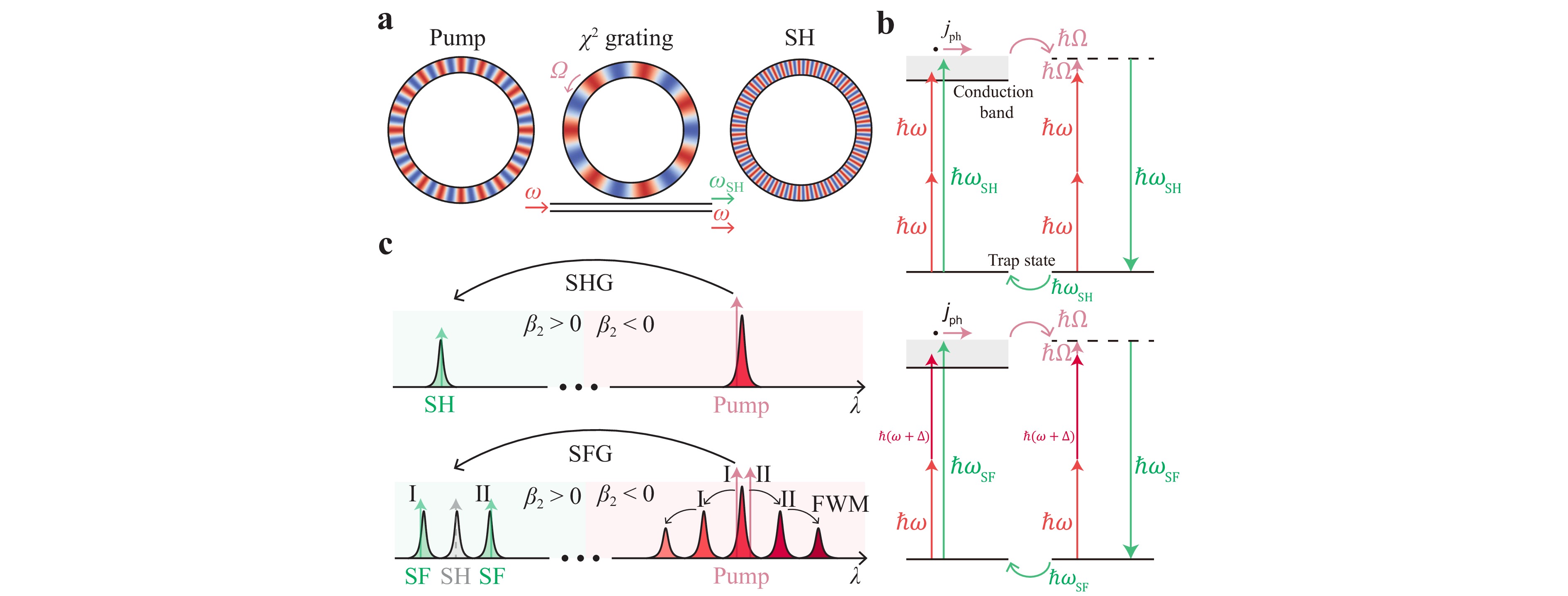
Fig. 1 a Schematic of the SHG process. When the doubly resonant condition is satisfied, the pump at $ \omega $ is coupled into the microresonator, and SH light at $ \omega_{SH} $ is emitted. Left: pump mode profile; middle: AOP-inscribed $ \chi^{(2)} $ grating oscillating at $ \Omega $13; right: SH mode profile. b Conceptual schematic of energy conservation in AOP-driven SHG and SFG. The coherent photogalvanic current is generated by interfering multiphoton absorption processes. For SHG (top), two pump photons, together with one $ \chi^{(2)} $-grating quantum, convert into a single SH photon13. In SFG (bottom), one pump photon mixes with a photon from another Kerr comb line, separated by $ \Delta $, and one $ \chi^{(2)} $-grating quantum to generate a single SF photon. c Adapted from Ref. 15. Illustration of the doubly resonant condition (top), where SHG occurs when the SH mode is near the second-harmonic wavelength of the pump mode, and the triply resonant condition (bottom), where four-wave mixing (FWM) around the pump forms a coherent comb, enabling SFG driven jointly by the pump and a comb line. The light green region represents normal dispersion, whereas the light red region corresponds to anomalous dispersion.
Building on the concept of AOP-driven SHG, a recent study published in Light: Science & Applications by Wang et al. takes a step further by exploring, for the first time, how a coherent Kerr comb near the pump wavelength participates in the AOP process15. To enable this capability, the microresonator in this study is designed to exhibit anomalous dispersion at the pump wavelength, as depicted in Fig. 1c, thereby supporting the formation of a coherent Kerr comb16. Conversely, the same device exhibits normal dispersion around the SH wavelength, which prevents Kerr comb formation. Once a coherent Kerr comb forms at the pump wavelength, the additional coherent comb lines interact with the pump light to induce AOP and drive an SFG process analogous to SHG. The corresponding energy conservation relation is shown in the lower panel of Fig. 1b. This SFG process further enables wide tunability of the green light. In this scheme, the generated green light is tuned over a broad range by accessing different resonances through slight adjustments of the pump detuning within a single resonance. This concept is illustrated in the lower panel of Fig. 1c: when the pump is detuned to position $ {\bf{I}} $, it interacts with the first comb tooth on the left (comb line $ {{\bf{I}}} $) to generate SF $ {{\bf{I}}} $; when the pump is detuned to position $ {\bf{II}} $, it instead mixes with the first comb tooth on the right (comb line $ {{\bf{II}}} $), yielding SF $ {{\bf{II}}} $.
Wang et al. achieve an 11-nm tunability across multiple green resonances while maintaining the pump within a single resonance. In addition, in contrast to the SFG process driven by a coherent Kerr comb, the authors show that a modulation instability (MI) comb can erase the self-inscribed $ \chi^{(2)} $ grating. This behaviour is attributed to the high intracavity power, strong phase noise, and complex mode content of the MI state. Collectively, these factors enhance the material's photoconductivity, disrupt the CPE, and result in the erasure of the $ \chi^{(2)} $ grating.
Beyond the Kerr-comb-assisted AOP mechanism described above, Wang et al. also report the following device-performance metrics. The core component of the tunable green light source is a high-Q SiN microresonator, delivering up to 3.5 mW of continuous-wave green power. By leveraging both SHG and Kerr-comb-assisted SFG, the device achieves a total green light tunability of 29 nm. Additionally, this study reports a low on-chip AOP threshold power of 4.5 mW, establishing a steady-state green light output within a few minutes. Increasing the on-chip power to 10.1 mW reduces the onset time to only a few seconds. The low AOP threshold eliminates the need for external optical amplification and paves the way for a fully integrated, compact green source.
In summary, Wang et al. extend the tunability of AOP-driven frequency conversion in SiN microresonators by demonstrating that a coherent Kerr comb near the pump wavelength can effectively participate in the AOP process. They achieve widely tunable green light emission and demonstrate a tuning mechanism in which the pump remains within a single resonance without mode hopping. Looking ahead, device performance can be further improved by optimising the coupling conditions of the microresonator, employing an asymmetric add-drop ring configuration, and increasing the finesse of the microresonator17. More broadly, the interplay between coherent Kerr combs and the AOP process offers new opportunities for compact, fully integrated visible sources and self-reference-stabilized frequency comb technologies.
Widely tunable on-chip green light generation
- Light: Advanced Manufacturing , Article number: 81 (2026)
- Received: 09 April 2026
- Revised: 30 April 2026
- Accepted: 07 May 2026 Published online: 10 June 2026
doi: https://doi.org/10.37188/lam.2026.081
Abstract: A widely tunable on-chip green light source in a silicon nitride (SiN) microresonator is demonstrated. By inscribing an effective $ \chi^{(2)} $ grating in the microresonator via all-optical poling (AOP), green light is generated through second-harmonic generation (SHG). Comb-assisted sum-frequency generation (SFG) is also realised using a coherent Kerr comb arising from the intrinsic $ \chi^{(3)} $ nonlinearity around the pump wavelength. The combination of these two mechanisms provides fine tunability across the green spectrum. Furthermore, the SFG process introduces a new tuning paradigm, enabling the green output wavelength to be switched over a broad range. These results extend the spectral accessibility of integrated photonics and highlight new opportunities for on-chip light sources.
Rights and permissions
Open Access This article is licensed under a Creative Commons Attribution 4.0 International License, which permits use, sharing, adaptation, distribution and reproduction in any medium or format, as long as you give appropriate credit to the original author(s) and the source, provide a link to the Creative Commons license, and indicate if changes were made. The images or other third party material in this article are included in the article′s Creative Commons license, unless indicated otherwise in a credit line to the material. If material is not included in the article′s Creative Commons license and your intended use is not permitted by statutory regulation or exceeds the permitted use, you will need to obtain permission directly from the copyright holder. To view a copy of this license, visit http://creativecommons.org/licenses/by/4.0/.

 DownLoad: