






-
Advancements in optical frequency comb generation1–4 using high-quality (high-Q) microring resonators (MRRs) have led to numerous breakthroughs in metrology5–14, spectroscopy15,16, communications17–20, quantum computing21, quantum data processing22, and quantum sources.23,24 For many applications, coherent frequency combs that form dissipative cavity solitons in the time domain should be generated. Solitons are solitary waves that self-balance nonlinear phase shift, dispersion, losses, and energy flow25–30. However, the practical implementation of on-chip soliton generation still encounters considerable challenges. The traditional method of soliton generation involves catching the soliton ‘step’ by scanning through the cavity resonance with a narrow-line laser. This procedure is nontrivial, prohibits self-starting26,31–33, and suffers from a low pump-to-comb conversion efficiency, which typically does not exceed 5% for bright solitons29,34–36.
Several approaches have been proposed to overcome these limitations, including modifying the microcavity and coupling the pump laser to the cavity through optical feedback37. Helgason et al. demonstrated a technique of inducing a controllable frequency shift in a selected cavity resonance using two linearly coupled anomalous-dispersion microresonators, achieving a conversion efficiency of 50%38. To address the self-starting challenge, Yu et al. proposed an edgeless photonic crystal resonator that enables spontaneous soliton formation instead of Turing patterns39. Another common but intricate technique is pumping an MRR with an electro-optically modulated continuous-wave (CW) external laser at a precisely selected frequency, which was successfully demonstrated on a lithium niobate platform in 202140. A popular and effective approach is the self-injection locking technique, which provides self-starting soliton comb generation11,41–45 with a CW-to-soliton comb conversion efficiency of up to 40%41. Briefly, the laser diode locks to the travelling-wave mode of the microcavity through a back-propagating wave emerging from Rayleigh scattering within the cavity46. In these schemes, the backscattered field is primarily used to stabilise the laser emission frequency to a microresonator mode rather than to form the laser cavity itself. In addition to cavity-soliton generation, self-injection locking is commonly used for narrow-linewidth, low-noise, and frequency-stabilised laser generation47–50.
Another elegant technique that simultaneously solves the problems of low energy conversion and lack of self-starting is the integration of a microcavity into a fibre-laser resonator. This concept was first demonstrated in 2012 to achieve stable ultrafast mode locking51. By merging a fibre laser and microcavity, Bao et al. demonstrated 50-nm-wide laser cavity-soliton combs with 75% power in the comb52. Recently, Maxwell et al. demonstrated that this system can exhibit self-starting soliton generation that is naturally robust to system perturbations and can spontaneously recover after disruption. This robustness is attributed to the interplay between slow erbium fibre gain saturation and cavity thermal shift53. In these studies, the authors used a four-port ring resonator inside a fibre-laser ring cavity. The emission from the fibre laser propagated through one bus waveguide to the microcavity and returned from the drop port to the laser cavity through the other bus waveguide. A similar approach was implemented using high-Q Fabry–Perot resonators, which can operate in the transmittance and reflectance regimes54–58.
In this study, we further developed the technique of laser-cavity soliton generation by demonstrating that a high-Q microring resonator can operate as a nonlinear reflective mirror of а fibre-laser cavity. Studies have shown that weak Rayleigh scattering in the resonator mode can be enhanced by an analogue of the Purcell factor, producing a back-propagating wave in the cavity and, under certain conditions, converting a major part of the pump power into it59,60. Although this back-propagating field has previously been used for the self-injection locking of a laser diode to a microresonator mode, it plays a different role in our system: The resonantly enhanced backscattered field provides the dominant feedback that closes and sustains the laser cavity. Specifically, we demonstrated that resonant backscattering from an MRR, operating as a frequency-selective mirror, can provide sufficiently large optical feedback to form a fibre-laser cavity, leading to more than 500-nm-wide self-starting comb formation. This approach enabled us to use a single-bus waveguide MRR, which simplifies fabrication and reduces losses compared with four-port cavity coupling, thereby maintaining a higher loaded Q-factor and resulting in comb formation with improved spectral properties. To prove the general applicability of this approach and to exclude parasitic reflections as a feedback source, in addition to the integrated MRR, we demonstrated self-starting comb generation in a crystalline MgF2 toroidal microcavity coupled via a tapered fibre. The tapered-fibre configuration minimises the interface reflections and confirms that the observed feedback originates from microresonator backscattering rather than facet reflections. This approach can be very efficient for robust laser-cavity comb generation with microcavities requiring prism or tapered-fibre coupling and in photonic circuits where the microring is combined with an integrated amplifier61–64.
-
Backward-propagating wave formation is a complex process defined by the relationship between microring resonator parameters, namely, the intrinsic loss (κ0), coupling rate (κC), and backward-wave coupling rate (γ).60 The MRR used in this study had a 1 THz free spectral range (FSR), an approximately 1 million Q-factor, anomalous second-order dispersion, and the following relationship between its parameters: κ0 < κC < γ < κ0 + κC (see the characterisation section for details). At a low pump power, this relationship guarantees a prominent back-propagating wave without significant mode splitting. When the power is sufficiently high for comb formation, a back-propagating comb also forms with a spectrum similar to that of forward propagation, which was observed under an external tuneable CW laser pump (Supplementary Fig. S1).
We used the MRR to form a fibre laser cavity by edge-coupling the chip with the MRR to a polarisation-maintaining (PM) Er-doped fibre amplifier (EDFA) and introducing a fully reflecting gold mirror on the other side (Fig. 1a). Additionally, the cavity includes a PM-WDM with a 980 nm laser diode and a pair of fibre connectors to simplify the coupling alignment. The total laser cavity length is 3.2 m, corresponding to an FSR of 32.5 MHz. At a threshold pump power of 43 mW, laser generation starts at the wavelength of one of the resonances owing to the build-up of the back-propagating wave in the MRR. As the pump power increases, the optical comb grows, reaching a width of more than 500 nm at the maximum available pump power of 500 mW, corresponding to 91 mW in the fibre before the chip and an output comb power of 16 mW in the bus waveguide (Fig. 1b). The laser can be turned off and turned on, and it immediately recovers the comb state, demonstrating robust operation under external perturbations (see Supplementary Video). This behaviour is similar to that of laser cavity solitons demonstrated earlier with a four-port cavity nested in a fibre laser, where the soliton was manifested as a stable attractor owing to the interaction between slow gain saturation and MRR heating53.
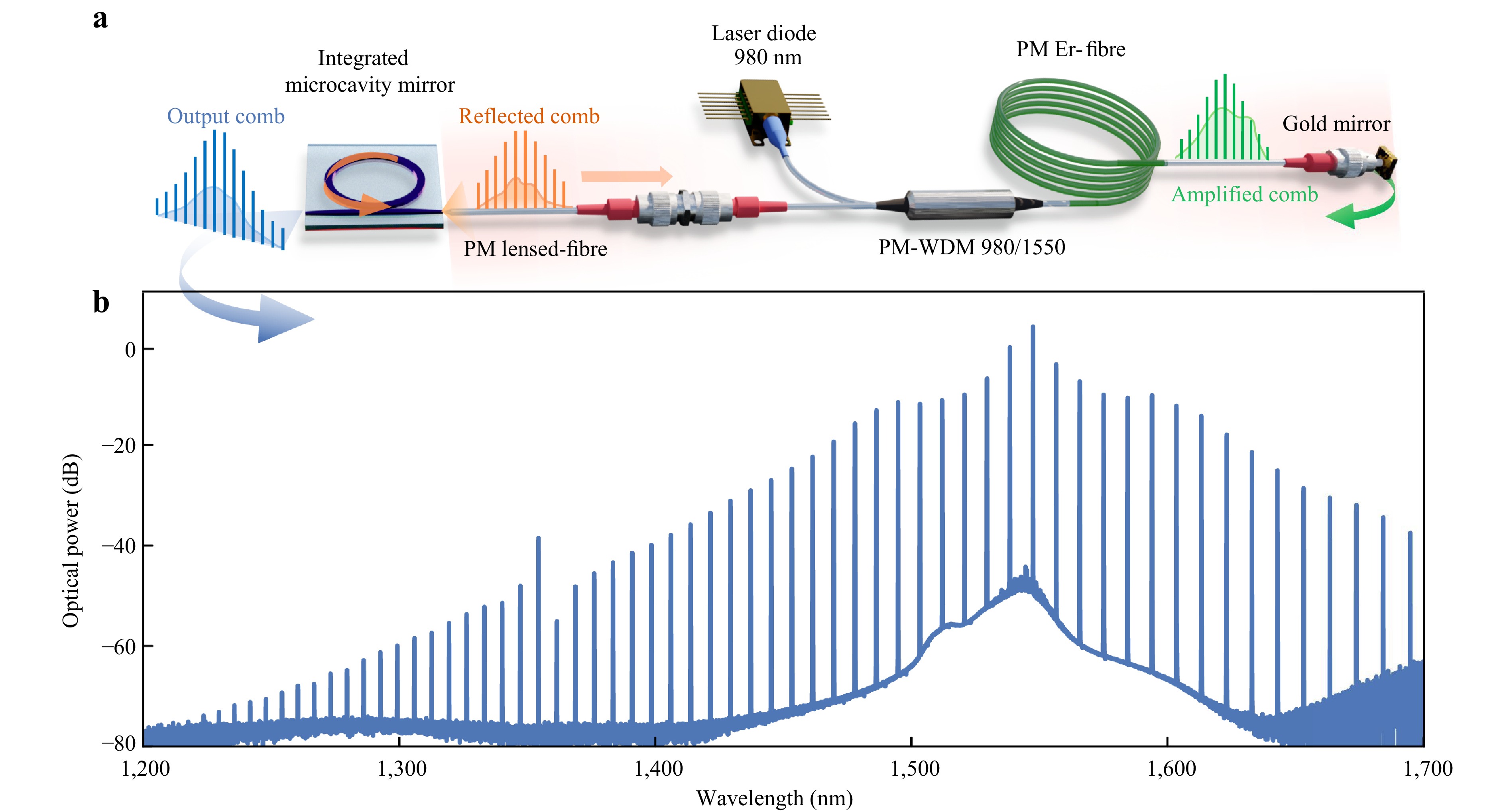
Fig. 1 Generation of broadband frequency combs using a high-Q silicon nitride (Si3N4) microresonator nested into a fibre-laser cavity in the reflection scheme. a Schematic illustration of the fibre laser with integrated photonic chip for cavity soliton generation: one-meter-long polarization-maintaining Er-fibre pumped with a 980 nm laser diode through a broadband wavelength-division multiplexer 980/1,550 nm (PM-WDM). All fibres in the system were polarization-maintained and exhibited a second-order dispersion of −23 fs2·mm−1. Lensed fibres were used to couple light to the chip. The Si3N4 microring resonator had a 1 THz repetition rate, nearly 1 million Q- factor, and anomalous dispersion. b Cavity soliton spectrum with a width exceeding 500 nm at an intracavity power.
We note that our scheme does not include an optical filter or delay line, which are often present in such systems, to ensure self-starting and comb coherence51–53,65,66. We observed that, in our system, these elements had a very minimal effect on the generation performance; thus, we eliminated them from the cavity. We suggest that a high FSR (approximately 8 nm at 1,560 nm) leaves only a few lines within the gain region, where it exceeds the losses, providing efficient filtering. A brief discussion is provided in the Supplementary Information (Section SI2).
To investigate the fibre intracavity dynamics of the comb, we introduced a 2 × 2 70/30 coupler into the fibre resonator (Supplementary Fig. S7), which enabled us to track the intracavity back-reflected and amplified combs. It introduces additional losses to the system, reducing the intracavity power while preserving the general behaviour. The optical spectra for the transmitted and reflected combs (Fig. 2a, b) have slight differences while maintaining the triangular shape typical of soliton combs. A small dip in the comb spectrum (Fig. 2a) at approximately 1,613 nm can be attributed to the avoided mode crossing, as observed from the resonator transmission spectra (Fig. 5c). The apparent reduction in the reflected comb width results from additional wavelength-dependent losses at the coupler and circulator, which increase significantly away from the elemental operation band. Fig. 2c shows the comb after double propagation through the erbium-doped fibre, demonstrating that significant amplification within the erbium gain spectrum region reduces the comb width. An external commercial amplifier was used to perform autocorrelation measurements (see Supplementary Information, SI4). The autocorrelation traces clearly showed pulse trains with a repetition rate of 1 THz for the output, reflected, and amplified combs (Supplementary Fig. S4). However, a substantial distortion of the comb spectra by the external amplifier prevented us from determining the pulse width. To address the pulse formation and its characteristics, we modelled the intracavity dynamics using coupled mean field equations for MRR forward-propagating, backward-propagating, and fibre-amplified combs. A detailed description of the model and numerical procedure is provided in the Supplementary Information (Section SI3). The dashed envelopes in Fig. 2a, c correspond to the numerical simulation, which exhibited excellent agreement for output and amplified combs. The insets in Fig. 2a, b show the corresponding modelled pulse trains, which had a bell-on-a-pedestal shape for the intracavity pulses. The pedestal was reproduced if the pulse shape was recovered from the Fourier transform under the assumption of full coherence (see Supplementary Information, SI5). The simulated pulse in the fibre laser section, shown in the inset of Fig. 2c, was much broader than the MRR pulses owing to spectral narrowing after the amplifier.
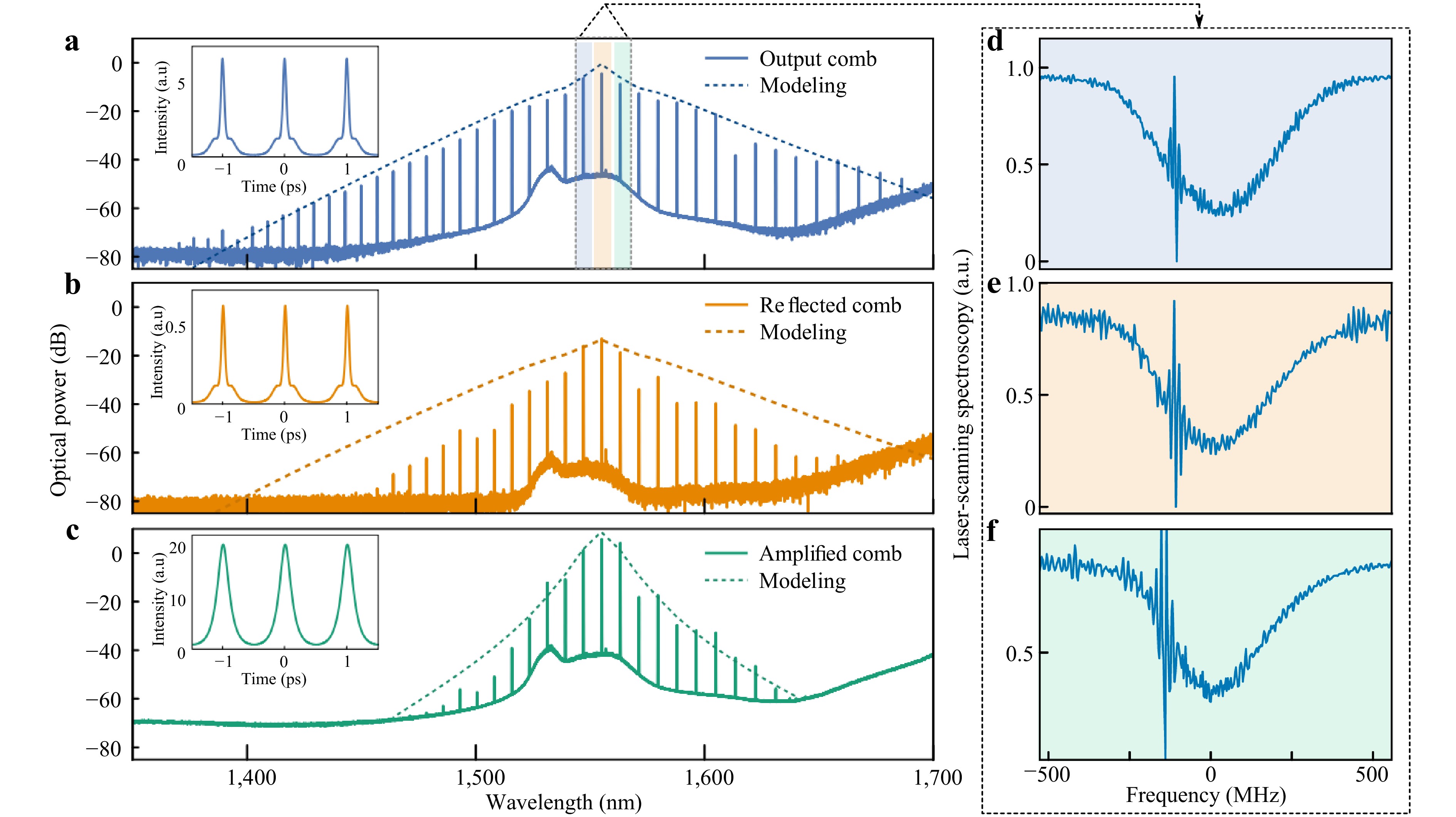
Fig. 2 Single soliton comb generation in the hybrid-laser scheme, a–c Measured output, a, reflected, b, and amplified, c, comb spectra. The dashed curves denote the intracavity spectral envelopes computed using the mean-field equations. The insets show pulse trains obtained from the same model, because direct autocorrelation measurements were not feasible owing to an insufficient pulse energy; d–f laser-scanning spectroscopy of the 1,542, 1,554, and 1,562 nm microcavity resonances, respectively, measured for an output comb. All plots indicate the red-detuned state for the central and side modes of the comb.
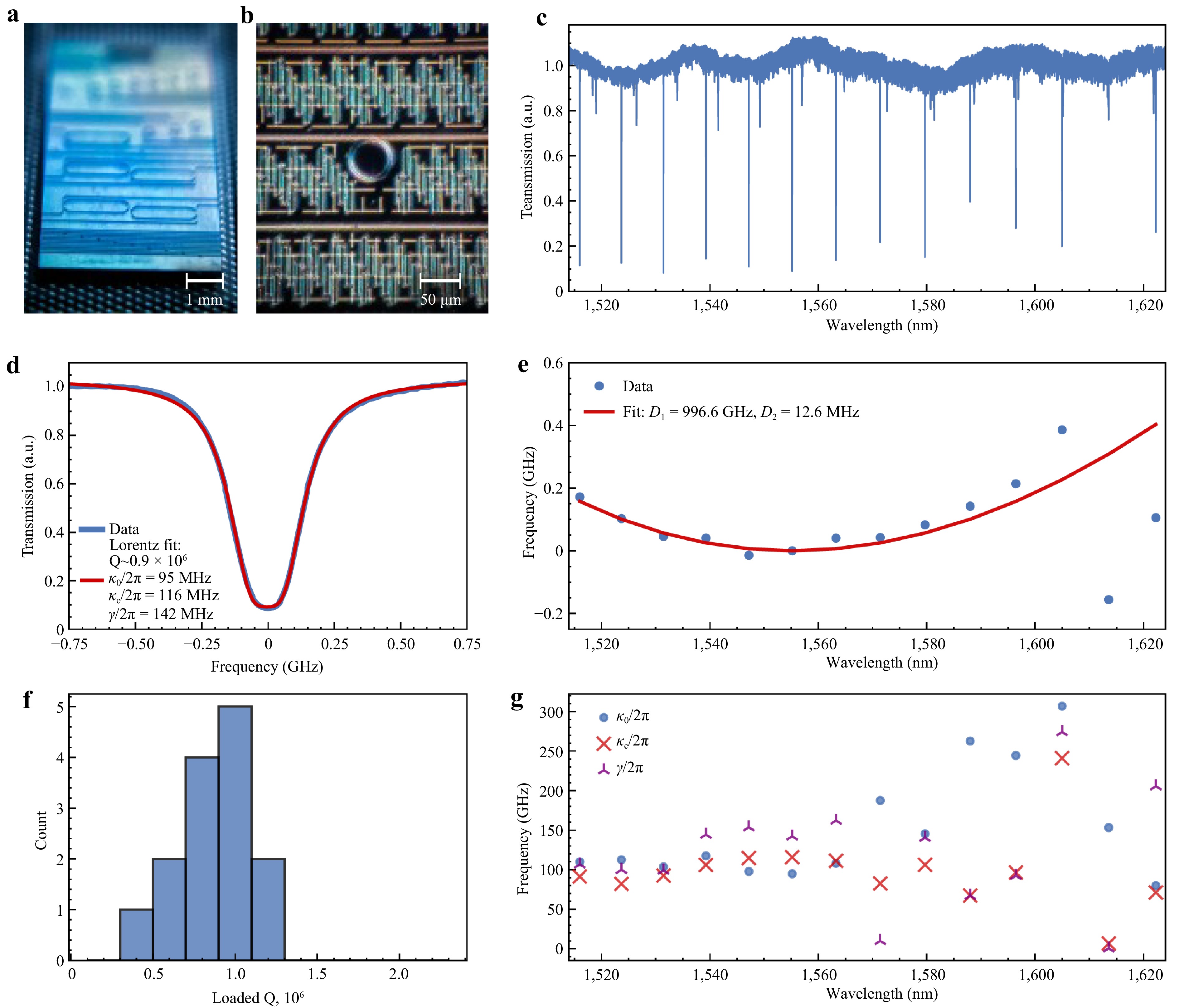
Fig. 5 Characterization of the Si3N4 microring resonator. a Photonic chip containing 1 THz microring resonators. b Structure under study consisting of the microring resonator and bus waveguide. c Microresonator mode spectrum. d Parameters of mode corresponding to the central comb line. e Dispersion landscape (microresonator eigenfrequencies deviation from the uniform FSR grid). f, g Distribution histograms of the Q-factor, intrinsic loss (κ0/2π), coupling rate (κc/2π), and backward-wave coupling rate (mode splitting, γ/2π) for microresonator modes in the range 1,510–1,620 nm, estimated using a Lorentzian function, with backscattering being considered.
To further prove the soliton comb operation, we checked whether the comb lines had red detuning using laser-scanning spectroscopy (LSS)52,65. We introduced an external tuneable 10 kHz linewidth CW laser into the fibre cavity through a fibre optic circulator attached to the additional 70/30 coupler (see Section SI6 in Supplementary Information). The low-power CW laser swept through one of the MRR ‘hot’ resonances simultaneously with comb generation. For the well-formed comb in Fig. 2a, the beating modes (Fig. 2d, f) clearly indicated a red-shift in the central and two side modes with respect to the cavity resonance, indicating that the system may operate in the soliton regime30,67. Note that we always observed only a single mode inside the resonator and observed no hopping between the fibre resonator modes. We concluded that the laser operates in a single supermode, i.e. a sequence of equidistant laser modes with 1 THz separation, which is also evidence for pulsed generation with a repetition rate of 1 THz.
Next, we measured the pump power-dependent spectrum, mode detuning, and fibre intracavity power simultaneously at the chip, as well as the reflected and transmitted positions (Supplementary Fig. S7). The power entering the bus waveguide (green line in Fig. 3a) exhibited a linear dependence on the pump power. This power was converted into a forward-propagating comb (blue area) and backward-propagating comb (red area), whereas the remaining power (green area) corresponded primarily to losses in the MRR. Additionally, we observed that the transmitted and reflected combs exhibited a nonlinear dependence on the pump power.
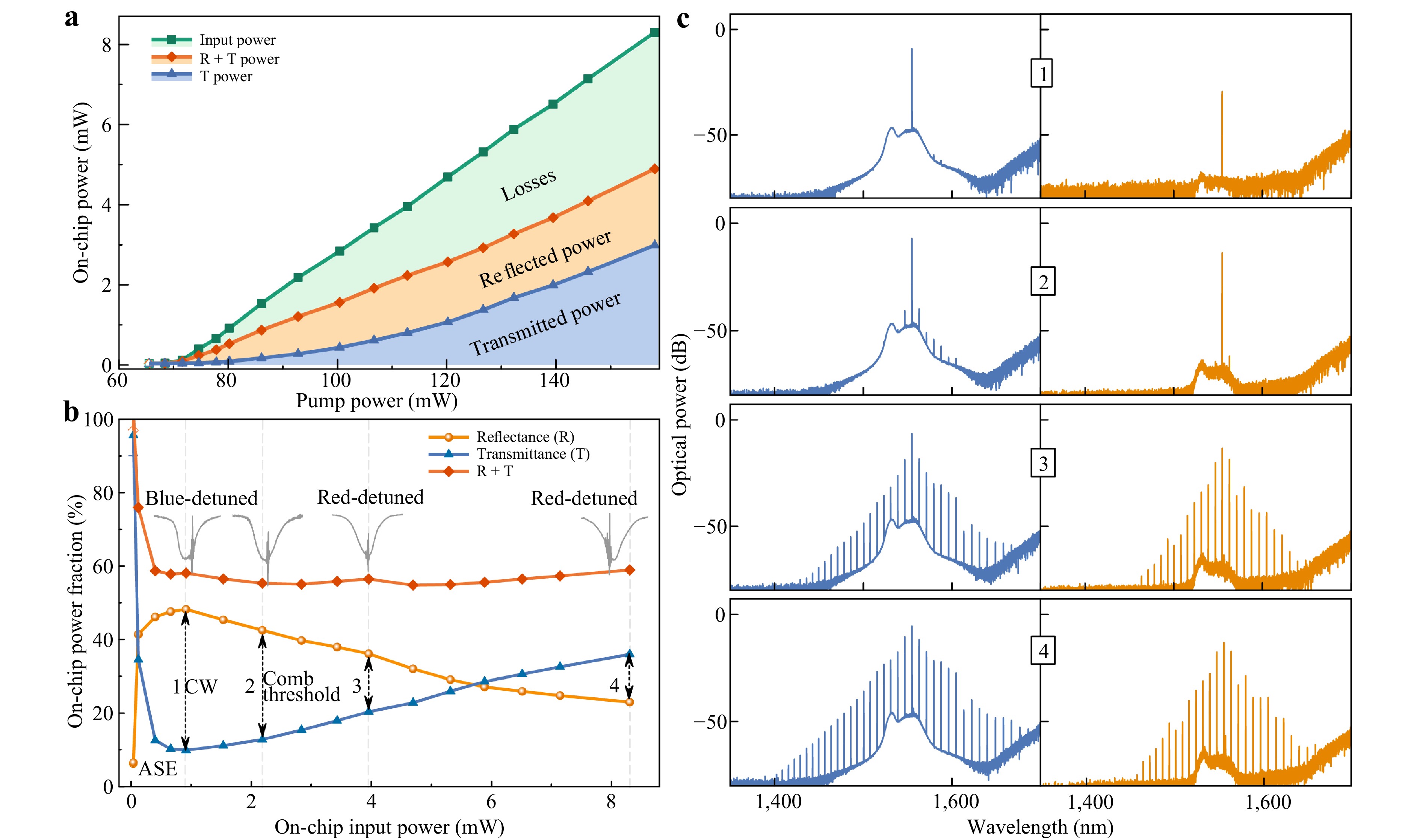
Fig. 3 Intracavity dynamic measurements. a On-chip power (in the bus waveguide) distribution for the transmitted and reflected combs, as well as the power propagated after a double EDFA pass (input), plotted as a function of pump power. b Chip reflection (red) and transmission (blue) as a function of the power in the bus waveguide. The brown line depicts the sum of transmitted and reflected signals, indicating nearly 40% losses in the chip. The numbers correspond to the spectra shown in c for different pump powers for transmitted (blue) and reflected (red) combs.
To investigate the comb formation in more detail, in Fig. 3b, we plotted the power fractions of the transmitted (blue line) and reflected (red line) combs, as well as the corresponding mode detunings as a function of power inside the bus waveguide. The corresponding comb spectra are shown in Fig. 3c. Below the lasing threshold, almost all the power was transmitted, whereas a small reflection on the order of 1% can be attributed to the reflection from the chip facet (see Supplementary Fig. S8 for the fractions of transmitted and reflected light measured in the fibres). As the power inside the waveguide approached 1 mW, a rapid increase in the reflection to 48% was observed, accompanied by a decrease in the transmitted signal to 10%. LSS measurements showed that in the CW state, the laser mode was blue-detuned with respect to the MRR resonance. However, as the power increased and the comb was excited, the laser supermode shifted to a red-detuned state. This behaviour resembled the comb formation observed in the filter-driven four-wave mixing setup reported by Rowley et al.53, with a notable difference in that multiple-soliton formation was not observed for this MRR at the available pump power. Interestingly, as the comb developed, the reflected signal dropped considerably to 23%, and the transmitted comb power fraction increased to 36%. We attribute this behaviour to the nonlinear interaction between the forward- and backward-propagating waves through cross-phase modulation68,69. Additionally, the fraction of light lost in the MRR can be determined by summing the fractions of the transmitted and reflected light (orange line in Fig. 3b). When the pump power is sufficient to form a CW laser line, the losses approach 40% and remain near this value, independent of the pump power. The gradual change in the losses resembles the shift of the laser supermode through the MRR resonances, with the maximum losses corresponding to the supermode position at the resonance minimum.
The reflection from the chip facet, reaching 1%, is sufficient to initiate CW laser generation even without the MRR. This raises the question of whether such parasitic reflections affect the start-up dynamics and whether a locking-type feedback mechanism can influence the observed behaviour44. Here, our aim is to isolate the feedback origin and verify that self-starting can be triggered by microresonator backscattering alone without relying on parasitic facet reflections. To prove that comb-generation self-starting can be achieved solely with a high-Q MRR mirror, we replaced the chip with a crystalline toroidal microresonator (MgF2; 109 Q-factor, FSR of 35 GHz, and normal dispersion) coupled with a tapered fibre (Fig. 4a). The relatively thick taper with a 3 μm waist was prepared to suppress non-resonant interface reflections (parasitic feedback) below 10−5. The response of the system to the pump power generally resembled that observed for the integrated MRR. Fig. 4b shows the reflected power from the toroidal resonator as a function of the power incident on the active fibre. When the incident power reached 3 mW (86 mW pump power), the reflection rapidly changed to 0.1%, accompanied by the formation of CW laser emission (see the insets in Fig. 4b for the spectra). A further increase in pump power leads to comb formation49,70–72. The system also exhibits self-starting behaviour, which is consistent, even when the pump power is turned off and on. Instead, the observed comb consisted of multiple subcombs associated with different toroidal mode families rather than a single coherent soliton state73. The use of a resonator that primarily supports a single mode can reduce the formation of multiple subcombs and favour the emergence of one coherent comb family74.
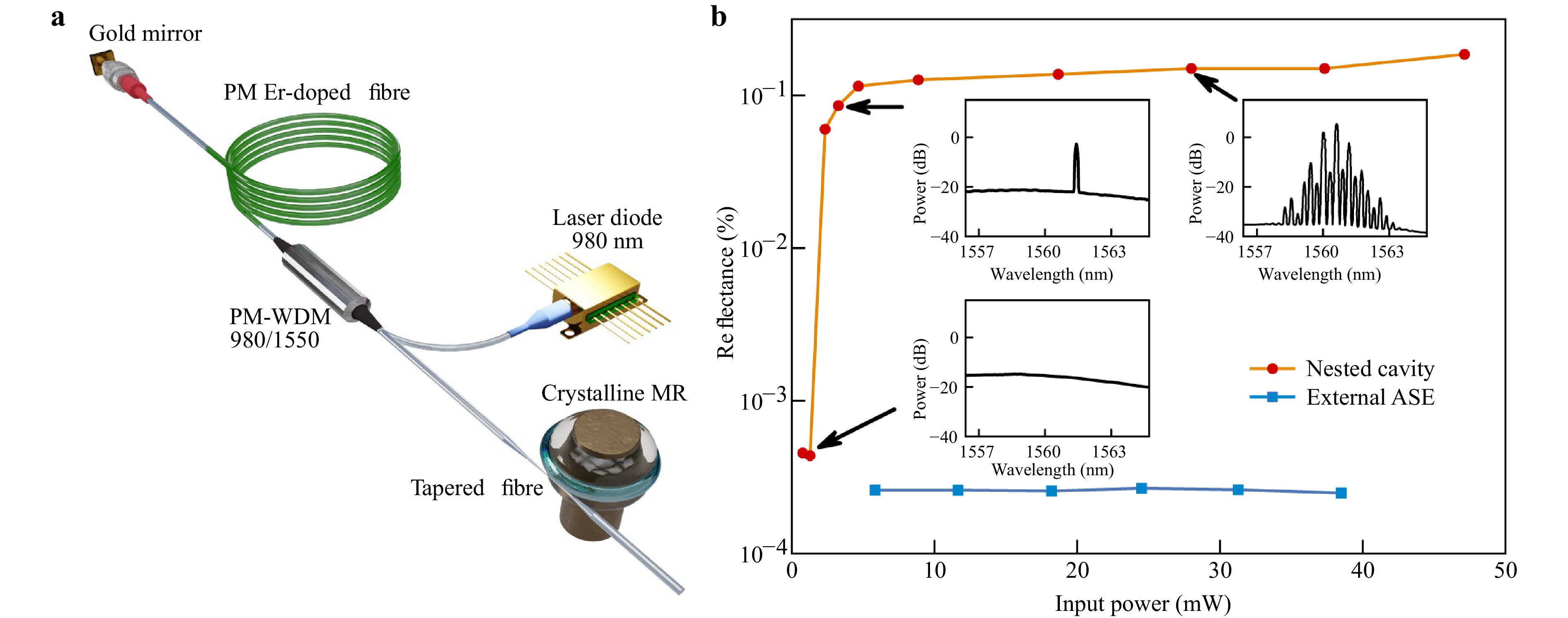
Fig. 4 Generation of frequency combs using a high-Q MgF2 crystalline toroidal microresonator nested into the fibre cavity, where only backward light propagation due to Rayleigh scattering creates feedback. a Hybrid-laser scheme with the crystalline MgF2 MRR with 109 Q-factor, 35 GHz FSR, and normal dispersion, used to generate whispering gallery modes. b Reflection from crystalline microcavity as a function of power incident from the active fibre (red curve). The corresponding spectra are shown in the insets. The blue curve shows the reflection from an external amplified spontaneous emission (ASE) source, which is independent of the source power.
-
We demonstrated that a ring microcavity can operate as a partially reflecting, nonlinear, frequency-selective mirror that forms a laser cavity for efficient and robust comb generation. In our scheme, the microring resonator plays a dual role: it generates a frequency comb and, through resonantly enhanced Rayleigh backscattering, provides dominant optical feedback that closes and sustains the laser cavity in a reflective configuration, distinct from traditional auxiliary stabilisation paths.
We validated the concept using two resonator platforms: a Si3N4 microring resonator with a single-bus waveguide and a crystalline MgF2 toroidal microresonator coupled with a tapered fibre. In both cases, we observed self-starting operation and recovery of the comb after external perturbations. For the integrated microring, we obtained a 1 THz FSR comb with a spectral width exceeding 500 nm. This coherence was supported by the observed red detuning of the main comb lines, autocorrelation measurements, and agreement with the numerical modelling. This comb exhibited long-term stability and recovered its state when turned off and on. The tapered-fibre MgF2 experiment, which minimised parasitic interface reflections, further supported the observation that the cavity feedback originates from microresonator backscattering rather than from facet reflections in an integrated coupling interface. Although our current demonstration used a fibre gain medium, the underlying feedback mechanism can be extended to integrated active waveguide platforms, offering potential pathways toward more practical and efficient microcomb sources in future photonic systems.
-
The photonic Si3N4 chip was fabricated in Ligentec, Switzerland, and contained structures consisting of 25 μm radius microring resonators and bus waveguide (Fig. 5a, b). All structures were fully characterised using a method based on a precalibrated Mach–Zehnder interferometer60. The characterisation of the resonator used in Figs. 2 and 3 included measurements of the microresonator transmission spectrum (Fig. 5d), microresonator dispersion landscape (Fig. 5e), distributions of the Q-factor, intrinsic loss κ0/2π, coupling rate κC/2π, and backward-wave coupling rate (mode splitting) γ/2π for all resonances in the wavelength range 1,510–1,620 nm (Fig. 5f). For the central line, the measured parameters were κ0/2π = 95 MHz, κC/2π = 116 MHz, and γ/2π = 142 MHz, with a linewidth of 300 MHz. According to the characterisation results, the microring resonator exhibited an anomalous group velocity dispersion of −13.5 fs2·mm−1, and the pump mode corresponding to the central line of the generated microcomb had Q ~ 0.9 × 10⁶ (Fig. 5c).
-
The microresonator and tapered fibre for coupling were fabricated at the Russian Quantum Center. The resonator was manufactured using magnesium fluoride via diamond turning75. The diameter, thickness, and radius of curvature of the resonator were 1.94, 1.0, and 0.35 mm, respectively. The taper was produced from a single-mode fibre (SMF28 Ultra) using a hydrogen flame76.
-
The fibre-laser cavity shown in Fig. 1a was assembled from the EDFA spliced to the gold mirror on one side and edge-coupled to the MRR on the other side through the lensed fibre. All fibres used in this study were polarization-maintaining (PM). To create a fully reflecting mirror, gold was sputtered onto the fibre ferrule, resulting in a reflection coefficient of 98%. The EDFA consisted of a 1 m Liekke Er-doped active fibre with an 80 dB/m absorption coefficient at 1,530 nm, pumped by a 980 nm laser diode with a maximum power of 500 mW through a 1,550/980 wavelength-division multiplexer (1,550/980 WDM). The total laser cavity length was 3.2 m, corresponding to a 32.5 MHz FSR.
-
The optical power in the bus waveguide (on-chip power) was calculated by measuring the power of the corresponding fibres (Fig. S7) and multiplying it by the coupling loss, which was 3.5 dB per facet. LSS and chip resonant/out-of-resonance measurements were performed by clean sweeping a narrow-linewidth tuneable Pure Photonics PPCL550 laser through the circulator and the 2.5 μm waist size lensed fibre (AMS Technologies, PM-lensed fibre TPMJ-3A-1550-8/125-0.25-7-2.5-14-2-AR). The laser power was 17 mW, which resulted in 1.5 mW on the chip. For the LSS, we used a Thorlabs DET08CFC/M 5 GHz photodetector and Tektronix MDO3102 oscilloscope. The average laser power characteristics were measured using Thorlabs S132C power sensors with a wavelength of 1,550 nm, corresponding to the central wavelength of the comb. The spectral properties of the optical frequency comb were measured using a DEVISER AE8600 and Yokogawa AQ6370E spectrum analyser with a 600–1,700 nm operating window. The temporal characteristics of the solitons were investigated using a Femtochrome FR-103XL autocorrelator at a resolution of 1 fs.
-
We modelled a hybrid fibre-laser–microresonator system using a mean-field formalism developed for laser-cavity-soliton microcombs, in which a Kerr microresonator is coupled to an external fibre loop via discrete supermodes. In our implementation, the microresonator is described by slowly varying envelopes of the clockwise (CW) and counterclockwise (CCW) intracavity fields, and we explicitly include resonant Rayleigh backscattering as a linear coupling term between these counterpropagating modes (Eq. S1–S3). The CCW field is coupled into the fibre cavity, amplified by the gain section, and fed back to the resonator, thereby reproducing the reflective cavity configuration used in the experiments. The coupled mean-field equations are integrated using a Fourier split-step scheme for dispersion and Kerr nonlinearity in the resonator, together with explicit time stepping for linear coupling, loss, and fibre-loop supermodes. The operating points (gain/detuning) were selected using standard modulational-instability (MI) linearisation around the homogeneous steady state, yielding MI maps that guide subsequent time-domain simulations of self-starting single-soliton states. We compared the simulated spectra and time-domain waveforms directly with the experimental data (Fig. 2); the complete parameter set is provided in the Supplementary Table.
-
This study was supported by the Russian Science Foundation (RSF) (25-22-00388).
Microring resonator as a Rayleigh mirror for broadband laser-cavity comb generation
- Light: Advanced Manufacturing , Article number: 108 (2026)
- Received: 04 March 2026
- Revised: 17 June 2026
- Accepted: 22 June 2026 Published online: 17 November 2026
doi: https://doi.org/10.37188/lam.2026.108
Abstract: Microresonator frequency combs typically require multiple coupling paths or auxiliary stabilisation elements, which can increase system complexity and сomplicate scalable photonic integration. Herein, we introduce a self-starting comb architecture in which a single-bus microring resonator, placed within a simple laser cavity comprising only an active fibre and an end mirror, serves as a nonlinear frequency-selective mirror. In our configuration, the optical feedback required to form the laser cavity emanates from resonant Rayleigh backscattering in the microring itself, thus avoiding multiport coupling and external frequency scanning for comb initiation. Using this approach, we experimentally observed self-starting coherent frequency combs with a 1 THz repetition rate, no detectable residual pump, and broadband spectra exceeding 500 nm at a central wavelength of 1,550 nm. We verified the concept of integrated Si3N4 microring resonators and crystalline MgF2 toroidal microresonators coupled via tapered fibres, thereby confirming the feedback mechanism. The reflective single-bus topology exhibits robust performance and reduces alignment sensitivity compared with multiport coupling schemes used in some frequency comb implementations. With the further development of active waveguide integration, this architecture may offer a path toward more practical and efficient frequency comb sources in future photonic systems.
Research Summary
Microcombs: Rayleigh backscattering enables self-starting comb generation
An integrated microring resonator that reflects light through Rayleigh backscattering can turn a simple fibre laser into a self-starting broadband frequency-comb source. Frequency combs provide many equidistant narrow spectral lines of light for optical spectroscopy, communications, and signal processing, but chip-based comb sources often require comb comb lunching procedure. A research team at Skolkovo Institute of Science and Technology now reports a hybrid laser architecture in which weak Rayleigh backscattering inside a microring resonator provides optical feedback for a fibre laser system. The microring acts as a nonlinear, frequency-selective mirror inside a fibre laser cavity, allowing the system to self-start comb generation and recover after perturbation. The demonstrated comb has a 1 THz repetition rate and spans more than 500 nm near 1550 nm, suggesting a simpler route towards robust laser-comb sources.
Rights and permissions
Open Access This article is licensed under a Creative Commons Attribution 4.0 International License, which permits use, sharing, adaptation, distribution and reproduction in any medium or format, as long as you give appropriate credit to the original author(s) and the source, provide a link to the Creative Commons license, and indicate if changes were made. The images or other third party material in this article are included in the article′s Creative Commons license, unless indicated otherwise in a credit line to the material. If material is not included in the article′s Creative Commons license and your intended use is not permitted by statutory regulation or exceeds the permitted use, you will need to obtain permission directly from the copyright holder. To view a copy of this license, visit http://creativecommons.org/licenses/by/4.0/.

 DownLoad: