



-
The mechanical effects of light are an extraordinary phenomenon in light-matter interactions. Technologies such as optical tweezers can be used to harness mechanical effects via precise control. When a laser beam is scattered or absorbed by microparticles, the transferred linear and angular momenta generate reactive forces that drive both translational and rotational movements of the particles1-3. Thus, there has been a gradual increase in the extensive investigations regarding the fundamental physics governing these interactions; this has significantly advanced optical manipulation4, optical sensing5, topological photonics6, and quantum information7.
In the domain of light–matter interactions, the mechanical effects of light are governed by multiple factors, including the surrounding medium, energy flux distribution, vectorial properties of the light field, and scattering properties of particles8. The modulation of light–matter interactions through these distinct attributes has stimulated diverse research directions and technological developments in optical manipulation, ranging from interfacial interactions9 and metasurface technologies10,11 to structured light field control12 and particles with tailored molecular structures13. Conventional studies have treated particle morphology as an uncontrolled variable, routinely approximating the objects of interest as idealised spherical entities14. Although this simplification facilitates the investigation of light-field behaviour, it presents significant challenges when applied to real-world particles exhibiting complex morphological features, such as biological cells with inherently diverse shapes15. Current research paradigms examining the mechanical effects in light–matter interactions have primarily emphasised intrinsic light field properties16 while overlooking morphology-induced mechanical effects.
A recent study by Yi et al. provided novel insights into this previously underexplored regime17. Their findings demonstrated that particle morphology and orientation can actively modulate the optical forces and torques acting on the particles. Notably, this study reveals a counterintuitive phenomenon wherein non-spherical particles experience bidirectional optical torque (positive or negative) under identical circularly polarised trapping beam illumination. The conventional understanding dictates that the torque direction is correlated with the helicity of the incident beam. In contrast, this work establishes that the particle morphology and orientation disrupt the local symmetry of light-matter interactions, thereby altering the torque characteristics. Fig. 1 illustrates the conceptual framework linking particle morphology and orientation to the torque reversal and rotational freezing phenomena. Experimentally, a single focused Gaussian beam was employed to achieve the lateral translation of particles in opposite directions, confirming that this emergent optomechanical effect originates exclusively from intrinsic particle morphological features rather than beam parameters or external structural modifications. In addition, systematic investigations combining simulations and experiments have examined the distinct behaviours of cylindrical, triangular prismatic, trapezoidal, and irregular particles under circular polarisation, including negative optical torque and lateral drift.
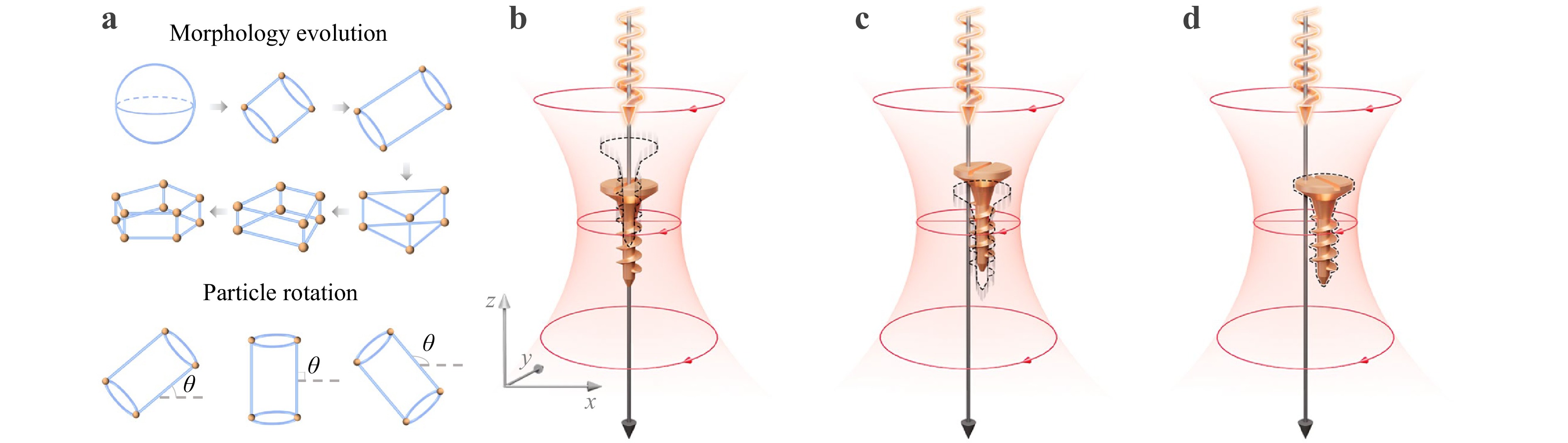
Fig. 1 Morphology-dependent optical torques. a Illustration of particle morphology and orientation. Top: evolution of particle shape from a sphere to cylinders and polyhedra of increasing complexity. Bottom: definition of the rotation angle that describes the orientation of a non-spherical particle relative to the horizontal axis. b Schematics of a screw (a specific morphology of shape and size) rotating clockwise (top view) and moving downwards in a right-handed circularly polarised beam. c In a paraxial system, when the rotation angle of the shaped particle changes, a negative optical torque emerges, causing the screw to rotate anticlockwise and move upward. d In a specific rotation angle, the screw rotationally freezes under the balance of positive and negative optical torques.
This study marks a distinct departure from conventional investigations of mechanical effects, which have predominantly concentrated on the light-field attributes or intrinsic material characteristics of particles18−21. The findings presented herein are expected to motivate researchers to reconceptualise the particle morphology as an active control variable rather than as a passive sample attribute in optical manipulation. In future, establishing design principles for customised optical forces and torques will require a systematic elucidation of the underlying physical mechanisms and the development of a comprehensive theoretical framework. Collectively, these results highlight the critical role of morphological modulation in light-matter interactions, opening new possibilities for shape-selective sorting, bioparticle micromanipulation, and torque-controlled optofluidic devices22−24.
Optical force and torque controlled by particle morphology
- Light: Advanced Manufacturing , Article number: 125 (2026)
- Received: 03 July 2026
- Revised: 20 July 2026
- Accepted: 21 July 2026 Published online: 19 November 2026
doi: https://doi.org/10.37188/lam.2026.125
Abstract: Optical manipulation relies on the optical force and torque exerted on particles. However, conventional studies have treated particle morphology as an uncontrolled variable by routinely approximating target particles as ideal spheres. Optical manipulation experiments using a standard Gaussian beam have revealed anomalous particle motion resulting from modifications to particle morphology. These findings motivate researchers to reconceptualise particle morphology as an active variable for regulating optical forces and torques, opening possibilities for novel applications in shape-selective sorting and torque-controlled devices.
Rights and permissions
Open Access This article is licensed under a Creative Commons Attribution 4.0 International License, which permits use, sharing, adaptation, distribution and reproduction in any medium or format, as long as you give appropriate credit to the original author(s) and the source, provide a link to the Creative Commons license, and indicate if changes were made. The images or other third party material in this article are included in the article′s Creative Commons license, unless indicated otherwise in a credit line to the material. If material is not included in the article′s Creative Commons license and your intended use is not permitted by statutory regulation or exceeds the permitted use, you will need to obtain permission directly from the copyright holder. To view a copy of this license, visit http://creativecommons.org/licenses/by/4.0/.

 DownLoad: