



-
Vertical-cavity surface-emitting lasers (VCSELs) have become foundational light sources for modern optoelectronics, enabling high-speed optical communication, three-dimensional sensing, and emerging display technologies, such as augmented and mixed reality1,2. Their well-known advantages, including low threshold currents, near-circular beam profiles, and wafer-scale integration, have driven decades of progress, particularly within III–V semiconductor platforms such as GaN3. Despite steady advances, mainstream VCSEL development has largely emphasised incremental optimisation within established material systems and canonical circular cavity architectures. Two recent independently conducted studies pointed to a broader development. One achieved electrically pumped surface-emitting amplified spontaneous emission (ASE) using colloidal quantum dots (QDs), a long-sought step that clarifies the feasibility of QD-based light-emitting diodes (QLEDs) for future surface-emitting lasers4. The other demonstrated how deliberately breaking rotational symmetry through non-circular cavity geometries reshapes the lasing dynamics of broad-area VCSELs5. Considered together, these works illustrate how the field is expanding along two axes, through new materials and new design freedoms, which extend well beyond the GaN-centred trajectory.
Colloidal QDs are attractive gain media for electrically-driven light sources. Their solution processability, tunable emission, and high quantum yields make them appealing; however, electrically driven lasing has been hindered by ultrafast nonradiative processes, the difficulty of injecting large current densities without thermal failure, and cumulative electrical and optical losses in typical QLED architectures6,7. Therefore, achieving electrically-pumped ASE has been a critical bottleneck. Prior to the present surface-emitting results, progress had been made on both the material and device sides. On the material side, the development of continuously graded-shell (CdSe/CdxZn1−xSe) QDs mitigated the confinement potential, thereby suppressing Auger recombination8. Wu et al. showed that charging QDs to bleach ground-state absorption reduced the average optical gain threshold to as low as 0.02 excitons per dot9. On the device side, Roh et al. demonstrated optically pumped ASE in a QLED structure by integrating a second-order distributed feedback grating directly into the indium tin oxide electrode10. That study showed that an ASE-capable resonator could be incorporated into a complete light-emitting stack without fatally compromising charge transport, and it clarified design rules for confining the optical mode within ultrathin QD gain layers in the presence of conductive electrodes. More recently, Ahn et al. realised electrically pumped ASE in an edge-emitting configuration11. Their approach combined a high-current-density charge-injection scheme with a low-loss photonic waveguide, implemented as a transverse Bragg reflector that channels guided modes with reduced attenuation. The results proved that net optical gain under electrical drive could be obtained as edge emission. However, achieving surface-emitting ASE within a QLED architecture remains an essential requirement for the realisation of VCSELs.
Tian et al. closed this gap by demonstrating an electrically pumped, surface-emitting ASE from colloidal QDs4. The device was based on an electro-thermal-optical co-design that balances high current injection with positive net gain in a top-emitting QLED cavity. Thermal management with a silicon heat-sink and nanosecond pulsed drive stabilised operation up to 2000 A cm−2. The optical resonator was a Fabry-Perot cavity formed by a reflective Ag/indium-zinc-oxide (IZO) bottom electrode and semi-transparent IZO/Ag top electrode. Crucially, dual IZO phase-tuning layers suppressed surface plasmon polariton losses and concentrated the optical field inside the QD gain region, which approximately doubled the modal gain relative to otherwise similar designs. With these elements, the device exhibits surface-emitting ASE at a threshold current density of 94 A cm−2, accompanied by narrow spectral linewidths, strong intensity, and pronounced directionality. Interestingly, the reported surface-emitting ASE appears to originate from the scattering of lateral ASE modes in the normal direction. Although the origin of this scattering remains unresolved, this first demonstration highlights that design strategies should broaden beyond photonic, cavity, and plasmonic engineering to include film morphology and device geometry, because their microstructural characteristics critically determine scattering channels and out-coupling efficiency. This work offers a credible platform for pursuing QD-based VCSELs that combine solution processability with spectral tunability.
If unconventional gain media open one path forward, then cavity engineering offers another. Conventional broad-area VCSELs employ circular apertures that inherently support whispering-gallery modes (WGMs)12. WGMs concentrate the field at the perimeter, which underutilizes the central gain region, complicates power scaling, and introduces polarization instabilities at high injection levels. Lu et al. addressed this limitation through a systematic study of non-circular geometries, including square, D-shaped, mushroom-shaped, and pentagonal cavities, fabricated from a commercial wafer5. Their comparative analysis quantified how geometry transforms the output power density, spatial coherence, beam profiles, polarisation dynamics, and multimode behaviour. Among them, pentagonal devices delivered the highest power, while mushroom-shaped cavities combined high output with low spatial coherence. By deliberately breaking rotational symmetry, these geometries bypass WGM-induced constraints and allow designers to tune the balance of power, coherence, and stability.
Although conducted independently, these two lines of research can be considered complementary. The QD study addressed feasibility at the material and device architecture levels. This demonstrates that solution-processable nanocrystals can serve as viable gain media for electrically driven surface-emitting ASE within a QLED architecture. The geometry study instead focused on functional optimisation at the cavity level. This shows that non-circular shapes provide a practical route to reassign optical energy within the aperture, suppress deleterious mode competition, and shape polarisation statistics, which is difficult to accomplish in circular cavities. The convergence of these concepts suggests a broader design space for future surface-emitting lasers.
Fig. 1 illustrates this convergence, highlighting how QD-based gain layers can be combined with geometry-tailored vertical cavities to create a new class of surface-emitting lasers. Such devices would be both low cost and highly adaptable, with performance metrics tailored to application needs rather than constrained by canonical forms. The broader message is that VCSEL research is shifting from incremental refinement within a single material–geometry template to a more diverse and creative regime. However, several challenges remain. For example, the physical mechanism that enables surface emission in the QLED cavity structure must be clarified. As such surface emission has only recently been reported for the first time, this represents only an initial step. Determining whether it arises from the scattering of lateral ASE, cavity-induced mode redistribution, or other pathways is an essential task for guiding further optimisation. For geometry-tailored VCSELs, integrating non-circular apertures with vertical cavity designs that remain manufacturable at scale will also be crucial. Although the two research directions are technically separable, they can inform each other at the level of design heuristics and performance trade-offs. Addressing these challenges will pave the way for application-specific surface emitters, enabling energy-efficient optical interconnects, speckle-free imaging, secure communication, and neuromorphic photonic processing.
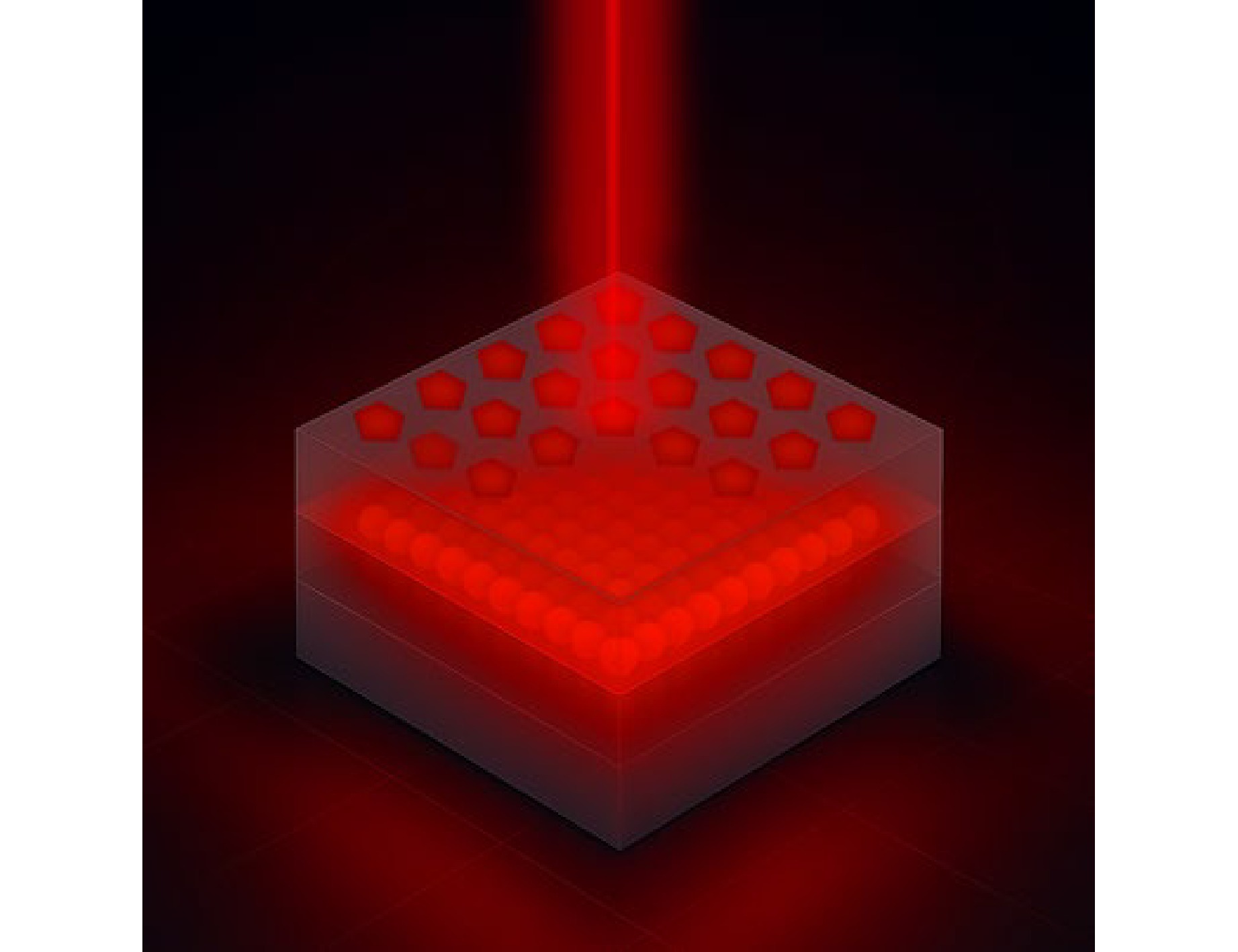
Fig. 1 Schematic illustration of a conceptual VCSEL design in which QD-based gain layers are integrated with geometry-tailored vertical cavities.
In conclusion, the field of surface-emitting lasers is broadening. Electrically pumped surface ASE in colloidal QDs establishes the viability of a QLED architecture as a foundation for QD-based VCSELs and fills a long-standing gap left after earlier demonstrations of optically pumped LED-like ASE and electrically pumped edge ASE. In parallel, geometry engineering in broad-area devices shows that cavity shape is a primary control knob for output power, coherence, and polarisation. These advances represent distinct but complementary directions, indicating that VCSEL research is moving beyond circular cavities towards a more diverse design landscape in which unconventional gain media and asymmetric cavity designs can be combined to meet evolving technological requirements.
Beyond conventional VCSELs: Emerging directions with colloidal quantum dots and geometry engineering
- Light: Advanced Manufacturing , Article number: (2025)
- Received: 17 September 2025
- Revised: 04 November 2025
- Accepted: 06 November 2025 Published online: 03 December 2025
doi: https://doi.org/10.37188/lam.2025.084
Abstract: Recent advances have highlighted new directions for vertical-cavity surface-emitting lasers (VCSELs). Engineering the device architecture enabled electrically pumped surface-emitting amplified spontaneous emission from colloidal quantum dots, while non-circular cavity geometries enhanced power scaling, coherence control, and polarization stability. These breakthroughs broaden VCSEL research, pointing to customizable, application-specific devices.
Rights and permissions
Open Access This article is licensed under a Creative Commons Attribution 4.0 International License, which permits use, sharing, adaptation, distribution and reproduction in any medium or format, as long as you give appropriate credit to the original author(s) and the source, provide a link to the Creative Commons license, and indicate if changes were made. The images or other third party material in this article are included in the article′s Creative Commons license, unless indicated otherwise in a credit line to the material. If material is not included in the article′s Creative Commons license and your intended use is not permitted by statutory regulation or exceeds the permitted use, you will need to obtain permission directly from the copyright holder. To view a copy of this license, visit http://creativecommons.org/licenses/by/4.0/.

 DownLoad: