



-
III-nitride light-emitting diodes have reshaped solid-state lighting, high-brightness displays, and optical communication technologies. Their commercial success relies significantly on polar c-plane GaN epitaxy, which provides a mature growth technology, high crystalline quality, and compatibility with wafer-scale manufacturing. However, having the same polar orientation introduces a persistent physical limitation. Owing to the spontaneous piezoelectric polarisation along the c-axis, strong internal electric fields are formed across multiple InGaN/GaN quantum wells. These fields induce the quantum-confined Stark effect, tilt the band profile, spatially separate the electron and hole wavefunctions, and weaken radiative recombination. In conventional light-emitting diodes (LEDs), this effect limits efficiency and wavelength stability. For micro-LEDs, in which the device size is reduced to the micrometre scale, the problem becomes more acute because laterally diffusing carriers can reach defective sidewalls before recombining1,2.
Several methods have been investigated for suppressing polarisation-induced losses. Non-polar and semi-polar LEDs can reduce the internal electric field; however, they typically rely on costly substrates or less-mature epitaxial platforms. InGaN quantum dots offer strong three-dimensional carrier confinement and have been investigated to overcome the efficiency and bandwidth limitations of micro-LEDs; however, their growth uniformity and large-scale manufacturability remain challenging. Quaternary InAlGaN barriers are another approach because their lattice constants, band structures, and polarisations can be adjusted simultaneously. Nevertheless, the direct growth of high-quality InAlGaN remains challenging because of phase separation, compositional fluctuations, and incompatible growth conditions for InN- and AlN-containing alloys5.
In this issue of Light: Science & Applications, Zhao et al. report a digital-alloy strategy that addresses these limitations while retaining the industrial advantages of the polar c-plane platform6. Instead of using a random quaternary alloy barrier, the authors construct a quantum barrier using short-period InGaN/AlGaN superlattices. In this digital alloy, In and Al atoms are introduced separately during metal-organic chemical vapour deposition, thereby reducing the immiscibility problem associated with direct InAlGaN growth. As schematically illustrated in Fig. 1, the LED stack comprises sapphire, u-GaN, n-GaN, a pre-layer, InGaN/DA MQWs, p-GaN, and ITO. The enlarged MQW region highlights the alternating InGaN and AlGaN growth steps used to form the digital-alloy barrier. The average composition and polarisation of the barrier can be engineered by controlling the thickness and composition of the ultrathin InGaN and AlGaN layers.
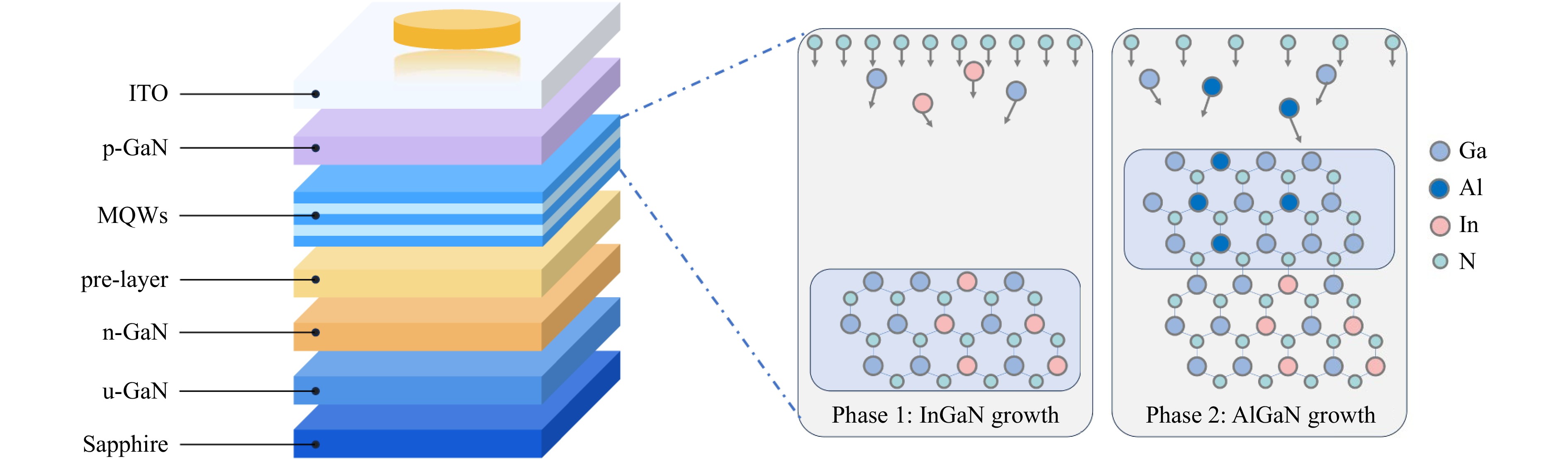
Fig. 1 Schematic illustration of InGaN/DA MQW LED and digital-alloy growth.
The key advancement is the precise control of the digital-alloy growth chemistry. Zhao et al. compare several NH3 delivery schemes during AlGaN growth. When NH3 is pulsed, nitrogen-related defects are generated and the luminescence of the multiple quantum wells is degraded. When NH3 is supplied continuously at a high flow rate, nitrogen deficiency is suppressed while excess indium becomes incorporated into the AlGaN layers, thus resulting in interface broadening and undesirable long-wavelength emission. Such indium accumulation affects the growth and optical properties of ultrathin In(Ga)N/GaN quantum-well structures7. The optimised condition involves continuous NH3 supply with reduced NH3 flow during AlGaN growth. This scheme maintains a stable nitrogen environment while suppressing excess indium incorporation, thereby yielding sharper digital-alloy interfaces and stronger quantum-well emissions.
Structural and optical characterisations support this interpretation. X-ray diffraction confirms the periodicity of the InGaN/AlGaN digital alloy, while the narrowing of satellite peaks indicates improved crystalline quality under optimised growth conditions. Photoluminescence measurements show that the broad emission associated with indium-rich regions can be suppressed by reducing NH3 flow during AlGaN growth. Scanning transmission electron microscopy and elemental mapping reveal well-defined interfaces and uniform elemental distributions in the optimised digital alloy. Cumulatively, these results establish a clear relationship between pulse-growth chemistry, atomic-scale interface control, and macroscopic optical performance.
The device results are noteworthy. By transferring the optimised growth strategy to an industrial metal-organic chemical vapour deposition (MOCVD) platform, the authors fabricated weak-polarisation-field blue LEDs on a 4-inch wafer. The optimised device achieved a peak external quantum efficiency of 15% and reduced the polarisation electric field to 0.5 MV cm−1. By contrast, the conventional InGaN/GaN multiple-quantum-well reference exhibited a polarisation electric field of approximately 2.0 MV cm−1. The weakened internal field was similarly reflected in the emission stability: the optimised weak-field LED showed a current-induced blueshift of only 0.3 nm, whereas the conventional reference LED showed a much greater shift. These results indicate that digital-alloy barriers can reduce the quantum-confined Stark effect without abandoning the manufacturable polar-plane architecture.
Beyond efficiency and wavelength stability, this study revealed an important advantage of micro-LED scaling: lateral carrier confinement. Time-resolved photoluminescence shows that the short decay lifetime decreased from 12.6 ns in the conventional InGaN/GaN structure to 0.69 ns in the InGaN/digital-alloy structure. This shortened lifetime indicates improved electron–hole wavefunction overlap and faster recombination, thereby reducing the probability that carriers diffuse laterally before emitting light. Microphotoluminescence measurements further showed a smaller emission spot diameter in the digital-alloy LED, which is consistent with a shorter lateral diffusion length.
This improved confinement directly affects scaled devices. As micro-LEDs shrink, the perimeter-to-area ratio increases, thus rendering sidewall-induced nonradiative recombination increasingly important8,9. Zhao et al. fabricated micro-LEDs of different sizes and compared the size dependence of peak efficiency and peak-efficiency current density. The digital-alloy micro-LEDs showed weaker degradation with decreasing device size than conventional InGaN/GaN micro-LEDs. By analysing the dependence of the peak-efficiency current density on the perimeter-to-area ratio, the authors estimated that the sidewall sensitivity reduced by approximately 50%. This result is significant because sidewall recombination remains a major obstacle in high-efficiency micro-LED displays.
Therefore, this study reframes the weak-polarisation-field LED design as an epitaxial engineering problem instead of solely a substrate-orientation problem. Nonpolar or semipolar growth reduces the internal fields, although at the expense of manufacturing complexity. Quantum dots provide strong confinement; however, their controlled growth over large wafers remains challenging. InGaN/AlGaN digital-alloy barriers offer a more conservative and potentially more scalable approach; they modify the polarisation field and carrier dynamics within the familiar c-plane multiple-quantum-well framework. This balance between physical performance and process compatibility is particularly beneficial for high-resolution displays, augmented- and virtual-reality systems, and visible-light communication.
However, several questions remain unanswered. Extending this strategy to green and longer-wavelength InGaN emitters will be more challenging because higher indium incorporation typically intensifies the strain, compositional fluctuation, and efficiency droop. Additionally, safer-level uniformity, long-term operational stability, and compatibility with transfer printing, bonding, and sidewall passivation processes require further evaluation. Moreover, the relationship between shortened carrier lifetime, radiative efficiency, and modulation bandwidth warrants more detailed investigation, particularly for applications that demand both high-brightness and high-speed operation.
Nevertheless, Zhao et al. demonstrated that weak polarisation and strong lateral confinement are achievable on the polar plane. By combining a digital-alloy barrier design with precisely tuned pulse-growth chemistry, this study provides a practical pathway towards efficient, wavelength-stable, and scalable III-nitride LEDs. For a technology critically governed by every micrometre of carrier diffusion, weakening the internal field while accelerating recombination represents a decisive step towards high-performance micro-LED manufacturing.
Digital-alloy barriers weaken polarisation in III-nitride LEDs
- Light: Advanced Manufacturing , Article number: 119 (2026)
- Received: 17 June 2026
- Revised: 01 July 2026
- Accepted: 01 July 2026 Published online: 17 August 2026
doi: https://doi.org/10.37188/lam.2026.119
Abstract: InGaN/AlGaN digital-alloy barriers have enabled weak-polarisation-field III-nitride light-emitting diodes (LEDs) on industrially compatible polar c-plane substrates. By optimising ammonia-flow-modulated pulse growth, this strategy improves digital-alloy interface quality, reduces the polarisation electric field to 0.5 MV/cm, and delivers blue LEDs with a peak external quantum efficiency of 15%. The resulting lateral carrier confinement mitigates sidewall-related efficiency loss, thus offering a practical pathway towards high-performance micro-LEDs.
Rights and permissions
Open Access This article is licensed under a Creative Commons Attribution 4.0 International License, which permits use, sharing, adaptation, distribution and reproduction in any medium or format, as long as you give appropriate credit to the original author(s) and the source, provide a link to the Creative Commons license, and indicate if changes were made. The images or other third party material in this article are included in the article′s Creative Commons license, unless indicated otherwise in a credit line to the material. If material is not included in the article′s Creative Commons license and your intended use is not permitted by statutory regulation or exceeds the permitted use, you will need to obtain permission directly from the copyright holder. To view a copy of this license, visit http://creativecommons.org/licenses/by/4.0/.

 DownLoad: